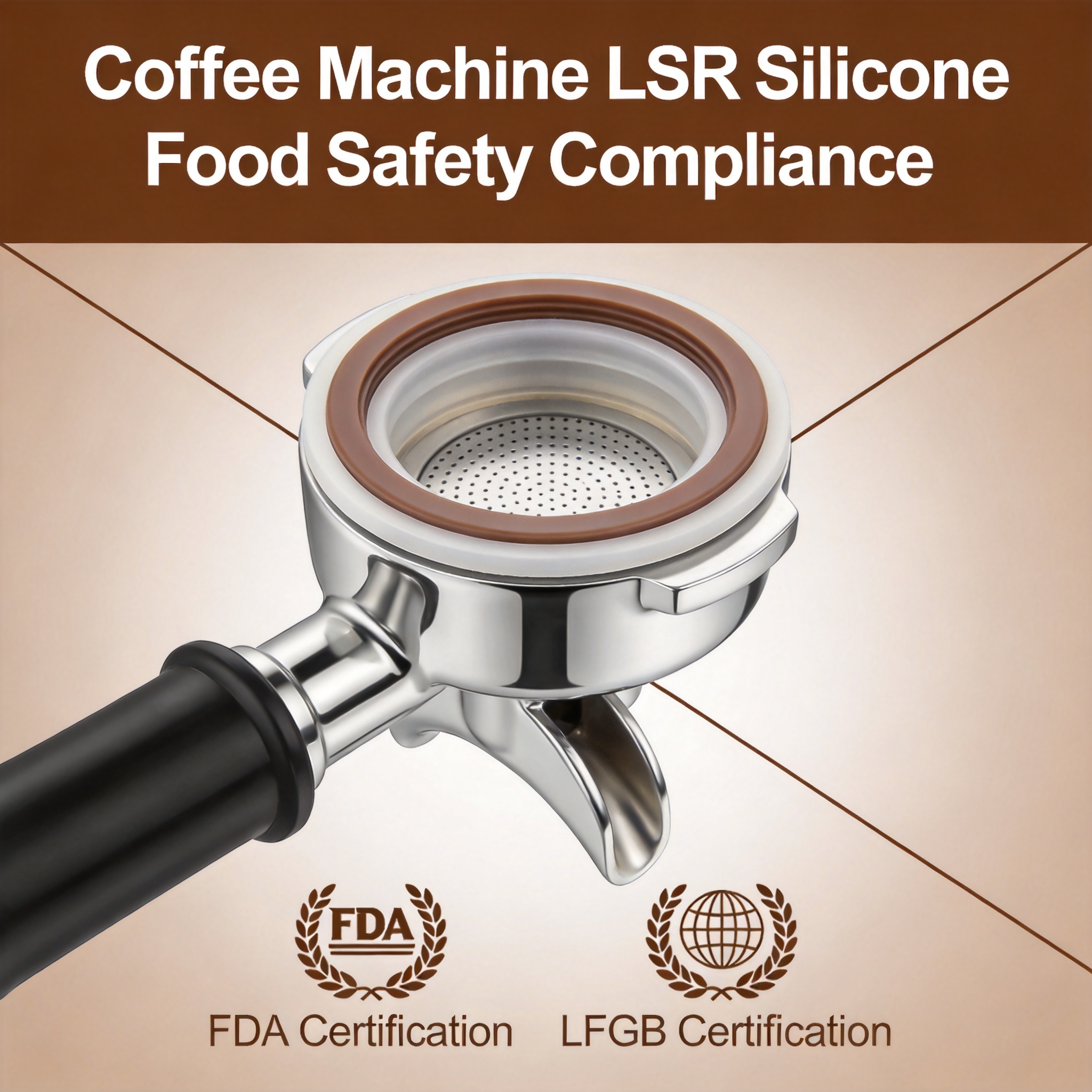
Comprehensive food safety compliance guide for coffee machine silicone seals.
NEV Battery Pack LSR Silicone Sealing Solutions
The battery pack of a new energy vehicle is the core component of the entire vehicle, and its safety, sealing performance, and thermal management capabilities directly determine the vehicle range and reliability. LSR silicone sealing components serve three critical functions in battery packs: IP protection, thermal management, and electrical insulation.
I. Core Challenges in Battery Pack Sealing
1. IP Protection Rating
Battery packs require IP67 or IP68 protection
Prevent water, dust, and salt spray intrusion causing battery short circuits
Continuous effectiveness during vehicle wading and car washing
2. Thermal Management Needs
Battery operating temperature window: 15-35°C, outside this range affects performance and lifespan
Battery temperature during charge/discharge can reach 60°C; thermal runaway exceeds 150°C
Seals must withstand -40°C to 150°C wide temperature range
3. Electrical Safety
Battery pack internal voltage 400-800V, seals must meet insulation requirements
Fastening bolt compression on sealing strip, compression 15-30%
Driving vibration and impact loads without seal failure
Cell swelling force: cell expansion during charge/discharge cycles requires seal compensation
II. LSR Sealing Solution Design
1. Battery Pack Lid Seal
Rectangular cross-section seal strip along lid perimeter
Compression design 20-25%, ensuring seal contact pressure ≥ 1.5 N/mm
LSR hardness Shore A 40-50, balancing sealing performance and compression set
In-mold one-piece forming, no joints, eliminating traditional rubber strip splice leakage points
2. Inter-Module Seals
Flexible gaskets compensating for manufacturing tolerances between modules
Thickness 2-5mm, uniform gap filling after compression
Thermally conductive LSR (1.0-3.0 W/m·K), combined sealing and heat conduction
3. Junction Box/BDU Seals
Precision seals mating with connector housings
Multi-chamber design isolating signal and power cable seals
Dielectric strength and flame retardancy as primary specifications
4. Explosion-Proof Valve Seals
Waterproof breathable membrane + LSR seal ring combination
Pressure relief during thermal runaway, water blocking during normal operation
Valve opening pressure: 2-10 kPa (designable)
III. Material Property Requirements
ParameterRequirementTypical Value
HardnessShore A 30-60Per design selection
Tensile strength≥ 7 MPa7-10 MPa
Elongation at break≥ 300%300-600%
Compression set≤ 15% (150°C×22h)8-15%
Dielectric strength≥ 20 kV/mm20-25 kV/mm
Flame retardancyUL94 V-0V-0
Thermal conductivity1.0-3.0 W/m·KPer formulation
Temperature range-40°C to 150°CCompliant
IV. Manufacturing and Quality Control
1. In-Mold Forming
Battery pack lid seals up to 2-4 meters, one-piece in-mold forming
Mold precision ±0.05mm, ensuring seal cross-section consistency
Vulcanization: 170°C × 60-90 seconds
2. Metal Insert Overmolding
Junction box seals often include metal inserts
Insert preheated to 150°C, ensuring strong LSR bond
Pull test: insert-to-LSR bond strength ≥ 50N
3. Dimensional Inspection
Seal cross-section optical inspection
Compression force vs. deformation curve measurement
Critical dimensions CPK ≥ 1.33
4. Seal Integrity Verification
Air tightness test: 0.5 bar positive pressure for 5 minutes, leak rate ≤ 0.1 mL/min
IP67 immersion test: 1m depth for 30 minutes, no water ingress
Post thermal cycling seal integrity re-verification
NEV battery pack LSR sealing solutions are the critical safeguard for battery safety and reliability, requiring systematic control across the entire chain from materials through design to manufacturing.