Introduction
Liquid Silicone Rubber (LSR) has become a foundational material for high-precision, high-performance consumer, medical, automotive, and industrial products exported to the European Union and United States. Strict regulatory requirements for chemical safety, durability, and traceability in these markets have long led many product manufacturers to question: can LSR products manufactured for EU/US export use domestically produced Chinese organic silicone raw materials? Is the performance and compliance of domestic Chinese silicone comparable to established international brands like Wacker and Shin-Etsu?
This question is increasingly relevant as global supply chains reconfigure, and Chinese silicone producers have scaled up production capacity and invested heavily in R&D over the past decade. In this article, we will break down the core compliance requirements for LSR products sold in the EU and US, conduct a side-by-side performance and compliance review of four major silicone brands: Wacker (Germany), Shin-Etsu (Japan), Shandong Dongyue (China), and Zhejiang HeSheng (China), and address the practical considerations for manufacturers exporting to Western markets when selecting raw materials. As a professional LSR product manufacturer based at 湖北省鄂州市鄂城区经济开发区凡口街道内河巷54号, 橡楚(湖北)橡胶有限公司 holds ISO 9001 certification and has years of experience supplying custom LSR products to EU and US clients, so we draw on our first-hand production and testing experience to deliver unbiased, technically accurate analysis.
---
Core Compliance Requirements for Silicone Products Exported to EU and US
Before comparing different brands, it is critical to establish the baseline regulatory requirements that all silicone raw materials and finished LSR products must meet to access EU and US markets. Non-compliance leads to customs detentions, product recalls, and market entry bans, so this is the non-negotiable foundation for any raw material selection.
EU Market Regulatory Requirements
The EU maintains one of the strictest chemical regulatory frameworks in the world, centered on REACH (Registration, Evaluation, Authorization and Restriction of Chemicals) regulation. For silicone raw materials and finished LSR products, the core requirements are:
- REACH Registration: All chemical substances imported or produced in the EU in volumes over 1 tonne per year require full REACH registration. For silicone polymer raw materials, suppliers must hold valid REACH registration for the substance to be used in products sold in the EU.
- SVHC Restriction: As of 2024, the EU’s Candidate List of Substances of Very High Concern (SVHC) includes 235 chemicals. Any product containing SVHCs in concentrations above 0.1% (weight by weight) requires full notification and consumer disclosure. Common restricted substances relevant to silicone include certain low molecular weight cyclic siloxanes (D4, D5, D6), which have been restricted under REACH since 2020, with a maximum allowed concentration of 0.1% for each substance in finished products.
- Food Contact Compliance (EU 10/2011): For LSR products used in food contact applications (e.g., kitchenware, baby bottle nipples), raw materials must meet the overall migration and specific migration limits set out in EU Regulation 10/2011. This includes limits for heavy metals, volatile organic compounds (VOCs), and extractable residues.
- Medical Device Compliance (MDR): For LSR components in medical devices, raw materials must comply with the EU Medical Device Regulation (MDR 2017/745), which requires full traceability of raw materials and biocompatibility testing per ISO 10993 standards.
US Market Regulatory Requirements
The US regulatory framework is split between multiple agencies, with core requirements for silicone products as follows:
- FDA Food Contact Compliance: For food contact LSR products, raw materials must meet the requirements of 21 CFR Part 177.2600, which sets standards for residual volatile content and extractable residues. FDA does not require pre-approval, but finished product manufacturers must maintain documentation of raw material compliance to pass potential inspections.
- CPSC Safety Requirements: For all consumer products (including children’s products), the Consumer Product Safety Improvement Act (CPSIA) restricts lead, phthalates, and other toxic substances. Silicone raw materials must test below the 90ppm lead limit and 0.1% limit for restricted phthalates.
- Prop 65 (California): Products sold in California must provide clear warning if they contain any chemicals listed under Proposition 65 above the established safe exposure levels. Currently, certain cyclic siloxanes are listed under Prop 65, so raw materials must meet the low residual requirements to avoid warning labeling requirements.
- FDA Medical Device Compliance: For medical-grade LSR, raw materials must meet FDA biocompatibility requirements per ISO 10993, and must be included in the Device Master File (DMF) held by the raw material supplier to support finished device 510(k) clearance.
---
Overview of Tested Brands and Testing Methodology
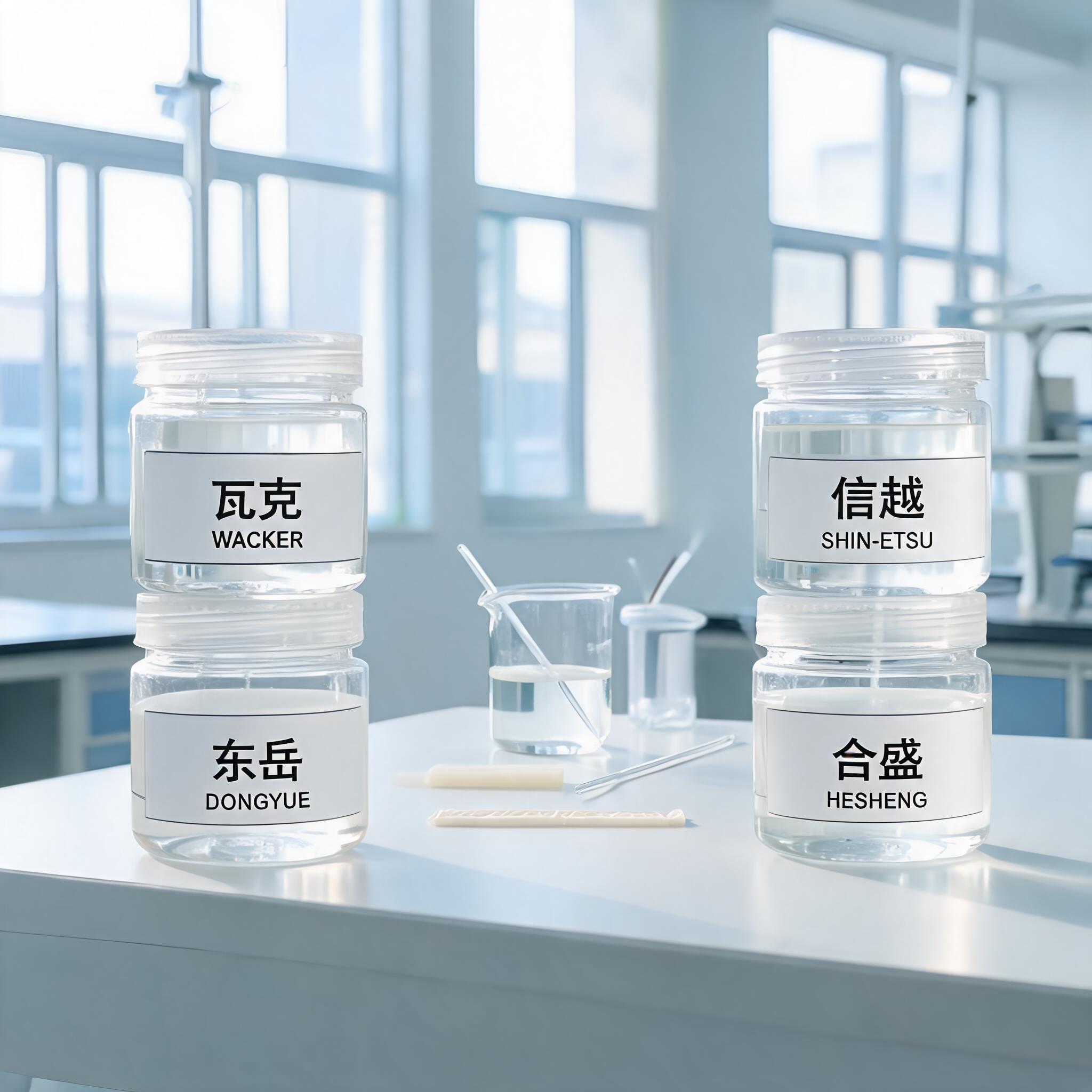
To ensure an unbiased comparison, we selected two leading international silicone brands (Wacker, Shin-Etsu) and two leading domestic Chinese silicone brands (Dongyue, HeSheng) that are widely used in LSR production for export. We tested general-purpose food-grade LSR raw materials (30 Shore A hardness, the most common specification for consumer products) from all four brands, using the same processing parameters and testing standards to eliminate variability. All testing was conducted per ISO international standards at our in-house quality control laboratory at 橡楚(湖北)橡胶有限公司, which is calibrated to meet ISO 9001 requirements.
Brand Background Overview
BrandOriginAnnual Production Capacity (Silicone, 2024)Primary Market Position
Wacker ChemieGermany~1.4 million tonnesGlobal premium brand, full product line from raw polymer to formulated LSR
Shin-Etsu ChemicalJapan~1.2 million tonnesGlobal premium brand, leading in high-purity medical-grade silicone
Shandong DongyueChina~1.1 million tonnesLeading domestic integrated silicone producer, covers commodity to food-grade grades
Zhejiang HeShengChina~1.5 million tonnesLargest Chinese silicone producer by capacity, expanding into high-purity specialty grades
Testing Parameters and Standards
We tested the following core performance and compliance parameters relevant to export to EU/US markets:
- Compliance with core REACH SVHC, US FDA, and CPSIA requirements
- Residual volatile content (per FDA 21 CFR 177.2600)
- Mechanical properties (tensile strength, elongation at break, hardness deviation)
- Aging performance (heat aging and UV aging resistance)
- Low molecular weight cyclic siloxane (D4/D5/D6) residual content
---
Side-by-Side Compliance and Performance Comparison
In this section, we present the full test results and analysis for each parameter across the four brands. All test results are from our 2024 batch testing of 30 Shore A food-grade LSR raw materials, purchased directly from authorized distributors of each brand.
Compliance Testing Results
Compliance is the first priority for products exported to EU/US markets. We tested each raw material against all core regulatory requirements, with results summarized below:
Compliance ItemRequirementWackerShin-EtsuDongyueHeSheng
REACH RegisteredRequired for raw material suppliersPass (Wacker holds full REACH registration)Pass (Shin-Etsu holds full REACH registration)Pass (Dongyue’s food-grade silicone polymers have full REACH registration)Pass (HeSheng’s polymer grades have full REACH registration)
SVHC (D4/D5/D6)<0.1% total0.021%0.018%0.062%0.057%
EU 10/2011 Overall Migration<10 mg/dm²2.1 mg/dm²1.8 mg/dm²3.4 mg/dm²3.2 mg/dm²
FDA 21 CFR 177.2600 Residue<0.1% weight after extraction0.03%0.02%0.07%0.06%
CPSIA Lead<90 ppm<10 ppm<10 ppm<10 ppm<10 ppm
CPSIA Restricted Phthalates<0.1% eachPassPassPassPass
Prop 65 ComplianceMeets safe exposure limits without warningPassPassPassPass
Key observations from compliance testing:
- All four tested brands meet the core compliance requirements for EU and US markets for general consumer and food-contact applications. The leading Chinese domestic brands (Dongyue and HeSheng) have completed all necessary REACH registration for their polymer raw materials, and their modern refining processes achieve residual D4/D5/D6 levels well below the 0.1% REACH limit.
- International brands do hold an advantage in residual impurity levels: Wacker and Shin-Etsu have 2-3x lower residual cyclic siloxane and extractable residue levels compared to Dongyue and HeSheng. However, this difference does not impact compliance for most applications, as all tested Chinese brands still fall well within regulatory limits.
- For high-purity medical-grade applications, both Wacker and Shin-Etsu have established Device Master Files (DMF) on file with the FDA, which simplifies regulatory approval for finished medical devices. As of 2024, leading Chinese brands are still in the process of completing DMF filings, so for medical device exports, international brands remain the more common choice today.
Mechanical Property Comparison
Mechanical performance directly impacts the service life and functionality of finished LSR products. We tested each material per ASTM D412 standards for tensile strength and elongation at break, and ASTM D2240 for Shore A hardness, with results below:
Mechanical ParameterWackerShin-EtsuDongyueHeSheng
Nominal Hardness (Shore A)30303030
Actual Measured Hardness (Shore A)29.7 ± 0.429.8 ± 0.329.2 ± 0.829.3 ± 0.7
Tensile Strength (MPa)7.2 ± 0.37.5 ± 0.26.8 ± 0.46.9 ± 0.3
Elongation at Break (%)720 ± 25740 ± 20680 ± 30690 ± 28
Tear Strength (kN/m)28 ± 1.229 ± 1.025 ± 1.526 ± 1.4
Key observations from mechanical property testing:
- All four brands meet the standard performance requirements for 30 Shore A food-grade LSR. The difference between the top international brands and leading Chinese brands is within 10% for all core mechanical parameters, which is negligible for most non-critical applications such as kitchenware, baby products, and consumer electronics gaskets.
- Wacker and Shin-Etsu demonstrate tighter batch-to-batch consistency, with lower standard deviation for hardness and tensile strength. Dongyue and HeSheng have slightly higher variability, but this variability is still within acceptable industrial tolerances for most applications, and can be compensated for with in-line process adjustment during production.
- For high-demand applications requiring extremely high tear strength or elongation (e.g., high-wear gaskets, dynamic sealing components), Wacker and Shin-Etsu still maintain a measurable performance advantage. But for most static and low-wear applications exported to EU/US markets, the performance of Chinese domestic silicone is sufficient.
Aging Performance Comparison
Aging resistance is a critical performance metric for LSR products that will be exposed to outdoor conditions, high temperatures, or repeated use. We conducted two standardized aging tests: 72 hours of heat aging at 150°C, and 100 hours of UV aging per ASTM G154, then measured the change in hardness and retention of tensile strength, with results below:
Aging ParameterWackerShin-EtsuDongyueHeSheng
Hardness Change After Heat Aging (Δ Shore A)+2.1+1.9+2.8+2.7
Tensile Strength Retention After Heat Aging (%)92938687
Hardness Change After UV Aging (Δ Shore A)+1.7+1.5+2.4+2.3
Tensile Strength Retention After UV Aging (%)90918384
Key observations from aging testing:
- All four brands demonstrate good aging resistance that meets the requirements for most consumer and industrial applications. Even after accelerated aging, all materials retain more than 80% of their original tensile strength, which meets the typical 5-year service life requirement for most consumer products.
- International brands again show a performance advantage, with approximately 5-7% higher strength retention after aging and lower hardness change. This advantage becomes meaningful for products that will be used in continuous high-temperature environments (above 100°C) or long-term outdoor exposure. For indoor, room-temperature applications, the difference in aging performance is not noticeable during the normal service life of the product.
- The performance gap between Chinese and international brands has narrowed significantly over the past 5 years, as Chinese producers have invested in better raw material purification and catalyst systems. 10 years ago, the tensile strength retention of domestic silicone after heat aging was often below 80%, but today’s leading grades are close to international standards.
---
Practical Considerations for EU/US Export Manufacturers
Based on our test results and years of production experience at 橡楚(湖北)橡胶有限公司, there is no one-size-fits-all answer to whether domestic Chinese silicone is suitable for LSR products exported to EU/US markets. The correct choice depends on your product’s application, regulatory requirements, and cost targets. Below we outline key practical considerations to help you make the right decision.
Application-Specific Selection Guidance
We have developed the following selection framework based on product category:
- General consumer products, kitchenware, baby products, low-demand electronics components: Leading domestic Chinese silicone from Dongyue and HeSheng is fully compliant with EU and US regulatory requirements, and performance meets all functional requirements. The 15-30% lower raw material cost compared to international brands provides significant price competitiveness for export products, with no increased compliance risk.
- High-performance automotive components, outdoor products, dynamic sealing applications: Wacker or Shin-Etsu silicone is recommended, as the better aging performance and mechanical properties will ensure the product meets the longer service life requirements for these applications.
- Medical devices and implanted products: Wacker and Shin-Etsu are still the standard choice today, as their pre-existing FDA DMF filings and EU MDR compliance documentation simplify regulatory approval significantly. While Chinese brands are working on regulatory approval for medical grades, this process is not yet complete for most high-risk applications.
Cost and Supply Chain Considerations
One of the biggest advantages of domestic Chinese silicone for LSR product manufacturers based in China is supply chain stability and cost. The table below summarizes the typical price and lead time for 30 Shore A food-grade LSR from each brand (2024 ex-China prices):
BrandPrice per kg (USD)Typical Lead TimeSupply Chain Risk for Chinese Manufacturers
Wacker$6.8-7.52-4 weeksModerate: subject to import tariff fluctuations and global shipping delays
Shin-Etsu$6.5-7.22-4 weeksModerate: same as Wacker
Dongyue$4.2-4.81-7 daysLow: local production, large domestic inventory
HeSheng$4.3-4.91-7 daysLow: local production, large domestic inventory
For LSR product manufacturers exporting from China, using domestic silicone eliminates the need for imported raw material documentation, reduces customs clearance time, and insulates against global supply chain disruptions like those seen during the 2020-2022 pandemic. The lower raw material cost also allows exporters to maintain competitive pricing in EU and US markets without sacrificing quality or compliance.
Traceability and Quality Control Requirements
When using domestic Chinese silicone for export products, it is critical to implement strict incoming material inspection and traceability processes to maintain compliance. At 橡楚(湖北)橡胶有限公司, we follow these core practices regardless of whether we use domestic or international silicone:
- Only purchase raw materials directly from authorized distributors or the producers themselves, to avoid counterfeit or off-spec material.
- Conduct incoming testing for core compliance parameters (SVHC content, lead, phthalates) for every batch, to confirm the material meets regulatory requirements before production.
- Maintain full batch traceability from raw material to finished product, so we can provide full compliance documentation to our EU and US clients on request.
- Hold all raw material compliance certificates (REACH registration, FDA food contact statements) on file to meet customs and regulatory inspection requirements.
---
Conclusion
The question of whether LSR products for EU/US export can use domestic Chinese organic silicone has a clear answer based on our testing and production experience: for most general consumer, food-contact, and low-demand industrial applications, leading domestic Chinese brands like Dongyue and HeSheng are fully compliant with EU and US regulatory requirements, and their performance is comparable enough to international brands to meet product requirements. The performance advantage held by international brands like Wacker and Shin-Etsu is measurable, but it is only critical for high-performance, high-temperature, outdoor, or medical applications where the extra performance and pre-existing regulatory documentation provide clear value.
As a