
橡楚编辑部 6/29/2026 45 min read
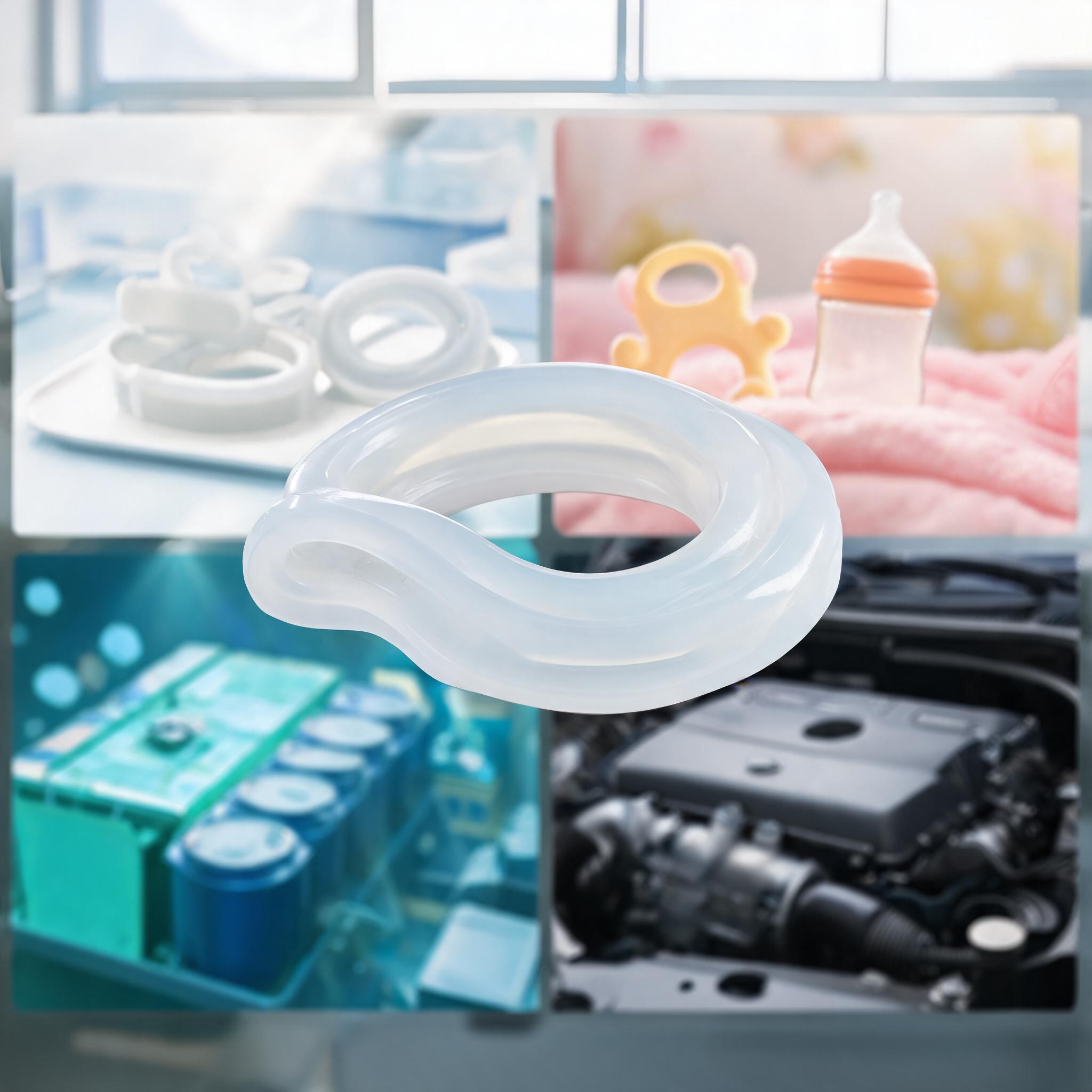
This article interprets the core performance requirements of waterproof liquid silicone rubber seals for new energy equipment, analyzes their application characteristics in scenarios such as photovoltaic inverters, energy storage cabinets, and three-electric systems of new energy vehicles, and sorts out common selection misunderstandings, helping industry practitioners match suitable LSR sealing solutions to ensure long-term waterproof reliability and service life of equipment in complex outdoor environments.
The global transition to renewable energy has accelerated the deployment of high-power, outdoor-facing new energy equipment, including photovoltaic (PV) inverters, wind turbine nacelle components, electric vehicle (EV) charging piles, and energy storage battery packs. These systems operate in harsh environmental conditions: extreme temperature fluctuations, prolonged UV exposure, heavy rainfall, salt spray in coastal regions, and chemical corrosion from battery electrolytes or hydraulic fluids. A single sealing failure can cause water ingress, leading to short circuits, insulation degradation, or catastrophic system failure, which can reduce equipment lifespan by 30–50% and increase maintenance costs by up to 45% according to 2024 data from the International Renewable Energy Agency (IRENA).
Liquid Silicone Rubber (LSR) has emerged as the preferred material for waterproof seals in these applications, outperforming traditional elastomers such as nitrile butadiene rubber (NBR), ethylene propylene diene monomer (EPDM), and thermoplastic polyurethanes (TPU) in long-term outdoor stability. This guide provides a technical breakdown of the performance attributes of waterproof LSR seals for new energy equipment, validates their performance under industry-specific operating conditions, outlines a structured selection framework, and analyzes recent material innovations tailored to evolving sector requirements.
Waterproof LSR seals are engineered to meet multi-dimensional performance requirements that balance waterproofing, mechanical resilience, and environmental compatibility. Unlike commodity sealing materials, LSR’s molecular structure — composed of alternating silicon-oxygen (Si-O) backbone chains with organic side groups — delivers inherent advantages that align directly with the demands of new energy systems. Below are the non-negotiable performance metrics for these components, with benchmark values for standard and high-spec grades.
The primary function of these seals is to prevent liquid and particulate ingress, defined by the International Electrotechnical Commission (IEC) 60529 Ingress Protection (IP) rating system. For new energy equipment, the minimum required rating is IP65 (protection against low-pressure water jets from all directions), while high-exposure components such as PV inverter external gaskets and EV charging plug seals require IP67 (immersion in 1m of water for 30 minutes) or even IP68 (continuous immersion at depths ≥1.5m for 1000+ hours).
LSR’s waterproofing performance stems from its low water absorption rate and ability to maintain consistent compression set under prolonged stress. Table 1 compares key waterproofing-related properties of LSR against common competing sealing materials:
In addition to freshwater ingress, LSR seals exhibit exceptional resistance to corrosive fluids common in new energy environments. For energy storage battery pack applications, LSR maintains 98% of its tensile strength after 1000h of exposure to 10% sulfuric acid electrolyte, compared to a 42% strength loss for EPDM under the same conditions. For offshore wind turbine components, LSR seals pass 1500h of neutral salt spray testing (ISO 9227) without cracking or seal gap formation, while NBR seals typically exhibit surface degradation after 400h.
Seals in new energy equipment are subjected to repeated compression, dynamic movement (e.g., EV charging plug mating cycles, wind turbine yaw system rotation), and mechanical vibration from equipment operation. LSR’s mechanical properties are tunable via formulation adjustments, allowing material engineers to match seal hardness and resilience to specific use cases.
Key mechanical performance parameters for waterproof LSR seals include:
New energy equipment operates across extreme ambient temperature ranges, from -40°C in high-altitude PV farms and Arctic wind farms to 180°C in high-power energy storage battery modules and inverter power cabinets. LSR’s Si-O backbone has a bond energy of 452 kJ/mol, significantly higher than the 348 kJ/mol carbon-carbon (C-C) bond energy in organic elastomers, giving it inherent thermal stability.
LSR’s operating temperature range extends from -60°C to 220°C for standard grades, with specialty formulated grades capable of withstanding intermittent temperatures up to 300°C. In long-term thermal aging testing (1000h at 150°C), LSR retains 90% of its original tensile strength and elongation, while EPDM loses 40% of its tensile strength and becomes brittle after the same exposure. At low temperatures, LSR remains flexible down to -60°C, with no glass transition-induced cracking, a critical advantage for equipment deployed in cold climate regions.
Chemical compatibility is another core requirement, as seals may come into contact with lubricants, battery electrolytes, cleaning agents, and atmospheric pollutants. Table 2 outlines the chemical resistance of standard LSR against fluids commonly encountered in new energy applications:
It is important to note that standard LSR has limited resistance to non-polar solvents such as gasoline and diesel, so specialty fluorinated LSR (F-LSR) grades are recommended for seals in EV fuel cell systems or hybrid energy equipment that may be exposed to hydrocarbon fuels.
Material performance data from laboratory testing is not sufficient to guarantee real-world reliability: seals must be validated against industry-specific standards that replicate the combined stressors of new energy operating environments. All waterproof LSR seals for new energy equipment must undergo a structured testing regimen aligned with global and regional industry standards to qualify for deployment.
The foundational test for all waterproof seals is ingress protection testing per IEC 60529. For IP67 validation, seals are installed in their intended housing, immersed in 1m of deionized water for 30 minutes, and inspected for water ingress via high-voltage insulation testing (minimum 1000V DC) and visual inspection. For IP68 validation, test parameters are customized to the use case: for offshore wind turbine seals, this typically involves immersion in 10m of salt water for 1000h, while for deep-submerged energy storage systems, it may involve immersion in 30m of water for 2000h.
Additional general performance tests include:
Beyond general tests, LSR seals must meet use case-specific standards tailored to the unique operating conditions of each new energy segment:
Selecting the appropriate LSR seal for a new energy application requires balancing performance requirements, material compatibility, manufacturing feasibility, and total lifecycle cost. A misselected seal can lead to premature failure, unplanned maintenance, and even safety hazards, so engineers should follow a four-step selection process aligned with system-level design requirements.
The first step is to map all environmental and mechanical stressors the seal will be exposed to over its design lifespan, typically 10–25 years for most new energy equipment. Key parameters to document include:
As a reference, Table 3 provides recommended baseline LSR properties for common new energy applications:
Once operating parameters are defined, engineers can select the appropriate LSR grade and optimize seal geometry to meet performance requirements. LSR grades are categorized by their functional additives and crosslink density:
Seal geometry is equally critical to performance. Common designs include:
While material performance is the primary priority, selecting a seal that is compatible with high-volume manufacturing and offers low total cost of ownership (TCO) is critical for commercial viability. LSR seals are manufactured via injection molding, which offers high dimensional accuracy (tolerance ±0.01mm for small components) and high production efficiency (cycle times of 30–60 seconds per part), making it suitable for mass production of EV and PV components.
When evaluating cost, engineers should consider:
For example, a 2023 case study of a 1GW utility-scale PV farm found that switching from EPDM gaskets to weather-resistant LSR gaskets increased upfront seal cost by 35%, but reduced annual water ingress-related inverter failures from 2.1% to 0.2%, delivering a net TCO saving of $2.7 million over the 25-year project lifespan.
As new energy equipment evolves toward higher power density, longer design lifespans, and stricter safety requirements, LSR material suppliers are developing next-generation formulations to address emerging challenges. Three key innovation areas are reshaping the waterproof LSR seal landscape for new energy applications.
The rollout of 1MW+ DC ultra-fast charging stations (3