
橡楚编辑部 6/29/2026 50 min read
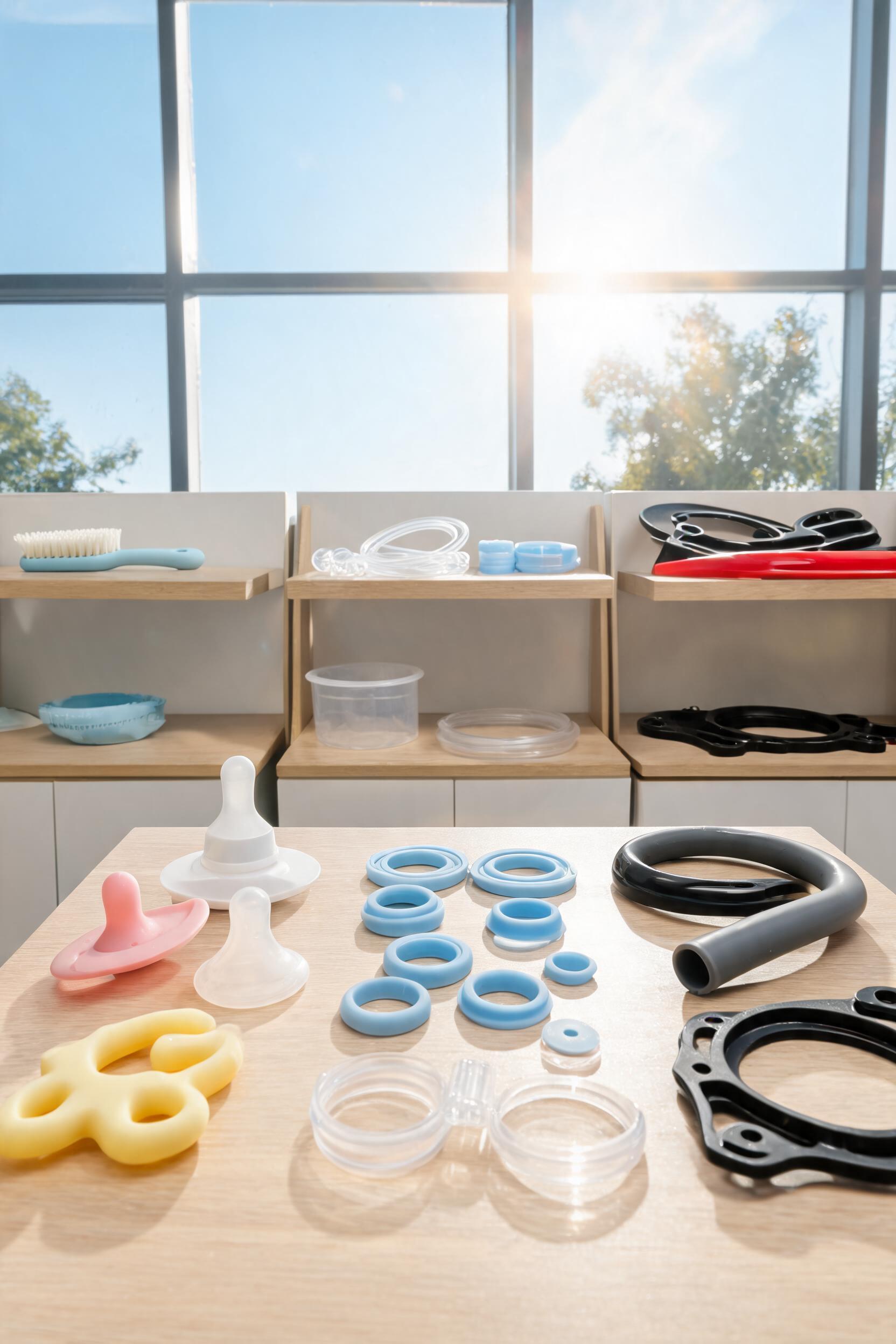
OEM/ODM liquid silicone rubber (LSR) product customization meets personalized demands in medical, automotive, consumer electronics and other industries, covering the whole process from demand docking, material selection, mold development to mass production control. Professional custom manufacturers ensure product precision, biocompatibility and durability through mature process control, helping customers reduce R&D costs, shorten time-to-market, and adapt to special performance requirements of different scenarios.
Liquid silicone rubber (LSR) has emerged as a preferred material for high-performance component manufacturing across medical, automotive, consumer electronics, and aerospace sectors, driven by its exceptional biocompatibility, extreme temperature resistance (-60°C to 230°C), chemical inertness, and long-term durability. For brands and product developers, navigating the complexities of LSR part design, tooling, and mass production often requires specialized expertise that in-house teams rarely possess. OEM (Original Equipment Manufacturing) and ODM (Original Design Manufacturing) LSR customization services address this gap by offering end-to-end support from concept validation to full-scale production, eliminating the need for clients to invest in dedicated LSR processing infrastructure or specialized technical teams.
Unlike traditional thermoplastic molding, LSR processing requires precise control of material metering, mixing ratios, curing temperatures, and injection pressures, as even minor deviations can lead to part defects such as incomplete filling, flash, or inconsistent mechanical properties. Professional OEM/ODM LSR providers bring decades of cumulative experience in material formulation, tooling design, and process optimization, enabling clients to reduce product development cycles by 30–40% compared to in-house trials, while lowering overall production costs by 25% on average, according to 2024 data from the Global Liquid Silicone Rubber Industry Association. This article outlines the full end-to-end workflow of OEM/ODM LSR customization, core technical advantages of partnering with specialized providers, key quality control frameworks, and real-world application case studies to guide product developers in selecting and leveraging OEM/ODM services effectively.
The OEM/ODM LSR customization process is structured to minimize technical risks, align with client product requirements, and ensure consistent performance across mass production batches. The workflow is divided into three sequential, client-collaborative phases, with formal approval gates between each stage to prevent costly rework in later production steps.
The pre-production phase lays the foundation for successful LSR product development, with activities tailored to the client’s input scope: OEM projects begin with a client-provided complete design (3D CAD files, performance specifications, and regulatory requirements), while ODM projects start with a client’s functional concept or product idea, with the provider leading design and material selection.
First, the provider’s technical team conducts a design for manufacturing (DFM) analysis, a critical step for LSR parts that addresses unique material behavior such as low viscosity (10,000–1,000,000 cP before curing), high thermal expansion during curing, and 1.5–3% post-molding shrinkage. The DFM report includes recommendations for draft angles (minimum 1° for vertical walls, 3° for textured surfaces), wall thickness (0.2–15mm optimal, with <20% variation between adjacent sections to avoid sink marks), and undercut resolution (either via side actions or collapsible cores for complex geometries). For example, for a medical LSR catheter balloon, the DFM analysis would specify a uniform 0.15mm wall thickness tolerance and a tapered gate design to eliminate residual stress at the injection point, which could cause balloon rupture during use.
Next, material formulation selection is aligned with end-use requirements. Standard LSR grades are available for general applications, but specialized formulations are developed for specific use cases:
For ODM projects, the provider also conducts industrial design and finite element analysis (FEA) simulations to validate mechanical performance: for example, simulating 10,000 cycles of compression for a seal part to ensure <10% permanent compression set, or testing thermal cycling from -40°C to 180°C to verify no cracking or dimensional drift. The pre-production phase concludes with a formal client sign-off on all design and material specifications, locking in requirements to avoid scope creep during tooling and production.
Once pre-production specifications are finalized, the process moves to tooling development, a stage where LSR-specific design choices directly impact part quality and production efficiency. LSR tooling is typically manufactured from P20 or S136 stainless steel, with a hardness of 48–52 HRC for high-volume production (100,000+ cycles) to resist wear from the abrasive fillers present in some LSR grades. Unlike thermoplastic molds, LSR molds require extremely tight parting line tolerances (≤0.005mm) to prevent flash, as the low viscosity of uncured LSR allows it to flow into gaps as small as 0.003mm. For parts with micro-features, such as microfluidic chips with 50μm channels, tooling is fabricated via high-precision CNC milling or electrical discharge machining (EDM) with ±0.001mm dimensional accuracy.
Tooling is followed by pilot production, a small-batch run of 50–500 parts to validate process parameters and part performance. The OEM/ODM team adjusts key injection molding parameters during this stage, including:
Pilot parts undergo full dimensional inspection (via coordinate measuring machine, CMM) and performance testing (tensile strength, elongation at break, compression set) to verify alignment with specifications. Any non-conformances are addressed via tooling adjustments or parameter tweaks before full mass production is approved. For example, if pilot testing reveals 0.02mm of shrinkage beyond the predicted value, the tooling cavity is adjusted to compensate for the higher shrinkage rate before mass production begins.
Mass production for LSR parts leverages high-speed injection molding machines with integrated cold runner systems, which reduce material waste by 30–40% compared to hot runner systems by keeping the LSR uncured in the delivery system. For high-volume projects (1 million+ parts per year), multi-cavity molds (16–128 cavities) are used to achieve cycle times as low as 15 seconds, with automated part demolding and in-line visual inspection to minimize labor costs. OEM clients retain full intellectual property (IP) rights to their designs, while ODM clients typically share IP rights with the provider or receive exclusive usage rights for the final product, as outlined in the initial service agreement.
LSR parts often require post-molding processing to meet final functional or aesthetic requirements, which OEM/ODM providers deliver as part of their end-to-end service. Common secondary operations include:
Post-production quality assurance (QA) is structured to catch defects before parts are shipped to the client, with tiered inspection protocols based on part criticality. For non-critical consumer parts, AQL (Acceptable Quality Limit) 2.5 inspection is standard, while for medical implantable parts, 100% inspection is required. Testing protocols include dimensional verification, material property testing, environmental simulation (thermal cycling, humidity exposure, chemical immersion), and application-specific performance testing (e.g., leak testing for seals, biocompatibility testing for medical parts). All batches are accompanied by a Certificate of Analysis (CoA) that lists batch number, material grade, test results, and compliance status, enabling full traceability from raw material to finished part. For clients requiring logistics support, most OEM/ODM providers offer packaging, labeling, and direct shipping to distribution centers or contract manufacturing partners.
Partnering with a specialized OEM/ODM LSR provider delivers tangible technical and economic benefits that cannot be replicated with in-house production or general-purpose plastic molding vendors, particularly for complex or high-regulation applications.
Specialized LSR providers invest heavily in R&D for custom material formulations, enabling them to tailor LSR properties to meet unique client requirements that off-the-shelf materials cannot address. For example, a medical device client needing an LSR seal that is compatible with both isopropyl alcohol and ethylene oxide sterilization can receive a custom formulation with <3% weight change after 1000 hours of alcohol immersion, compared to 12% for standard medical LSR. For automotive clients, custom flame-retardant LSR grades can achieve UL94 V-0 performance at 0.8mm wall thickness, while maintaining 700% elongation at break, a combination that is not available in standard commercial grades.
This expertise extends to process optimization for complex geometries that are prone to molding defects. For example, LSR parts with integrated micro-vent holes (100μm diameter) require precision control of injection speed to avoid incomplete filling of the micro-features, while overmolding LSR onto delicate electronic components requires low injection pressure (<80 bar) and low curing temperature (<160°C) to avoid damaging the components. Specialized providers have established process libraries from thousands of past projects, reducing trial-and-error time by 60% compared to manufacturers with limited LSR experience. A 2023 case study from a leading European medical device manufacturer found that switching from a general plastic molding vendor to a specialized LSR ODM provider reduced part defect rates from 8% to 0.2% for a surgical instrument handle, cutting annual warranty costs by $1.2 million.
OEM/ODM LSR customization eliminates the need for clients to make large upfront capital investments in specialized equipment, which is a major barrier to in-house LSR production. A standard 100-ton LSR injection molding machine with cold runner system costs $80,000–$150,000, while supporting equipment for material mixing, deflashing, and testing adds an additional $50,000–$100,000 in upfront costs. For low-to-medium volume projects (10,000–100,000 parts per year), these capital costs make in-house production economically unviable, whereas OEM/ODM providers spread these costs across multiple clients, enabling clients to pay only per part produced.
In addition to capital cost savings, OEM/ODM providers reduce product development time significantly. For example, a typical LSR product development cycle (concept to mass production) takes 8–12 weeks with a specialized provider, compared to 16–24 weeks for in-house development, as the provider has pre-existing supply chains for raw materials, tooling vendors, and regulatory testing partners. For ODM clients, this time saving is even more pronounced, as the provider can leverage existing modular design templates for common products such as seals, keypads, and wearable components, cutting development time by an additional 30%.
Economies of scale further reduce production costs for high-volume projects: specialized providers purchase LSR raw materials in bulk (10+ tonne orders), securing 15–25% lower material costs than small-volume buyers. They also optimize tooling designs for multi-cavity production, reducing per-part cycle times and labor costs. A 2024 cost analysis by the LSR Manufacturing Association found that for a 1 million per year production run of an automotive EV battery seal, OEM/ODM customization was 32% cheaper than in-house production, even after accounting for the provider’s profit margin.
For highly regulated sectors such as medical, automotive, and food contact, OEM/ODM LSR providers maintain pre-established compliance frameworks that eliminate the need for clients to invest in independent regulatory certification. Most specialized providers hold ISO 9001 (quality management), ISO 13485 (medical devices), IATF 16949 (automotive), and GMP (good manufacturing practices) certifications, and their material formulations are pre-tested for FDA, LFGB, and RoHS compliance. This means that parts produced by these providers come with all required compliance documentation, reducing the time to market for regulated products by 2–6 months, as clients do not need to conduct independent material testing or facility audits.
IP protection is a core component of reputable OEM/ODM LSR service agreements. For OEM clients, who provide their own design, all IP related to the product design, tooling, and production process remains the exclusive property of the client, and providers are contractually prohibited from using the design or producing the part for third parties. For ODM projects, where the provider leads the design process, IP agreements are customized to client needs: options include exclusive IP rights for the client, shared IP rights, or non-exclusive rights with a guaranteed period of exclusive use (1–5 years) for the client. Reputable providers also implement strict data security protocols, including encrypted file storage and restricted access to client design files, to prevent IP leakage. For example, a leading U.S. consumer electronics brand requires all its LSR OEM partners to adhere to ISO 27001 information security standards, with annual third-party audits to verify compliance.
Selecting the right OEM/ODM LSR provider is critical to ensuring product quality, on-time delivery, and long-term partnership success. The following criteria should be evaluated during the vendor selection process, based on the client’s industry, product complexity, and volume requirements.
First, verify that the provider has demonstrated experience with LSR products in your specific industry, as regulatory and performance requirements vary widely across sectors. For medical device clients, this means confirming that the provider has ISO 13485 certification and a track record of producing Class II or Class III medical LSR parts, with existing processes for cleanroom production (ISO Class 7 or 8, as required). For automotive clients, IATF 16949 certification and experience with EV component production (battery seals, sensor components) is a prerequisite.
Evaluate the provider’s in-house technical capabilities, including:
Request sample parts from past projects similar to your product, and ask for references from clients in your industry to validate the provider’s technical track record. For example, if you are developing a wearable ECG electrode, request samples of past conductive LSR wearable parts and test their resistivity and skin adhesion performance before finalizing the partnership.
Production capacity should align with your current and projected volume requirements, to avoid delivery delays as your product scales. Evaluate the provider’s number of LSR injection molding machines (typical capacities range from 50 tons for small precision parts to 300 tons for large automotive components), number of shifts per day, and maximum annual output for your part type. For example, a provider with 20 LSR molding machines running 3 shifts per day can produce 5–10 million small LSR parts per year, which is sufficient for most consumer electronics and medical device applications.
Supply chain resilience is another critical factor, particularly in the context of ongoing global raw material shortages. Verify that the provider has multiple approved suppliers for LSR raw materials, and maintains a 2–3 month safety stock of common material grades to avoid production disruptions. For long-term projects, ask for a supply continuity plan that outlines how the provider will address raw material price fluctuations or supply chain disruptions. Many leading OEM/ODM LSR providers also have multiple production facilities across different regions, enabling them to shift production between facilities if one location is impacted by geopolitical issues or natural disasters.
Finally, evaluate the provider’s quality management system, including defect rate tracking, corrective and preventive action (CAPA) processes, and batch traceability systems. A reliable provider should be able to provide historical defect rate data for similar projects, with a target defect rate of <0.5% for high-volume production.
OEM/ODM LSR product customization is a high-efficiency, low-risk solution for product developers across industries, offering access to specialized material expertise, process optimization, and regulatory compliance support that would be prohibitively expensive to build in-house. The end-to