
橡楚编辑部 7/1/2026 50 min read
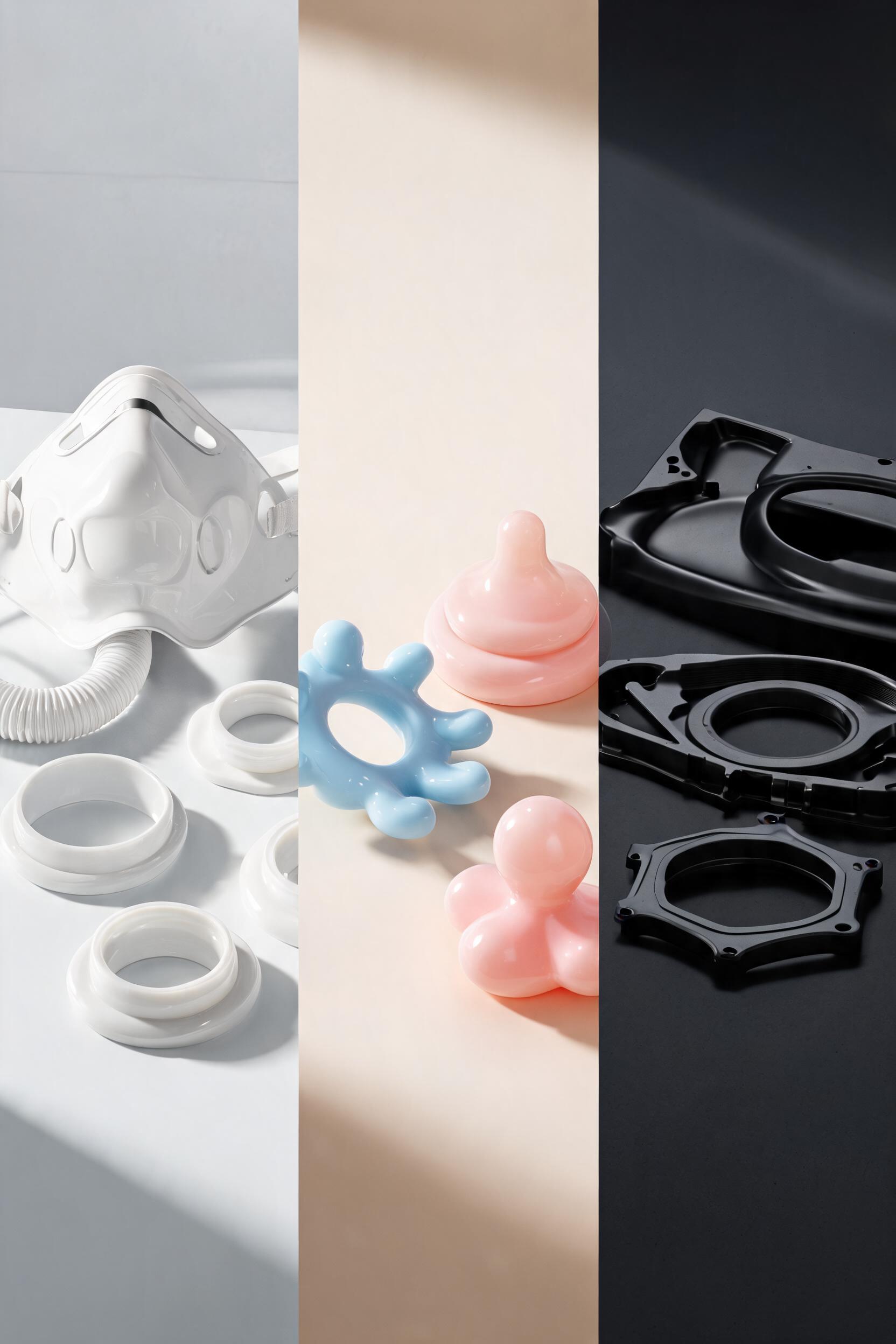
Medical grade clean liquid silicone rubber (LSR) parts are widely used in various invasive and non-invasive medical scenarios due to their excellent biocompatibility and stable dust-free performance. This article sorts out the core performance requirements, clean production control standards, and selection points for common application fields of such parts, helping medical industry practitioners clearly understand compliance requirements and quality judgment standards to avoid selection and procurement risks.
Medical grade clean liquid silicone rubber (LSR) parts are critical components in modern healthcare, where material purity, biocompatibility, and contamination control directly impact patient safety and clinical outcomes. Unlike conventional silicone or thermoplastic components, these parts are manufactured in ISO 14644-1 Class 7 or higher cleanroom environments, with strict adherence to global regulatory standards including U.S. FDA 21 CFR Part 177.2600, EU Regulation 10/2011, and ISO 10993 biocompatibility guidelines. Their unique combination of material stability, design flexibility, and low particle emission makes them irreplaceable for invasive surgical tools, long-term implantable devices, and pharmaceutical manufacturing systems.
The global market for medical LSR components is projected to reach $3.2 billion by 2028, growing at a CAGR of 7.2%, driven by rising demand for minimally invasive procedures and wearable diagnostic devices. This article analyzes the core material characteristics of medical grade clean LSR parts, their specialized manufacturing controls, leading clinical and industrial applications, and emerging innovations shaping the future of the sector.
The performance of medical clean LSR parts stems from the inherent properties of high-purity two-part platinum-cured LSR, combined with post-processing controls that eliminate residual contaminants. These characteristics differentiate them from commodity silicone components, which often contain peroxides, plasticizers, or filler additives that pose leaching risks in medical contexts.
The primary requirement for medical LSR parts is compliance with tiered biocompatibility standards, tailored to their duration of contact with human tissue or pharmaceutical products. Table 1 outlines the required testing protocols for different contact categories:
Platinum-cured medical LSR eliminates the residual byproducts associated with peroxide curing systems, which can cause inflammatory responses in long-term implant applications. For high-risk components such as pacemaker leads or cochlear implant seals, additional post-curing at 200°C for 4 hours reduces volatile organic compound (VOC) content to <0.1% by weight, far below the 0.5% limit set by FDA guidelines for permanent implants. Unlike PVC or polyurethane components, LSR does not require phthalate plasticizers, eliminating the risk of endocrine-disrupting compound leaching in pediatric or maternal care applications.
Medical clean LSR parts are manufactured and packaged to minimize particulate, microbial, and chemical contamination, making them suitable for use in sterile processing environments and aseptic manufacturing lines. Key cleanliness metrics for Class 7 cleanroom-produced LSR parts include:
For pharmaceutical manufacturing applications such as single-use bioreactor seals and filling machine gaskets, additional compliance with USP <661> and USP <788> particulate matter standards is required. LSR parts outperform PTFE and EPDM rubber alternatives in these applications, as they do not shed microplastic particles during repeated cycling or exposure to pH 1-14 chemical environments. A 2023 study by the International Society for Pharmaceutical Engineering (ISPE) found that LSR gaskets reduced particulate contamination in monoclonal antibody (mAb) filling lines by 68% compared to traditional rubber components, cutting batch rejection rates by 22%.
Medical clean LSR parts maintain consistent performance across extreme operating conditions, a critical requirement for both reusable surgical tools and long-term implantable devices. Key mechanical properties of medical grade LSR are outlined in Table 2:
LSR also exhibits excellent dielectric properties, with a dielectric strength of 20-25 kV/mm, making it ideal for insulation in active implantable devices such as neurostimulators and cardiac defibrillators. Unlike thermoplastic elastomers, LSR does not degrade or lose elasticity after exposure to common medical disinfectants, including isopropyl alcohol, hydrogen peroxide, and chlorine-based solutions, making it suitable for reusable surgical components that require frequent high-level disinfection.
The production of medical grade clean LSR parts requires end-to-end process control that exceeds standard injection molding practices, as even minor contamination during manufacturing can compromise patient safety. All production processes are validated per ISO 13485 quality management system requirements, with full traceability from raw material lot to finished component.
All manufacturing steps for medical clean LSR parts take place in controlled cleanroom environments, with environmental monitoring conducted on a continuous basis. Raw material handling is the first critical control point: medical grade LSR base and crosslinker are stored in sealed, food-grade stainless steel drums, and transferred directly to injection molding machines via closed automated feeding systems to eliminate human contact and ambient contamination.
Cleanroom specifications are matched to the part’s end use:
Environmental monitoring systems track particle count, temperature (22°C ±2°C), relative humidity (45% ±5%), and differential pressure (minimum 10 Pa positive pressure between cleanroom zones) 24/7, with automated alerts for out-of-specification conditions. All production personnel undergo rigorous gowning training, wearing hairnets, face masks, non-shedding Tyvek coveralls, and sterile gloves, with required gowning audits every 6 months to minimize human-sourced contamination.
Medical LSR parts are produced via cold-runner liquid injection molding (LIM) systems, which eliminate the waste and contamination risk associated with conventional hot-runner systems. The LIM process uses closed, temperature-controlled mixing chambers that combine the two-part LSR at a precise 1:1 ratio, with inline viscosity monitoring to ensure consistent material curing. Molding parameters are validated per FDA process validation guidelines (IQ/OQ/PQ), with typical process parameters including:
Post-processing steps are minimized to reduce contamination risk, but may include flash removal, post-curing, and functional testing. Flash removal is performed via automated laser trimming rather than manual trimming, reducing particulate generation and ensuring dimensional tolerance of ±0.02mm for micro-sized parts such as catheter valve seals. Post-curing is conducted in dedicated forced-air ovens located within the cleanroom, with temperature profiling to ensure uniform heating and complete elimination of residual low-molecular-weight siloxanes.
All finished parts undergo 100% visual inspection for defects such as bubbles, flash, and discoloration, with AQL 0.4 sampling for dimensional and functionality testing. For high-risk implantable parts, additional non-destructive testing (NDT) via X-ray or ultrasound is conducted to detect internal voids that could compromise mechanical performance.
Medical clean LSR parts are compatible with all common sterilization methods, with validation conducted to ensure that sterilization does not compromise material properties or introduce residual contaminants. Table 3 compares the impact of different sterilization methods on LSR performance:
After sterilization, parts are packaged in sterile, peelable Tyvek pouches or vacuum-sealed medical-grade polyethylene bags, with labeling that includes lot number, manufacturing date, sterilization date, and expiry date. Packaging validation includes drop testing, vibration testing, and accelerated aging testing (6 months at 40°C/75% RH) to ensure that packaging integrity is maintained throughout the supply chain, preventing contamination before end use.
The unique combination of biocompatibility, cleanliness, and durability makes medical clean LSR parts suitable for a wide range of healthcare and life science applications, from disposable surgical components to long-term implantable devices.
Long-term implantable devices represent the highest-risk application for LSR parts, requiring decades of stable performance without inflammatory or toxic responses. Common implantable LSR components include:
All implantable LSR parts undergo additional testing for chronic toxicity and carcinogenicity, with 6-month implantation studies in large animal models to validate tissue response before regulatory approval.
Minimally invasive surgery (MIS) relies on small, precision components that can navigate narrow anatomical pathways while maintaining sterility and functional performance. LSR parts are widely used in MIS tools and diagnostic devices due to their flexibility, lubricity, and resistance to surgical disinfectants. Key applications include:
The biopharmaceutical industry relies on clean LSR parts to maintain product purity in single-use manufacturing systems, where cross-contamination between batches can lead to millions of dollars in product loss. Key applications include:
The medical clean LSR sector is undergoing rapid innovation, driven by advances in material science and manufacturing technology that expand the range of possible applications.
New composite LSR materials are being developed to add targeted functionality without compromising biocompatibility or cleanliness. Key developments include:
Advances in liquid silicone 3D printing are enabling low-volume, custom LSR parts for personalized medicine applications, such as patient-specific implant components and custom surgical guides. Current LSR 3D printing technologies use UV-curable medical grade LSR resins, with layer resolution as low as 0.05mm and mechanical properties comparable to molded LSR parts. These technologies reduce lead times for custom parts from 4 weeks to 48 hours, making them ideal for point-of-care manufacturing in hospital settings, particularly for pediatric patients who require size-matched implant components that are not available in standard off-the-shelf sizes. Regulatory pathways for 3D printed LSR parts are still under development, but the FDA released draft guidance for 3D printed medical devices in 2023, which is expected to accelerate adoption over the next 5 years.
Medical grade clean LSR parts are foundational components of modern healthcare, combining unmatched biocompatibility, contamination control, and functional durability to support applications ranging from long-term implantable devices to biopharmaceutical manufacturing. Their production requires rigorous end-to-end process control, from cleanroom raw material handling to validated sterilization and packaging, all aligned with global regulatory standards to ensure patient safety. As material science advances, particularly in functionalized LSR composites and additive manufacturing, the range of applications for these parts will continue to expand, enabling new personalized medical treatments and more efficient biopharmaceutical production processes. For medical device and pharmaceutical manufacturers, selecting a qualified LSR parts supplier with certified cleanroom production capabilities and regulatory expertise is critical to ensuring product performance, compliance, and ultimately, positive patient outcomes.