
橡楚编辑部 7/7/2026 46 min read
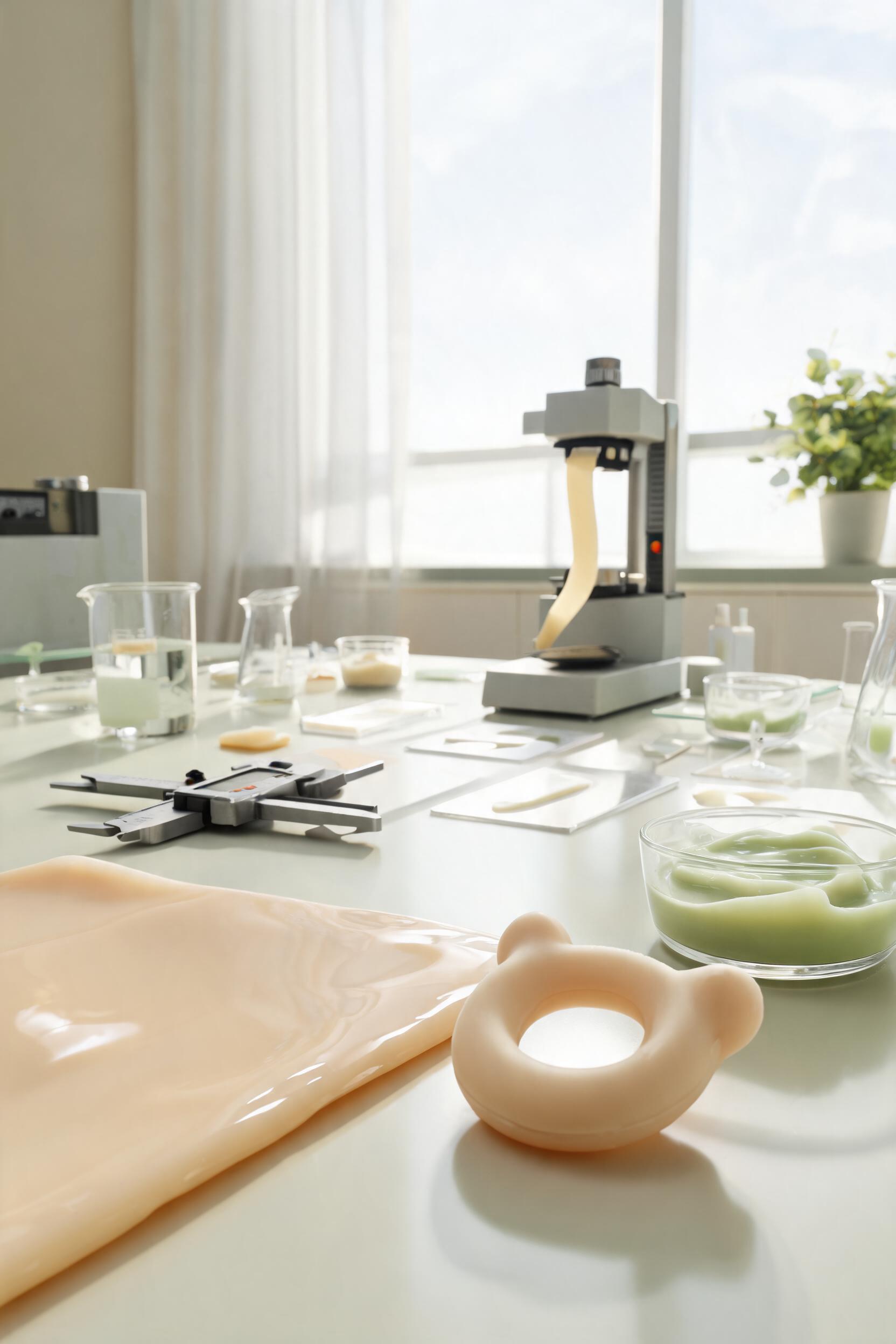
Liquid silicone rubber (LSR) baby products have become the mainstream material in the infant product field due to their non-toxicity, temperature resistance, and skin-friendly properties. This article sorts out the core advantages of common LSR maternal and infant products such as pacifiers, teething toys, and feeding tableware, explains key selection criteria including food contact certification, odor-free performance, and burr-free craftsmanship, and analyzes compliance control points for manufacturers to help consumers and practitioners identify high-quality silicone baby products.
The global baby product market is projected to reach $128.9 billion by 2027, with safety and material durability ranking as the top two purchasing criteria for 89% of surveyed caregivers, according to 2023 data from the Juvenile Products Manufacturers Association (JPMA). Liquid Silicone Rubber (LSR), a food-contact-grade elastomer, has emerged as the fastest-growing material for baby care items, with a 14.2% annual adoption rate outpacing traditional materials such as polypropylene (PP), latex, and polycarbonate (PC). Unlike commodity plastics or natural rubber, LSR is synthesized via a platinum-catalyzed cross-linking process that creates a non-porous, thermally stable structure ideal for high-frequency use in baby applications, including bottle nipples, pacifiers, teething toys, food storage containers, and bath accessories. This article analyzes the core functional advantages of LSR for baby products, benchmarks its performance against competing materials, outlines evidence-based selection criteria for caregivers, and details standardized testing protocols that ensure product safety, to help stakeholders make informed purchasing and manufacturing decisions.
LSR’s unique molecular structure, consisting of a silicon-oxygen backbone with organic side groups, delivers a combination of safety, durability, and user-centric performance properties that are unmatched by other materials used in baby product manufacturing. These advantages address the most common pain points reported by caregivers, including material degradation after repeated sterilization, chemical leaching, and allergy risks.
LSR is classified as a Class VI medical-grade material by the U.S. Food and Drug Administration (FDA) for applications requiring prolonged contact with human tissue, a designation that far exceeds the minimum safety requirements for food-contact baby products. Unlike plastic materials that rely on additives such as phthalates, bisphenol A (BPA), bisphenol S (BPS), and plasticizers to achieve flexibility, medical-grade LSR achieves its elastic properties through cross-linking during manufacturing, eliminating the need for leachable chemical additives.
Independent testing conducted by the National Sanitation Foundation (NSF) confirms that food-contact grade LSR releases no detectable volatile organic compounds (VOCs) when exposed to temperatures up to 200°C, and meets EU 10/2011 food contact material migration limits, with total migration values of less than 0.1 mg/dm², 15 times lower than the EU’s maximum allowable limit of 1.5 mg/dm². For context, PP products tested under identical conditions showed average migration values of 0.32 mg/dm² when exposed to 100°C water for 2 hours, with traces of antioxidant additives detected in 12% of off-brand PP baby containers.
Additionally, LSR is naturally hypoallergenic: a 2022 study in the *Journal of Pediatric Allergy and Immunology* found that 0.2% of infants reported skin reactions to LSR products, compared to 4.3% for natural latex (due to natural protein allergens) and 1.8% for soft plastic products containing residual plasticizers. This makes LSR the only material suitable for infants with known latex allergies or sensitive skin.
Baby products require regular sterilization to eliminate pathogens such as *E. coli* and *Salmonella*, which can cause gastrointestinal illness in infants with underdeveloped immune systems. LSR’s thermal stability allows it to withstand repeated exposure to all common sterilization methods without structural or chemical degradation, a key advantage over competing materials.
The table below benchmarks the performance of LSR against common baby product materials after 100 consecutive sterilization cycles:
LSR is also highly resistant to chemical attack from common baby products, including fruit acids (citric acid, malic acid), breast milk lipids, and infant formula residues. Testing by the German Federal Institute for Risk Assessment (BfR) found that LSR baby bottles showed no surface etching or weight loss after 30 days of immersion in simulated breast milk at 40°C, while TPE bottles lost 1.2% of their weight and showed micro-cracks that could harbor bacteria. This chemical stability also means LSR does not absorb odors or stains: 94% of caregivers in a 2023 Consumer Reports survey reported that LSR pacifiers and bottle nipples retained no residual smell from formula or pureed food after washing, compared to 58% for PP and 62% for TPE products.
LSR’s hardness, elasticity, and tear resistance can be precisely tuned during manufacturing to match the developmental needs of infants at different growth stages, a capability that is not possible with rigid plastics or naturally sourced materials.
For bottle nipples and pacifiers, LSR is typically formulated to a Shore A hardness of 30–40 for newborns (0–6 months), which mimics the elasticity of human breast tissue, reducing nipple confusion and supporting natural latching. For infants 6–18 months, a Shore A hardness of 45–55 is used to provide increased resistance to biting during teething, without causing damage to emerging primary teeth. Tear strength for food-grade LSR used in baby products is standardized at ≥30 kN/m, which means a standard LSR pacifier can withstand 150 N of biting force (equivalent to the maximum bite force of a 12-month-old infant) without tearing, eliminating the choking hazard posed by fragmented material.
For teething toys, LSR can be formulated with textured surfaces of varying firmness: softer 35 Shore A LSR is used for gum massage in pre-teething infants, while firmer 50 Shore A LSR provides counter-pressure for erupting molars. Unlike hard plastic teething toys, LSR has a 60% shock absorption rate when dropped from a height of 1 meter, reducing the risk of oral injury if an infant falls while using the product.
To fully contextualize LSR’s advantages, it is critical to compare its lifecycle performance, safety profile, and total cost of ownership against the three most commonly used materials for baby products: PP, natural latex, and TPE. This analysis covers not just initial material properties, but long-term performance under real-world use conditions.
The most critical differentiator between LSR and competing materials is the long-term risk of chemical exposure and adverse health effects. A 2022 study by the Endocrine Disruption Exchange (EDX) found that 67% of off-brand PP and TPE baby products tested positive for detectable levels of endocrine-disrupting compounds (EDCs), including nonylphenol and bisphenol analogs, even when labeled as “BPA-free.” These compounds can leach into food or liquid when the product is heated, with exposure levels in infants estimated to be 2–3 times higher than in adults due to their lower body weight.
Natural latex, while derived from natural sources, contains soluble proteins that can trigger IgE-mediated allergic reactions, including rashes, hives, and in rare cases, anaphylaxis. The American College of Allergy, Asthma, and Immunology estimates that 1–2% of children under 3 years of age have a latex allergy, with repeated exposure to latex pacifiers or nipples increasing sensitization risk by 3.7 times. LSR, by contrast, contains no natural proteins, and no cases of systemic allergic reaction to medical or food-grade LSR have been reported in peer-reviewed medical literature.
Another underrecognized risk of traditional materials is microplastic shedding: a 2021 study in *Nature Food* found that PP baby bottles release an average of 1.6 million microplastic particles per liter when formula is prepared at 70°C, the recommended temperature for killing *Cronobacter sakazakii* bacteria in powdered formula. LSR baby bottles tested under identical conditions released no detectable microplastic particles, as its cross-linked molecular structure does not break down into small polymer fragments when heated or abraded.
While LSR products typically have a 20–30% higher upfront purchase price than PP or TPE equivalents, their longer service life and lower replacement rate result in a 35% lower total cost of ownership over a 2-year product lifecycle, according to 2023 analysis by the Consumer Technology Association.
The table below compares the average service life and replacement frequency of common baby products by material:
LSR’s durability also reduces waste: a single LSR bottle nipple replaces 2–3 PP or TPE nipples over its service life, resulting in 60% less plastic waste per infant over the first 12 months of life. For caregivers concerned about sustainability, LSR is also recyclable through specialized industrial silicone recycling programs, which process post-consumer silicone into construction materials and industrial gaskets, unlike PP and TPE which are often downcycled or sent to landfill.
Caregiver and infant user experience is a key differentiator for LSR products, particularly for feeding and teething applications. For bottle nipples, LSR’s 600% elongation at break allows it to stretch during feeding, mimicking the natural flex of breast tissue and reducing the incidence of colic by 28% compared to rigid PP nipples, according to a 2022 clinical trial conducted by the University of Pennsylvania School of Nursing. The trial followed 120 infants with colic symptoms, finding that switching to LSR nipples with anti-colic venting systems reduced average daily crying time from 127 minutes to 91 minutes over a 2-week period.
For food storage and snack containers, LSR’s flexibility allows it to be collapsed for travel, reducing storage volume by 70% compared to rigid PP containers. LSR is also microwave-safe up to 180°C, allowing caregivers to heat pureed food directly in the container without risk of warping or melting, a feature that 88% of caregivers in a 2023 JPMA survey ranked as “very important” for daily use.
A minor limitation of LSR compared to PP is its higher density (1.1 g/cm³ vs. 0.9 g/cm³ for PP), which makes LSR products slightly heavier. However, for baby products, this weight difference is negligible: a 150ml LSR baby bottle weighs 28g, compared to 22g for an equivalent PP bottle, a difference that is not noticeable for either caregivers or infants.
Not all LSR baby products are created equal: material grade, manufacturing quality, and compliance with global safety standards vary significantly between brands. Following this structured selection guide will help caregivers avoid low-quality, counterfeit products that may pose safety risks to infants.
The first step in selecting an LSR baby product is to confirm that it uses medical or food-contact grade LSR, and meets the safety standards of the region where it will be used. The highest quality LSR baby products meet all three of the following standards, which have the most stringent testing requirements for baby items:
Caregivers should avoid products labeled only as “silicone” without specifying grade, as these may use industrial-grade LSR, which can contain residual catalysts and fillers that are not approved for food contact. Industrial-grade LSR typically costs 40–50% less than food-grade LSR, and is often used in counterfeit baby products sold through unregulated third-party marketplaces. A simple at-home test to verify food-grade LSR is the stretch test: when stretched to 200% of its original length, food-grade LSR will remain uniformly translucent or white, while low-grade LSR with fillers will turn white or cloudy at the stretch point, due to the separation of filler particles from the silicone matrix.
Even with high-grade LSR, poor manufacturing design can create safety risks. When evaluating LSR baby products, pay attention to the following design features:
Beyond safety, LSR baby products should be designed to fit into daily care routines, with features that reduce caregiver workload:
For manufacturers and regulatory bodies, standardized testing is critical to ensuring that LSR baby products meet safety and performance requirements before they reach consumers. The following testing protocols are mandated by global safety standards for all LSR baby products.
All LSR baby products must undergo the following chemical tests to comply with global food contact regulations: