
橡楚编辑部 7/3/2026 47 min read
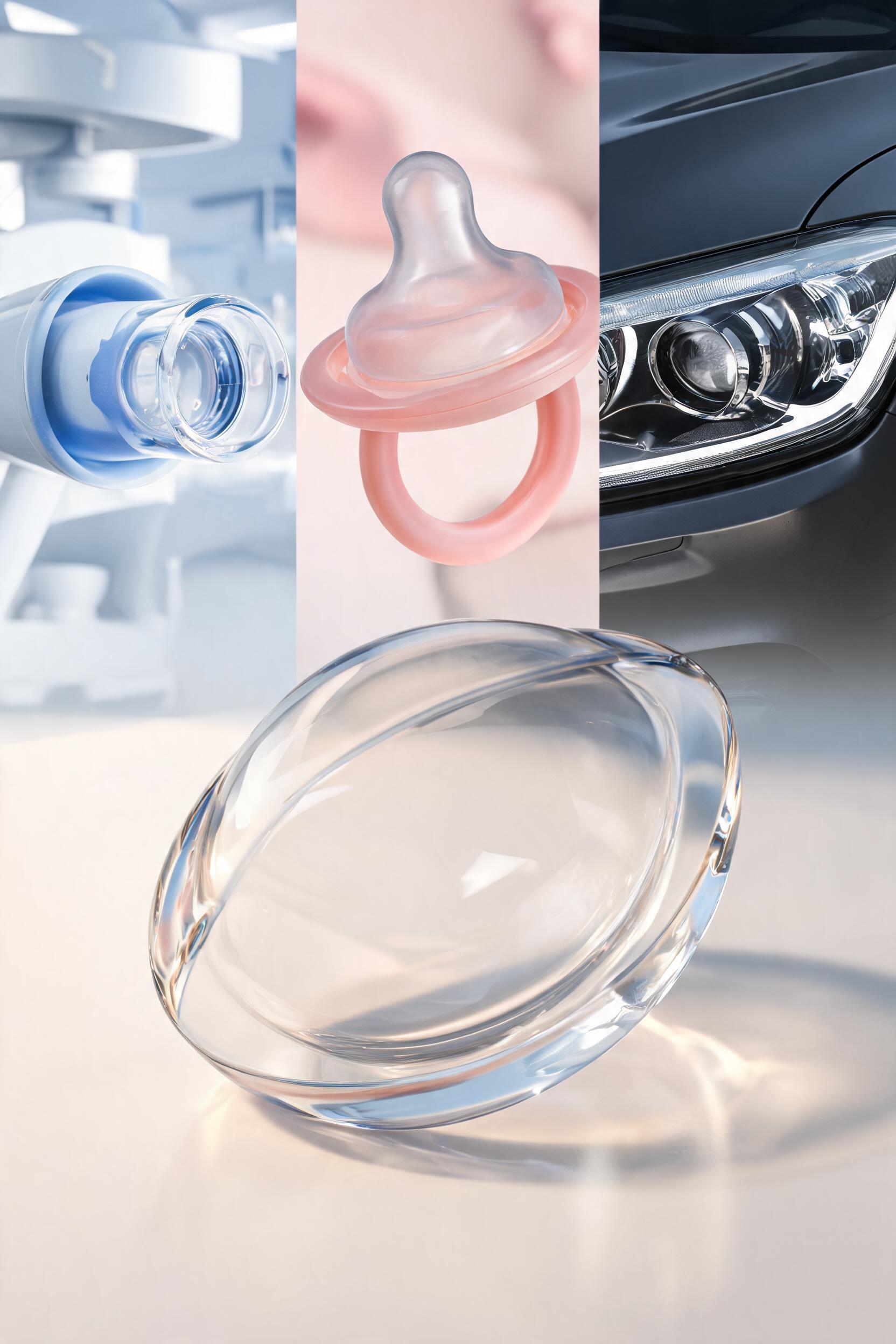
High transparency optical liquid silicone rubber (LSR) lenses, with excellent properties such as high light transmittance, yellowing resistance and impact resistance, are gradually replacing traditional glass and PC lenses, becoming core optical components in lighting, optical imaging, automotive sensing and other fields. This article systematically sorts out the core performance advantages, molding process key points, quality control standards and mainstream industry application scenarios of high transparency optical LSR lenses, providing reference for material selection and production of related enterprises.
Optical systems across consumer electronics, automotive, and medical device sectors are increasingly shifting from traditional glass and thermoplastic optical components to high transparency optical liquid silicone rubber (LSR) lenses, driven by demand for lightweight, durable, and formable optical solutions that perform reliably in harsh environments. Unlike commodity LSR grades, high transparency optical LSR is formulated with ultra-pure polydimethylsiloxane (PDMS) base polymers, nano-scale fumed silica reinforcing fillers with controlled refractive index matching, and minimal cross-linking byproducts, achieving total luminous transmittance exceeding 94% across the 400–1100 nm visible and near-infrared (NIR) spectrum, with haze values below 0.8% for 2 mm thick samples. This combination of optical performance, mechanical flexibility, and thermal stability addresses critical limitations of glass (brittleness, high processing cost for complex geometries) and polycarbonate (PC)/polymethyl methacrylate (PMMA) (yellowing under UV exposure, limited operating temperature range) for next-generation optical designs. This article systematically analyzes the core material properties of high transparency optical LSR lenses, optimized precision manufacturing processes, and emerging high-growth application cases, providing a technical reference for optical engineers evaluating LSR as an alternative to conventional optical materials.
The performance advantage of high transparency optical LSR lenses stems from their unique chemical structure and formulation tuning, which balances exceptional optical clarity with functional attributes unavailable in rigid optical materials. To quantify these properties, Table 1 compares key performance metrics of high transparency optical LSR, optical grade PMMA, optical grade PC, and borosilicate crown glass (BK7), the most common competing materials for lens applications.
The primary optical advantage of high transparency optical LSR lies in its customizable optical parameters and consistent performance across a broad wavelength range, eliminating tradeoffs required for conventional optical materials.
First, refractive index (RI) tunability allows optical designers to match lens performance to specific system requirements without altering material mechanical properties. Standard optical LSR grades offer RI values ranging from 1.41 to 1.43, achieved via pure PDMS base polymers with minimal phenyl group modification. For applications requiring higher RI to reduce lens thickness or expand field of view, phenyl-modified PDMS formulations can push RI up to 1.53, with transmittance reduction limited to less than 1% across the visible spectrum. Unlike thermoplastics, where RI is an inherent property of the polymer backbone, LSR RI tuning is achieved by adjusting the ratio of methyl to phenyl functional groups in the PDMS chain, with no impact on cross-linking density or thermal stability.
Second, high transparency optical LSR exhibits extremely low chromatic aberration, with Abbe numbers ranging from 45 to 60, significantly higher than PC (Abbe number 30) and comparable to PMMA and BK7 glass. This low dispersion reduces color fringing in multi-lens optical systems, eliminating the need for additional corrective lens elements that increase system weight and cost. For NIR applications such as motion sensors and facial recognition modules, optical LSR maintains transmittance above 90% at 940 nm, the most common wavelength for NIR light sources, outperforming PMMA which drops to 82% transmittance at this wavelength due to C-H bond absorption.
Third, UV stability of optical LSR addresses a critical limitation of thermoplastic lenses for outdoor and high-UV exposure applications. Unlike PMMA and PC, which undergo chain scission and yellowing when exposed to UV radiation, PDMS-based LSR has no carbon-carbon double bonds in its backbone, making it inherently resistant to UV degradation. Testing per ISO 4892-3 shows that after 1000 hours of QUV B exposure (313 nm, 0.89 W/m² irradiance), high transparency optical LSR exhibits less than 2% transmittance loss and no measurable yellowing, compared to 12% transmittance loss and a yellowing index (ΔYI) of 18 for PMMA under identical conditions. For outdoor automotive lighting and aerospace optical systems, this UV stability eliminates the need for protective UV coating layers that add manufacturing cost and can introduce optical distortion.
Beyond optical performance, high transparency optical LSR lenses offer unique mechanical and thermal properties that enable optical system designs not feasible with rigid materials.
The low density and high flexibility of LSR reduce optical system weight and improve impact resistance, critical for portable electronics and automotive applications. At 1.05–1.15 g/cm³, optical LSR is 58% lighter than BK7 glass and 12% lighter than PMMA, reducing overall device weight for wearable electronics and electric vehicle (EV) lighting systems where mass reduction directly improves battery life. The high elongation at break (150–300% for most optical grades) allows LSR lenses to withstand mechanical shock and vibration without cracking: drop testing per MIL-STD-810H shows that 2 mm thick LSR lenses survive 1.5 m drops onto concrete with no optical or structural damage, while PMMA and PC lenses of identical thickness crack or shatter in 72% and 38% of tests, respectively. For wearable devices such as smart glasses and AR headsets, this flexibility also allows LSR lenses to be mounted in curved frames without inducing birefringence, a common issue with rigid thermoplastic lenses that are force-fit into non-planar housings.
Thermal stability of optical LSR ensures consistent optical performance across extreme temperature ranges, outperforming both thermoplastics and glass for high-heat or low-temperature applications. Glass transition temperature (Tg) of optical LSR is below -110°C, meaning the material remains flexible and optically stable at temperatures as low as -60°C, with no measurable shift in refractive index or transmittance. At the high end, optical LSR operates continuously at 200°C with less than 1% transmittance loss after 1000 hours of thermal aging, compared to PMMA which softens at 80°C and PC which exhibits yellowing after 100 hours at 140°C. Unlike glass, which has a coefficient of thermal expansion (CTE) of 7.2 ppm/°C, optical LSR has a CTE of 200–300 ppm/°C, but its low modulus (0.1–10 MPa, depending on hardness) allows it to absorb thermal expansion mismatches with metal or plastic housings without inducing stress birefringence. For automotive headlight lenses, which can experience temperature swings from -40°C in winter to 150°C during operation, this thermal stability eliminates the risk of lens cracking or optical distortion that plagues thermoplastic designs.
Producing optical LSR lenses with consistent sub-micrometer form accuracy and minimal haze requires specialized processing equipment and process control, as LSR’s low viscosity and cross-linking reaction introduce unique challenges compared to thermoplastic injection molding. The standard manufacturing workflow for high precision optical LSR lenses includes material handling, injection molding, post-curing, and quality validation, with process tolerances an order of magnitude tighter than for commodity LSR parts.
The core manufacturing step for optical LSR lenses is cold-deck, high-precision injection molding, which is optimized to minimize filler agglomeration, air entrapment, and cross-linking inconsistencies that degrade optical performance.
First, material preparation and metering require closed-loop, temperature-controlled dosing systems to maintain consistent mixing ratios of the two-part LSR formulation (Part A: vinyl-functional PDMS + platinum catalyst; Part B: hydride-functional PDMS + cross-linker). Unlike commodity LSR, optical LSR formulations have no added pigments or process aids, and even minor contamination (0.1% by weight of foreign particles) can cause visible defects or increase haze by more than 2%. To prevent contamination, material handling is performed in ISO Class 7 cleanrooms, with all material contact surfaces made of polished 316L stainless steel or PEEK to avoid particle shedding. The two parts are mixed in a static mixer with a 1:1 volume ratio, with metering accuracy controlled to ±0.1% to ensure consistent cross-linking density across production runs.
Second, the molding process uses a cold-runner injection system with electric servo-driven screw dosing to achieve precise fill control. The mold cold deck is maintained at 15–20°C to prevent premature cross-linking of LSR in the runner system, while the mold cavity is heated to 120–160°C via integrated cartridge heaters with temperature control accuracy of ±0.5°C. Injection speed is controlled between 5–20 cm³/s, with fill pressure ranging from 50–150 bar, to minimize shear stress that can align fumed silica fillers and induce birefringence. For lenses with surface features smaller than 10 μm (such as micro-lens arrays for diffractive optical elements), vacuum venting of the mold cavity to 10 mbar is required to eliminate air traps that cause surface defects. Typical cycle times for optical LSR lenses range from 30–90 seconds, depending on lens thickness, with in-mold cross-linking completing 90–95% of the cure reaction before demolding.
Mold tooling for optical LSR lenses requires ultra-high surface finish and precise temperature uniformity to avoid optical defects. Cavity inserts are typically made of S136 stainless steel, hardened to 52 HRC, and polished to a surface roughness (Ra) of less than 5 nm for plano surfaces and less than 10 nm for aspheric surfaces, matching the finish required for glass lens molding tools. Unlike thermoplastic molds, LSR optical molds require zero draft angles for lens surfaces, as the flexibility of cured LSR allows demolding of undercuts and vertical sidewalls without damage to optical surfaces. For multi-cavity molds, cavity-to-cavity dimensional variation is controlled to less than 2 μm to ensure consistent optical performance across all molded lenses.
After molding, optical LSR lenses undergo specialized post-processing and quality testing to ensure they meet strict optical specifications, with rejection rates typically below 2% for well-optimized processes.
Post-curing is a required step for optical LSR lenses to remove residual cross-linking byproducts (primarily hydrogen gas) and complete the cure reaction, which reduces haze and improves long-term thermal stability. Post-curing is performed in a forced-air convection oven under nitrogen atmosphere (oxygen content <50 ppm) to avoid surface oxidation that can cause yellowing. Standard post-cure conditions are 2–4 hours at 150–180°C, depending on LSR grade, which reduces residual volatile organic compound (VOC) content to less than 100 ppm and increases cross-linking density to over 98%. For lenses intended for medical or food-contact applications, post-curing may be extended to 8 hours at 200°C to meet biocompatibility requirements per ISO 10993. Unlike thermoplastic lenses, optical LSR lenses require no surface coating for scratch resistance or UV protection in most applications, reducing post-processing steps and cost. For high-wear applications such as eyewear lenses, a 2–5 μm thick plasma-deposited silica hard coating can be applied to increase surface hardness to 4–5 H (pencil hardness), with no impact on transmittance or haze.
Quality validation for optical LSR lenses combines dimensional metrology, optical performance testing, and environmental reliability testing to ensure consistency across production runs. Dimensional inspection uses coordinate measuring machines (CMM) and white light interferometers to verify lens surface form accuracy, with typical tolerances of ±1 μm for surface sag and ±0.5 μm for micro-lens array feature height. Optical performance testing includes total transmittance and haze measurement per ASTM D1003, refractive index measurement via Abbe refractometer, and MTF (modulation transfer function) testing to quantify imaging performance. For high-precision lenses such as those used in camera modules, birefringence measurement via polarimetry is required to ensure residual stress from molding is below 10 nm/cm, which avoids contrast reduction in captured images. Environmental reliability testing includes thermal shock cycling (-40°C to 125°C, 1000 cycles), UV exposure (1000 h QUV A), and humidity aging (85°C/85% RH, 1000 h), with post-test optical performance required to remain within 2% of initial values.
The unique combination of optical, mechanical, and thermal properties of high transparency optical LSR lenses has driven rapid adoption across three high-growth sectors, where conventional optical materials are unable to meet evolving design requirements.
The automotive sector is the largest consumer of high transparency optical LSR lenses, driven by the shift to EVs and the proliferation of advanced driver-assistance systems (ADAS) that require durable, high-performance optical components.
Automotive adaptive driving beam (ADB) headlight lenses are a leading application, where LSR’s thermal stability and design flexibility enable complex, lightweight optical systems. Traditional ADB headlights use multiple PC lenses mounted on individual LED modules, requiring active cooling systems to prevent PC softening under the high heat of high-power LED arrays (up to 150°C operating temperature). LSR lenses operate reliably at these temperatures without cooling, reducing headlight system weight by up to 40% and eliminating cooling system cost. LSR’s low viscosity also allows molding of complex free-form lens arrays that collimate light from 100+ individual LED pixels into precise beam patterns, reducing glare for oncoming drivers while improving road illumination for the driver. A 2023 study by a major German automotive supplier found that LSR-based ADB headlights have 35% lower total cost of ownership than PC-based systems, with 2x longer service life due to improved UV and thermal stability.
LSR lenses are also increasingly used for ADAS sensor covers and optical components for radar, LiDAR, and camera systems. For LiDAR sensors operating at 905 nm and 1550 nm wavelengths, high transparency optical LSR provides transmittance above 92% at both wavelengths, with no signal attenuation from temperature-induced refractive index shifts. Unlike glass LiDAR covers, which are heavy and prone to cracking from stone impacts, LSR covers are flexible and impact-resistant, surviving 10 g impact loads from 10 mm diameter stone chips at 100 km/h with no surface damage. LSR’s ability to be overmolded onto plastic or metal housings also eliminates the need for gaskets or adhesives, reducing sensor assembly cost and improving sealing against water and dust ingress per IP6K9K requirements.
In consumer electronics, high transparency optical LSR lenses enable thinner, lighter, and more durable optical systems for smartphones, smart wearables, and AR/VR devices.
Smartphone camera module lenses are a fast-growing application, where LSR’s high refractive index grades and low birefringence allow miniaturization of multi-lens optical systems. Traditional smartphone camera lenses use 5–7 layers of PC or PMMA thermoplastic lenses to achieve high-resolution imaging, but thermoplastic birefringence limits low-light performance and introduces color distortion. High RI (1.53) optical LSR lenses have 3x lower birefringence than PC, allowing lens designers to reduce the number of lens elements by 1–2, cutting camera module thickness by up to 20% while improving MTF performance by 15% at 200 lp/mm spatial frequency. LSR’s thermal stability also eliminates the focus shift common in thermoplastic lens modules when exposed to high temperatures from phone processor operation, maintaining consistent image sharpness across -20°C to 60°C operating temperatures.
For AR/VR headsets, LSR lenses address critical user experience issues related to weight, comfort, and optical performance. Traditional VR headsets use 2–3 mm thick PMMA Fresnel lenses, which are rigid and cause pressure points on the user’s face during extended wear. 0.5 mm thick flexible LSR Fresnel lenses are 70% lighter than PMMA equivalents, reducing headset weight from 500 g to under 300 g for next-generation devices, while their flexibility allows them to be shaped to match the curvature of the user’s face, improving field of view by 25% and reducing edge distortion. LSR’s low chromatic aberration also eliminates the blue/yellow color fringing common in PMMA VR lenses, improving image clarity and reducing user motion sickness. For smart glasses, LSR prescription lenses can be molded directly into the glasses frame,