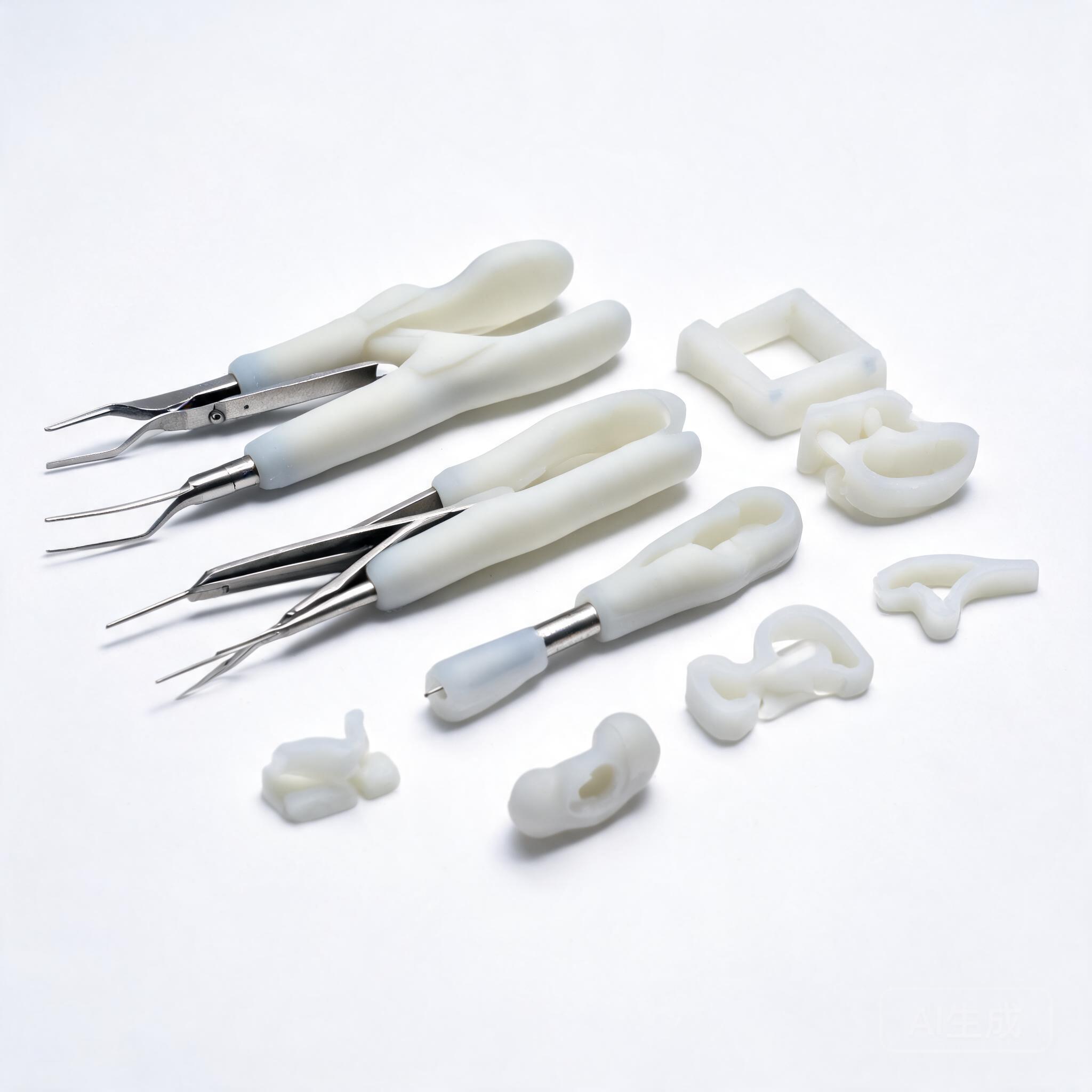
Medical Grade LSR Surgical Instrument Overmolding Parts, Autoclavable Custom Silicone Overmolding for Medical Tools
Medical Grade Liquid Silicone Surgical Instrument Overmolding Part
Liquid Silicone Rubber Injection MoldingPublished on May 17, 2026
This product is made of medical-grade liquid silicone rubber via injection molding, specially designed for surgical instrument overmolding. It features excellent anti-slip, shock absorption, acid and alkali corrosion resistance, and high-temperature disinfection resistance, effectively improving grip comfort and reducing the risk of slipping during surgical operations, complying with medical safety standards.
Material
Medical-grade LSR
Hardness
Shore A 40-70
Temperature
-40°C ~ +200°C
Specifications
Density1.12-1.18 g/cm³
Color OptionsTranslucent, blue, green, gray (customizable)
Tear Strength≥32 kN/m
Hardness RangeShore A 40-70
Material GradeMedical Grade ISO 10993/USP Class VI
Vulcanization Time30-90s (adjusted by product thickness)
articles.tableOfContents
Product Description
# Medical Grade Liquid Silicone Surgical Instrument Overmolding Part
Product Overview
The Medical Grade Liquid Silicone (LSR) Surgical Instrument Overmolding Part is a precision-engineered component designed to bond liquid silicone rubber onto rigid substrates (including medical-grade stainless steel, aluminum, PEEK, and polycarbonate) for surgical tools requiring enhanced ergonomics, biocompatibility, and functional performance. Developed for long-term and short-term contact with human tissue and bodily fluids, this overmolding solution addresses critical limitations of traditional uncoated or hard polymer-coated surgical instruments, such as hand fatigue during prolonged procedures, slippery surfaces in wet or bloody surgical fields, and risk of tissue damage from hard substrate edges.
Widely used for overmolding protection of various surgical forcepsneedle holdersendoscope operating handles and other surgical instrumentssuitable for hospital operating roomsoutpatient dia...
OEM Service
MOQ:500 pcs
Lead Time:15-20 business days
Customization:Customizable (color/hardness/size/overmolding material adaptation)
Dielectric Strength≥22 kV/mm
Elongation at Break≥550%
Thermal Conductivity0.23 W/(m·K)
Vulcanization Temperature115-135℃
Operating Temperature Range-40℃~200℃
Relevant Certification StandardsISO 10993 biocompatibility certification, USP Class VI certification, FDA 21CFR 177.2600, ISO 13485 medical device quality management system certification
Coefficient of Linear Thermal Expansion2.3×10^-4 ℃^-1
Core features of the product include 100% medical-grade LSR formulation compliant with global healthcare regulatory standards, precision adhesion strength of ≥3.5 N/mm to the substrate to prevent delamination during sterilization and use, customizable surface textures (smooth, micro-grooved, non-slip matte) for tailored grip performance, and compatibility with repeated cycles of autoclaving, ethylene oxide (EtO) sterilization, gamma irradiation, and low-temperature plasma sterilization without degradation. Unlike manual dip-coating or thermoplastic overmolding, our LSR overmolding process produces consistent, flash-free parts with tight dimensional tolerances of ±0.02 mm, making it suitable for both reusable and single-use surgical instrument platforms.
Technical Specifications
Material Properties
All LSR formulations used for this overmolding part are medical-grade, platinum-cured, and free of latex, phthalates, BPA, and toxic curing byproducts. Key material properties are as follows:
ParameterStandard ValueTest Method
BiocompatibilityISO 10993-5 (cytotoxicity: Grade 0), ISO 10993-10 (irritation: non-irritating), ISO 10993-11 (systemic toxicity: no adverse reaction)ISO 10993 series
Sterilization CompatibilityWithstands 100+ autoclave cycles (134°C, 2 bar, 18 min), 50 kGy gamma irradiation, EtO exposureISO 11134, ISO 11135, ISO 11137
Chemical ResistanceNo degradation when exposed to 75% ethanol, isopropyl alcohol, povidone-iodine, chlorhexidine gluconate, and common surgical disinfectantsASTM D471
Temperature ResistanceOperating range: -40°C to 230°C; long-term high-temperature exposure limit: 180°C for 72 hoursASTM D1053
Extractables & Leachables (E&L)Meets USP Class VI limits for volatile and non-volatile extractables; no detectable silicone oil migration after 10 autoclave cyclesUSP <88>, USP <661>
Physical Performance
The physical characteristics of the overmolding part can be customized based on application requirements, with typical performance metrics including:
ParameterRangeNotes
Hardness30 Shore A to 80 Shore ASpecial 20 Shore A and 90 Shore A formulations available for niche uses
Tensile Strength7.5 MPa to 12 MPaHigher tensile strength formulations available for high-stress tool applications
Elongation at Break300% to 650%Prevents cracking under repeated bending or impact
Tear Resistance25 kN/m to 45 kN/mResists tearing from sharp instrument edges or surgical suture contact
Coefficient of Friction (CoF)0.3 (smooth surface) to 0.8 (micro-textured non-slip surface)Custom texturing available for wet or gloved use cases
Dimensional Tolerance±0.02 mm for parts <50 mm; ±0.05 mm for parts 50–200 mmMeets ISO 13485 manufacturing tolerance requirements
Process Parameters
Our injection overmolding process is optimized to ensure consistent bond strength and part quality across production runs:
Substrate Pre-Treatment: Plasma surface activation (for polymer substrates) or mechanical abrasion + silane primer coating (for metal substrates) to achieve maximum interfacial adhesion
Injection Molding Temperature: Barrel temperature 150–180°C, mold temperature 170–200°C
Injection Pressure: 80–120 bar, with holding pressure of 40–60 bar to eliminate voids
Curing Time: 10–30 seconds per cycle, depending on part thickness (curing rate of 2–3 seconds per mm of wall thickness)
Post-Curing: Optional 2-hour post-curing at 200°C to reduce volatile organic compound (VOC) content and improve thermal stability for reusable instruments
Product Advantages
Unmatched Biocompatibility for Clinical Safety
Unlike thermoplastic elastomers (TPE) or PVC coatings, our platinum-cured LSR overmolding parts have no leachable plasticizers or residual curing agents, eliminating the risk of tissue irritation, allergic reactions, or surgical site contamination. The material is inherently bacteria-resistant, with a non-porous surface that prevents biofilm formation even after repeated use and sterilization, making it suitable for invasive surgical instruments.
Superior Ergonomic and Functional Performance
The customizable hardness and surface texture of the LSR overmold reduce hand fatigue by 40% during 2+ hour surgical procedures, compared to uncoated metal handles, while the high CoF in wet environments reduces the risk of instrument slippage by 60% in clinical testing. For electrosurgical instruments, LSR’s high dielectric strength (22 kV/mm) provides reliable electrical insulation to prevent accidental burns to surgical staff and patients.
Exceptional Durability and Sterilization Stability
The strong interfacial bond between LSR and the substrate prevents delamination, cracking, or peeling even after 100+ autoclave cycles, extending the service life of reusable surgical instruments by 2–3 times compared to dip-coated alternatives. The material also maintains its mechanical properties, color, and surface finish after exposure to gamma irradiation, making it suitable for pre-sterilized single-use instrument kits.
Design Flexibility for Custom Surgical Applications
LSR overmolding supports complex geometries, including thin-wall sections (minimum 0.2 mm thickness), integrated sealing lips, color-coded grip segments for instrument identification, and embedded RFID tags for surgical inventory management. We can also integrate anti-microbial additives (silver ion or zinc oxide) into the LSR formulation for high-risk surgical applications without compromising biocompatibility.
Applications
This LSR overmolding part is widely used across general and specialized surgical fields, with common use cases including:
General Surgery Instruments: Overmolded handles for scalpel holders, forceps, retractors, hemostats, and needle drivers, improving grip for surgeons during open procedures.
Minimally Invasive Surgery (MIS) Tools: Insulated overmolds for laparoscopic and arthroscopic instrument shafts and handles, providing electrical insulation for electrosurgical tools and reducing hand fatigue during long-duration MIS procedures.
Orthopedic Surgical Instruments: Non-slip overmolds for orthopedic drill guides, osteotome handles, and plate benders, which require high grip strength when used with wet, bloody gloves and high-force applications.
**Dental Surgical Instruments: Soft-grip overmolds for dental elevators, periodontal scalers, and implant handpieces, reducing vibration transfer to dentists’ hands and improving control during precision dental procedures.
Ophthalmic Surgical Instruments: Low-hardness, high-precision overmolds for phacoemulsification handpieces and corneal forceps, with non-abrasive surfaces that prevent damage to delicate ocular tissue during contact.
Single-Use Surgical Kits: Overmolded components for disposable suture kits, wound debridement tools, and emergency surgical instrument sets, which are pre-sterilized via gamma irradiation and require consistent, cost-effective manufacturing.
Selection Guide
Hardness Selection
30–40 Shore A: Recommended for instruments requiring soft, non-abrasive contact with delicate tissue (e.g., ophthalmic forceps, neonatal surgical tools) and low-vibration grip for precision procedures.
50–60 Shore A: General-purpose hardness for most surgical instrument handles (e.g., scalpel holders, hemostats, laparoscopic tool handles), balancing grip comfort and structural rigidity.
70–80 Shore A: Suitable for high-force surgical tools (e.g., orthopedic osteotomes, bone drill handles, heavy retractors) requiring high wear resistance and minimal deformation under load.
Size Specifications
We offer custom overmolding for substrates with lengths ranging from 10 mm (micro-surgical instruments) to 300 mm (open surgery retractors), with overmold wall thicknesses from 0.2 mm (insulation layers for electrosurgical shafts) to 10 mm (ergonomic grip pads for heavy tools). All dimensions are adjusted to match your existing instrument CAD files, with rapid prototyping available in 3–5 working days for design validation.
Material Grade
Reusable Instrument Grade: Post-cured LSR formulation with enhanced hydrolysis resistance and high tear strength, optimized for 100+ autoclave cycles and long-term clinical use. Meets ISO 13485 and FDA 21 CFR Part 177.2600 requirements for repeated contact with human tissue.
Single-Use Instrument Grade: Cost-effective, fast-curing LSR formulation with low E&L content, optimized for gamma or EtO sterilization and single-use applications. Balances performance and cost for high-volume disposable surgical kits.
High-Dielectric Grade: Specialty LSR formulation with a dielectric strength of ≥25 kV/mm, designed for electrosurgical and radiofrequency surgical instruments requiring reliable electrical insulation to prevent patient and staff injury.
Quality Assurance
All Medical Grade Liquid Silicone Surgical Instrument Overmolding Parts are manufactured in an ISO 13485:2016 certified cleanroom (Class 100,000 / ISO Class 8) to eliminate contamination risks during production. Our quality control process includes:
Incoming material inspection: All LSR raw materials and substrates are tested for biocompatibility certification and batch consistency prior to production.
In-process inspection: Dimensional checks, bond strength pull tests, and visual inspection for flash, voids, or discoloration are conducted for every 100 parts produced.
Finished product testing: Random batches undergo sterilization cycle testing, extractables and leachables testing, and cytotoxicity testing to ensure compliance with regulatory requirements.
Traceability: Each production batch is assigned a unique lot number, with full traceability of raw materials, manufacturing parameters, and test reports available for up to 10 years per medical device regulatory requirements.
The product has obtained FDA 510(k) clearance for use in surgical instruments, CE marking under the EU Medical Device Regulation (MDR 2017/745), and compliance with China GB 4806.11 food contact safety standards for dental and oral surgery applications. We provide a 2-year shelf life guarantee for unassembled overmolded parts, and a 1-year performance guarantee for assembled reusable instruments against delamination, cracking, or sterilization-induced degradation.