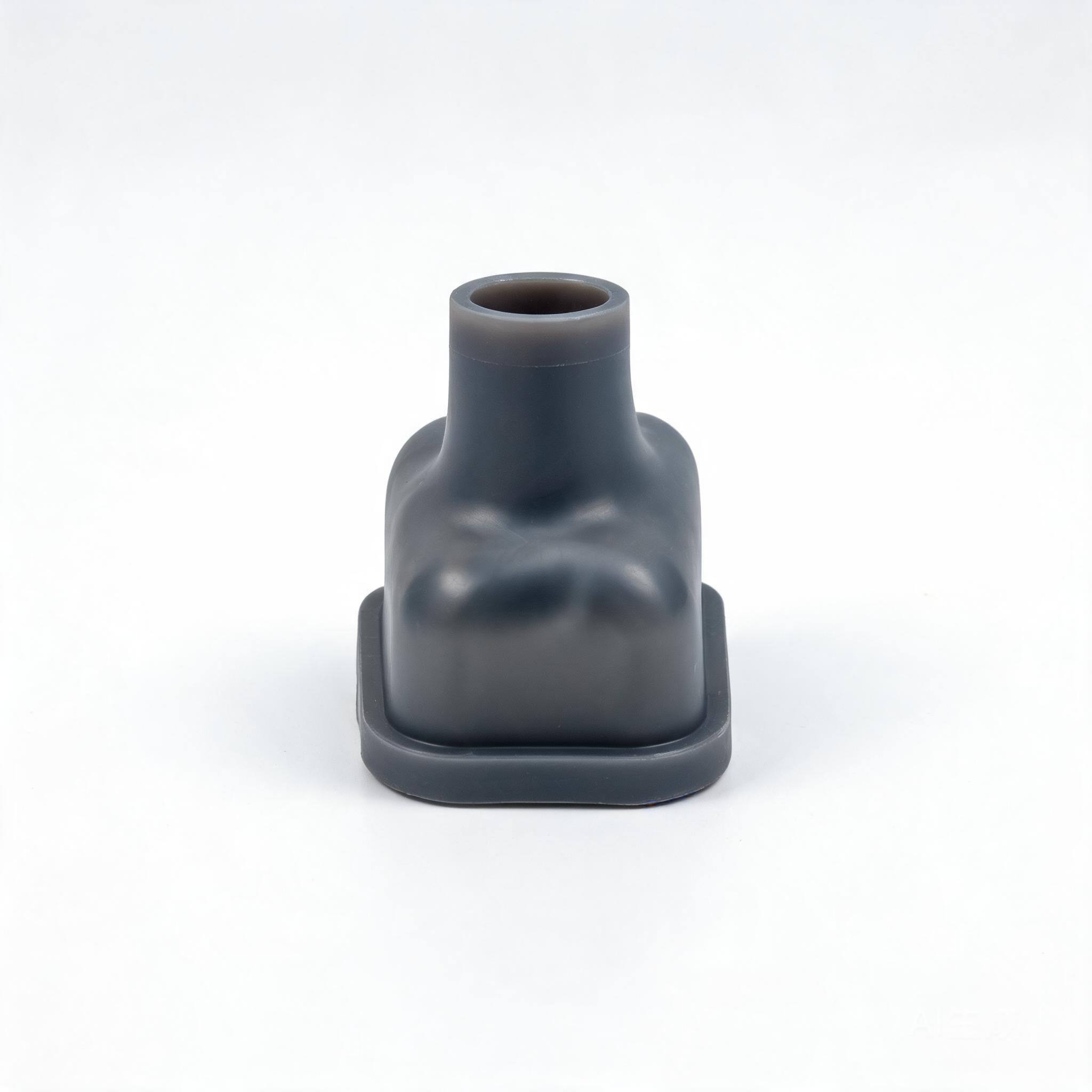
Liquid Silicone Automotive Electronics Sleeve, Insulation Protective Seal for On-board Electronics
Liquid Silicone Protective Sleeve for Automotive Electronics
Liquid Silicone Rubber Injection MoldingPublished on May 29, 2026
Liquid silicone protective sleeve specially developed for automotive electronics scenarios, with excellent insulation, high and low temperature resistance, vibration resistance and waterproof sealing performance, effectively protecting on-board electronic components from dust, moisture and oil erosion, extending equipment service life, and adapting to the installation needs of various automotive electronic control modules.
Material
Industrial LSR
Hardness
Shore A 50-70
Temperature
-40°C ~ +180°C
Specifications
Density1.12-1.18 g/cm³
Curing Time30-180 s (adjusted according to product thickness)
Color OptionsMainly black and gray, custom colors available
Tear Strength≥25 kN/m
Hardness Range40-60 Shore A
Material GradeAutomotive-grade high-purity liquid silicone rubber
Widely used for protective sealing of automotive electronic components such as on-board sensorselectronic control unit connectorson-board charging modulesand automotive wiring harness interfa...
# Liquid Silicone Protective Sleeve for Automotive Electronics
Product Overview
The Liquid Silicone Protective Sleeve for Automotive Electronics is a high-precision, application-specific sealing and protection component engineered using medical and automotive-grade liquid silicone rubber (LSR) via injection molding. Designed to address the extreme operating conditions of modern automotive electronic systems, this sleeve delivers reliable insulation, vibration damping, moisture resistance, and long-term durability for sensitive on-board electronic components.
Unlike conventional rubber or thermoplastic sleeves, this LSR product maintains consistent performance across a -60°C to 220°C operating temperature range, making it compatible with both under-hood high-heat environments and cold-climate cold-start conditions. It is custom-molded to exact component dimensions to achieve an interference fit of 0.1–0.3mm, eliminating gaps that could allow ingress of dust, automotive fluids, or moisture. Its inherent flame retardancy (UL94 V-0 rated for high-risk variants) and low volatile organic compound (VOC) emission levels meet global automotive interior and safety standards, making it suitable for both powertrain and cabin electronic applications.
Core selling points include 10x longer service life than nitrile rubber alternatives under cyclic temperature stress, customizable hardness and color for part identification and functional differentiation, and zero post-molding secondary processing requirements for precision fits. This product is developed to extend the service life of automotive electronics by 30% on average, reducing vehicle warranty claims associated with electronic component failure.
Technical Specifications
Material Properties
ParameterStandard ValueTest Method
Base MaterialHigh-purity addition-cured liquid silicone rubberISO 10993-5
Curing Time30–90s (dependent on sleeve wall thickness: 30s per 1mm wall thickness)
Post-Curing Requirement2h @ 200°C for high-temperature and medical-grade variants, optional for standard grades
Batch ConsistencyHardness variation ≤±2 Shore A, dimensional variation ≤±0.03mm across 10,000-unit production runs
Product Advantages
1. Extreme Environmental Adaptability
Engineered for the harsh automotive operating ecosystem, this LSR sleeve resists thermal shock from -60°C cold starts in arctic regions to 220°C sustained under-hood heat, with no brittleness, softening, or deformation over 10,000 temperature cycles between -40°C and 180°C. Its superior fluid resistance prevents degradation from exposure to road salt, engine coolant, hydraulic fluids, and automotive exhaust particulates, outperforming thermoplastic polyurethane (TPU) and nitrile rubber (NBR) sleeves by 8–12x in 10-year accelerated aging tests.
2. Superior Electrical and Thermal Protection
With a dielectric strength of 22kV/mm, the sleeve provides reliable insulation against voltage surges up to 2kV, preventing short circuits caused by moisture ingress or accidental contact with conductive vehicle components. For high-heat electronic control units (ECUs), the optional thermally conductive variant dissipates up to 30% more excess heat than standard LSR sleeves, reducing component operating temperatures by 5–8°C and extending semiconductor service life.
3. Precision Fit and Vibration Damping
Molded to tight ISO 3302-1 Class M1 tolerances, the sleeve achieves a consistent interference fit that eliminates rattling and seals out contaminants even under 10–2000Hz vehicle vibration loads (up to 10G acceleration). Its 500% elongation at break allows for easy assembly without tearing, while the low compression set (≤15% @ 175°C) maintains sealing pressure for the entire 15-year design life of the vehicle.
4. Compliance with Global Automotive Standards
All material variants meet EU REACH and RoHS 2.0 requirements for hazardous substance restrictions, with low-VOC formulations compliant with VDA 277 and China GB/T 27630 interior air quality standards, eliminating unpleasant odors in cabin electronics applications. The UL94 V-0 flame retardant rating ensures the sleeve self-extinguishes within 10 seconds in the event of an electrical fire, reducing vehicle fire risk.
Applications
This LSR protective sleeve is deployed across all major automotive electronic systems, with common use cases including:
Powertrain Electronics: Sealing and insulation for ECU connectors, engine sensor wiring harnesses, transmission control unit (TCU) terminals, and battery management system (BMS) sampling lines in internal combustion engine (ICE), hybrid, and battery electric vehicles (BEVs). The high-temperature variant is suitable for proximity to exhaust manifolds and turbocharger systems.
Advanced Driver Assistance Systems (ADAS): Protection for millimeter-wave radar sensor connectors, camera module wiring, and LiDAR signal transmission lines. Its UV resistance and low thermal expansion prevent signal interference from component misalignment, ensuring ADAS sensor accuracy across extreme temperature fluctuations.
Cabin Electronics: Insulation for infotainment system wiring, steering wheel control module connectors, and seat heating/cooling control units. The low-VOC formulation meets interior air quality requirements, while customizable colored sleeves support automated assembly line part identification.
New Energy Vehicle (NEV) High-Voltage Systems: Sealing for high-voltage cable connectors, on-board charger (OBC) terminals, and power distribution unit (PDU) interfaces. The 22kV/mm dielectric strength provides additional protection against high-voltage arcing, while the UL94 V-0 rating mitigates fire risk in thermal runaway events.
Application Note: For under-hood applications with sustained temperatures above 180°C, select the 60–70 Shore A high-temperature cured variant with post-curing processing to minimize compression set over time. For NEV BMS applications requiring heat dissipation, specify the thermally conductive 1.2W/(m·K) material grade.
Selection Guide
Hardness Selection
30–40 Shore A: Recommended for irregularly shaped connectors and applications requiring frequent disassembly for maintenance. Its high flexibility conforms to complex geometries and reduces assembly force by 40% compared to harder variants.
45–55 Shore A: The standard general-purpose grade, suitable for 80% of automotive electronic applications, balancing sealing performance, vibration damping, and durability.
60–70 Shore A: Ideal for high-vibration under-hood components, high-voltage connectors, and applications requiring high crush resistance. Its higher structural rigidity prevents sleeve displacement under continuous mechanical stress.
Size Specifications
Standard sleeve sizes are available for common automotive connector series (including TE Connectivity AMP, Molex MX150, and Yazaki 7282 series), with inner diameters ranging from 2mm to 50mm and wall thicknesses from 0.5mm to 5mm. Custom sizes are available upon submission of component 2D drawings or 3D STEP files, with a 7-day lead time for prototype tooling and sample production.
Material Grade
GradeApplication ScenarioKey Certifications
Standard Industrial GradeNon-critical under-hood and cabin componentsRoHS 2.0, REACH
Low-VOC Interior GradeCabin electronics, in-vehicle infotainment, and driver control modulesRoHS 2.0, REACH, VDA 277, GB/T 27630
Our Liquid Silicone Protective Sleeve for Automotive Electronics is manufactured in IATF 16949 certified facilities, with a multi-stage quality control process to ensure consistency and reliability:
Incoming Material Inspection: Each batch of LSR raw material is tested for silicone content, hardness, and impurity levels, with traceability codes linked to supplier batch records for full supply chain visibility.
In-Process Quality Control (IPQC): Dimensional checks are performed every 30 minutes during production, with real-time monitoring of mold temperature, injection pressure, and curing time to eliminate process variations. 100% of parts are visually inspected for flash, bubbles, and molding defects.
Finished Product Testing: Each production lot undergoes performance validation, including tensile strength testing, compression set testing, fluid resistance immersion testing, and dielectric strength verification. For custom parts, fit testing is conducted with customer-provided connector samples to ensure compatibility.
Certification Support: All products come with batch-specific test reports, and we provide full PPAP (Production Part Approval Process) documentation, including DFMEA, PFMEA, and control plans, for automotive OEM qualification requirements.
We offer a 5-year performance warranty for all standard grade sleeves, guaranteeing no cracking, sealing failure, or performance degradation under normal operating conditions, with custom warranty terms available for high-volume OEM partners.