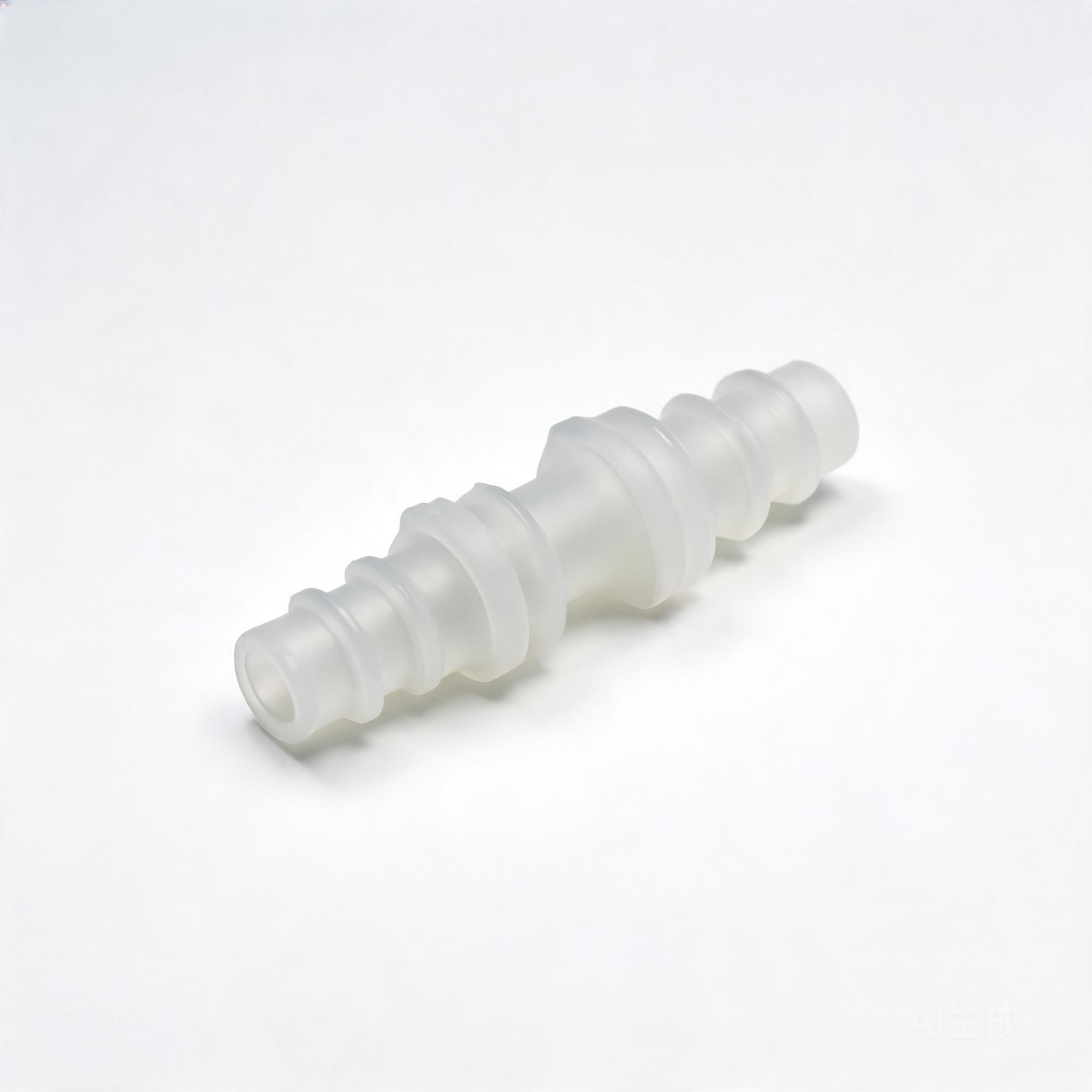
LSR High Voltage Insulating Connector, Arc Resistant Industrial Power Fitting
Industrial Liquid Silicone High Voltage Insulating Connector for Power Systems
Liquid Silicone Rubber Injection MoldingPublished on May 17, 2026
Made of high-purity industrial LSR through injection molding, it has excellent high-voltage insulation, arc resistance, weather resistance and aging resistance, with stable sealing performance. It can be used for a long time in complex power environments, effectively avoiding safety hazards such as high-voltage leakage and tracking, and adapts to the connection needs of various high-voltage power equipment.
Material
Industrial LSR
Hardness
Shore A 60-80
Temperature
-50°C ~ +180°C
Specifications
Density1.18±0.03 g/cm³
Curing Time30~60 s (adjusted by product thickness)
Color OptionsRed, Black, Gray (customizable)
Tear Strength≥25 kN/m
Arc Resistance≥180 s
Hardness Range60±5 Shore A
Material GradeIndustrial grade LSR for power insulation
# Industrial Liquid Silicone High Voltage Insulating Connector for Power Systems
Product Overview
Related Tags
liquid silicone high voltage insulating connectorLSR insulating connectorhigh voltage power sealarc resistant silicone fittingindustrial silicone insulating part
Colors
Black, White, Transparent, Customizable
Certifications
ISO 9001RoHSUL94 V-0 etc.
Applications
Widely used in high-voltage power transmission and distribution equipmentnew energy power generation devicesindustrial power control systems and other scenariosas an insulating and sealing co...
The Industrial Liquid Silicone High Voltage Insulating Connector is a critical passive component engineered to provide reliable electrical insulation, environmental sealing, and mechanical support for power cable junctions in medium-to-high voltage (MV/HV) power transmission and distribution systems. Manufactured via precision injection molding of medical and industrial-grade liquid silicone rubber (LSR), this connector addresses the long-standing pain points of traditional EPDM or ceramic insulating connectors, including poor low-temperature flexibility, short service life in harsh outdoor environments, and complicated on-site installation procedures.
At its core, the product integrates a one-piece LSR insulating body, embedded tin-plated copper conductive terminals, and a reinforced locking structure, delivering a combination of 10kV~35kV dielectric withstand strength, IP68 ingress protection, and compatibility with 10mm²~240mm² power cables. It is designed to eliminate partial discharge at cable connection points, reduce line loss caused by poor contact, and extend the maintenance interval of power grid nodes to over 30 years. Key selling points include suitability for extreme temperature ranges, resistance to UV and chemical corrosion, and compliance with global power industry safety standards, making it ideal for both overhead line junctions and underground power network connections.
Technical Specifications
Material Properties
The connector’s primary insulating layer is made of high-purity addition-cured liquid silicone rubber with a customized high-voltage insulation formula, with material properties meeting the requirements of IEC 60486 for insulating elastomers:
ParameterStandard ValueTest Method
LSR Base Material Purity≥99.5% (volatile content ≤0.1%)IEC 60335-1
Dielectric Constant (50Hz)2.8~3.2GB/T 1409
Volume Resistivity≥1×10¹⁶ Ω·cmGB/T 1410
Dielectric Loss Tangent (50Hz)≤0.002GB/T 1409
Tracking Resistance (CTI)≥600VIEC 60112
Flammability RatingUL 94 V-0UL 94
Thermal Conductivity0.35 W/(m·K)ASTM E1461
Resistance to Sulfur Dioxide, Ozone, and Salt SprayNo cracking or performance degradation after 1000h agingGB/T 12000
Embedded conductive terminals are made of T2 oxygen-free copper with a 5μm~8μm tin plating layer, with a conductivity of ≥98% IACS to minimize contact resistance at the connection point. The optional reinforcing shell is made of glass fiber reinforced PA66, with a UV stabilizer content of 2.5% to improve long-term outdoor weather resistance.
Physical Performance
The finished connector meets the following physical performance indicators to adapt to complex installation and operating conditions:
ParameterStandard ValueTest Method
Rated Voltage10kV, 20kV, 35kV (customizable up to 110kV for special scenarios)IEC 60502-2
Rated Current125A, 250A, 400A, 630AGB/T 12706.4
Operating Temperature Range-60°C ~ +180°CIEC 60811-1-2
Partial Discharge Inception Voltage≥1.5× rated voltage (partial discharge <10pC at rated voltage)IEC 60270
Impulse Withstand Voltage (1.2/50μs)75kV (10kV), 125kV (20kV), 170kV (35kV)GB/T 16927.1
IP Protection RatingIP68 (10m water depth, 72h immersion without water ingress)IEC 60529
Tensile Strength of LSR Insulating Layer≥8.5 MPaGB/T 528
Elongation at Break≥500%GB/T 528
Tear Strength≥35 kN/mGB/T 529
Mechanical Shock ResistanceNo structural damage after 10 impacts of 10J energyIEC 60068-2-27
Vibration ResistanceNo loosening or performance degradation after 10~2000Hz, 5g vibration testIEC 60068-2-6
Process Parameters
The LSR injection molding process for the connector is strictly controlled to ensure consistency of insulating layer density and bonding strength with embedded terminals:
Process ParameterControl Range
LSR Mixing Ratio (A/B Component)1:1 ±0.5%
Injection Temperature120°C ~ 140°C
Curing Time30s ~ 60s (adjusted according to product wall thickness)
Mold Clamping Force≥1200kN
Bonding Strength Between LSR and Copper Terminal≥5 N/mm (no delamination after 100 thermal shock cycles)
Dimensional Tolerance of Insulating Layer±0.05mm (for sealing surface)
Product Advantages
Superior Extreme Environment Adaptability
Unlike traditional EPDM insulating connectors that become brittle and crack at temperatures below -40°C, or ceramic connectors that are prone to fracture under mechanical shock, this LSR connector maintains stable flexibility and insulation performance in a temperature range of -60°C to 180°C, and can adapt to harsh scenarios such as alpine regions, desert areas, and coastal salt spray environments. After 5000 hours of UV accelerated aging test, the tensile strength retention rate of the LSR insulating layer is ≥90%, and the dielectric performance remains unchanged, far exceeding the 2000-hour aging requirement of EPDM products.
Ultra-Low Partial Discharge Risk
The one-piece injection molding process eliminates internal gaps and interface defects that are common in assembled insulating connectors, and the high-purity LSR formula reduces the content of conductive impurities in the material. The partial discharge of the connector at rated voltage is controlled below 10pC, which is far lower than the industry standard requirement of 50pC, effectively avoiding insulation breakdown and line failure caused by long-term partial discharge erosion, and reducing the operation risk of power grid nodes.
Fast Installation and Maintenance-Free Design
The connector adopts a push-in locking structure, which can complete the cable connection without special tools, and the installation time is only 1/3 of that of traditional heat-shrinkable or cold-shrinkable insulating connectors. The LSR insulating layer has inherent self-adhesion and elastic recovery performance, which can automatically compensate for the size change of the cable caused by thermal expansion and cold contraction, maintaining stable sealing pressure and contact pressure for a long time, and there is no need to re-tighten the connector during the 30-year service life.
Environmental Friendly and Recyclable
Compared with cross-linked EPDM materials that cannot be recycled, the LSR material used in the connector is a thermoset elastomer that can be crushed and reused as a filler for industrial rubber products after the end of its service life, reducing the environmental burden of power grid construction waste. The product does not contain heavy metals, halogens or other toxic substances, and meets the requirements of EU RoHS 2.0 and REACH regulations, suitable for power grid projects with green certification requirements.
Applications
The LSR high-voltage insulating connector is widely used in the following power system scenarios:
Overhead Power Distribution Networks: Used for T-connection of 10kV~35kV overhead insulated cables, branch connection of line conductors, and connection between overhead lines and down conductors, replacing traditional porcelain insulators and bolted connection fittings to reduce line fault rates in thunderstorm and ice disaster weather.
**Underground Power Cable Systems: Suitable for intermediate connection of buried power cables, connection between cables and ring main units, and junction sealing of cable distribution boxes, with IP68 protection level to prevent water ingress and insulation failure in underground humid or waterlogged environments.
New Energy Power Generation Systems: Used for cable connection in photovoltaic power station converters, wind turbine tower internal wiring, and energy storage system DC power distribution links, with excellent resistance to high and low temperature cycles and ozone corrosion, adapting to the long-term variable load operation characteristics of new energy systems.
**Rail Transit Power Supply Systems: Used for connection of 1500V DC and 27.5kV AC catenary power supply cables in urban rail transit and high-speed railway systems, with low temperature resistance and shock resistance to meet the operating requirements of rail transit lines in cold regions.
**Industrial High-Voltage Distribution: Suitable for internal high-voltage cable connection of steel plants, petrochemical plants, and mining enterprises, with resistance to chemical corrosion and dust, avoiding insulation failure caused by corrosive gases and dust in industrial environments.
Selection Guide
Hardness Selection
Shore A 40~45: Recommended for scenarios with frequent cable bending and dynamic load changes, such as wind turbine internal connections and mobile power supply systems, with higher flexibility to reduce stress at the cable outlet.
Shore A 50~55: Universal hardness, suitable for most overhead line and underground cable connection scenarios, balancing flexibility and mechanical support performance.
Shore A 60~65: Recommended for high-current scenarios above 400A and fixed installation scenarios with high mechanical strength requirements, such as main line connections of industrial power distribution systems, with higher structural rigidity to avoid deformation under long-term high-temperature operation.
Size Specifications
Select the connector specification according to the cross-sectional area of the connected cable and the rated voltage of the line:
Rated VoltageApplicable Cable Cross-SectionRated Current RangeConnector Outer Diameter
10kV10mm² ~ 95mm²125A ~ 250Aφ35mm ~ φ50mm
10kV120mm² ~ 240mm²250A ~ 400Aφ55mm ~ φ70mm
20kV25mm² ~ 120mm²125A ~ 400Aφ60mm ~ φ80mm
35kV35mm² ~ 240mm²250A ~ 630Aφ75mm ~ φ100mm
For special cable sizes and non-standard connection structures, customized design services are provided, with a minimum order quantity of 50 pieces for customized products.
Material Grade
Industrial Grade: Meets the basic requirements of GB/T 12706.4 and IEC 60502-2, suitable for conventional power distribution network and general industrial application scenarios, with a cost performance ratio 20% higher than similar imported products.
Grid Special Grade: Passes the type test of China Southern Power Grid and State Grid Corporation of China, with additional partial discharge cycle test and 1000-time thermal cycle test, suitable for provincial and national key power grid construction projects.
New Energy Special Grade: With added anti-ultraviolet and anti-ozone formula, passing 1000-hour damp heat cycle test, suitable for photovoltaic, wind power and other new energy power generation systems installed in outdoor harsh environments.
Quality Assurance
All LSR high-voltage insulating connectors are produced in strict accordance with the ISO 9001:2015 quality management system, and each production batch undergoes the following inspection procedures before delivery:
Raw Material Inspection: Every batch of LSR raw materials is tested for dielectric performance and impurity content, and unqualified raw materials are not allowed to enter the production line.
In-Process Inspection: 100% dimensional inspection of the injection molded semi-finished products, and 10% random inspection of the bonding strength between the LSR insulating layer and the copper terminal.
Finished Product Test: 100% of the finished products undergo power frequency withstand voltage test (42kV for 1 minute for 10kV products, 95kV for 1 minute for 35kV products) and contact resistance test (contact resistance ≤1.1× the resistance of the same length of cable), and products that fail the test are scrapped uniformly.
Type Test: The product has passed the type test of the National Electric Power Equipment Quality Inspection and Testing Center, including 1000 thermal cycle tests, short-circuit current withstand test, and wet power frequency withstand voltage test.
The product has obtained the following certifications: IEC 60502-2 compliance certification, GB/T 12706.4 national standard certification, UL 94 V-0 flammability certification, and EU RoHS 2.0 environmental protection certification. We provide a 3-year free warranty for all standard products, and a 30-year performance warranty for products used in power grid projects. If product quality problems occur during the warranty period, we provide free replacement and on-site troubleshooting services.