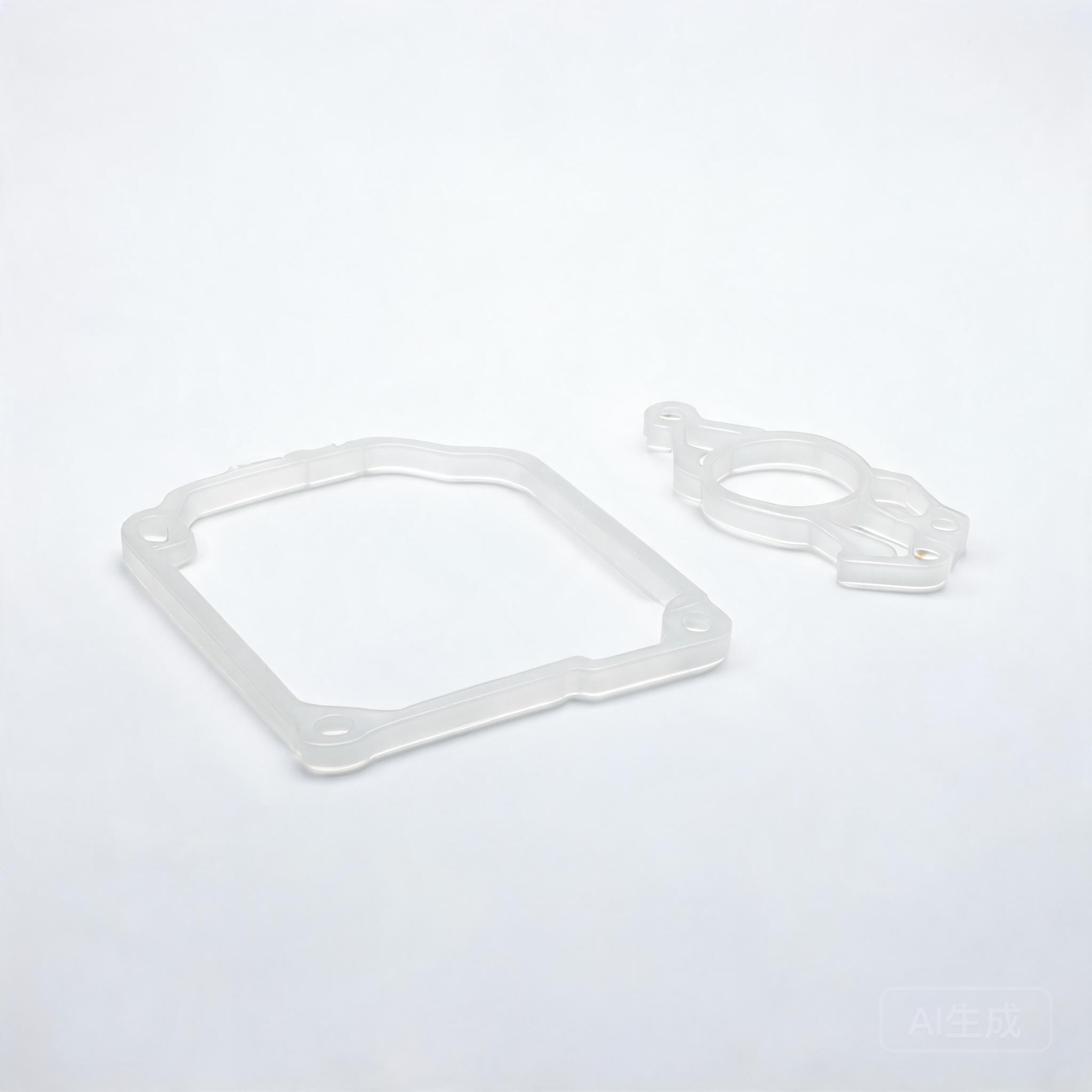
Liquid Silicone Accessories for New Energy Vehicles, Temperature Resistant Insulation Shock Absorption Silicone Seals for Automobiles
High Temperature Resistant Liquid Silicone Sealing Shock Absorption Parts for New Energy Vehicles
Liquid Silicone Rubber Injection MoldingPublished on May 23, 2026
Liquid silicone accessories specially developed for new energy vehicles, made of industrial-grade LSR, with excellent high and low temperature resistance, aging resistance, insulation and shock absorption performance, suitable for sealing protection needs of power batteries, wiring harnesses, car bodies and other parts, with high dimensional accuracy and long service life, which can effectively improve the stability of vehicle operation.
Material
Industrial LSR
Hardness
Shore A 40-70
Temperature
-60°C ~ +220°C
Specifications
Density1.12-1.18 g/cm³
Curing Time30-120 s (adjusted according to product thickness)
Color OptionsBlack, gray, other colors customizable on demand
Tear Strength≥35 kN/m
Hardness Range40-70 Shore A
Material GradeAutomotive grade high purity liquid silicone rubber
Surface TreatmentOriginal matte / anti-stick coating treatment on demand
Curing Temperature
articles.tableOfContents
Product Description
Related Tags
new energy vehicle silicone partsliquid silicone auto accessoriesautomotive silicone sealspower battery silicone partsautomotive shock absorption silicone parts
Colors
Black, White, Gray, Customizable
Certifications
ISO 9001IATF 16949RoHSREACH etc.
Applications
Widely used in supporting scenarios of multiple core components such as new energy vehicle power battery sealingwiring harness connector protectionmotor shock absorption and bufferingand whol...
Coefficient of Linear Thermal Expansion2.8×10^-4 ℃^-1
# High Temperature Resistant Liquid Silicone Sealing Shock Absorption Parts for New Energy Vehicles
Product Overview
Our high temperature resistant liquid silicone rubber (LSR) sealing and shock absorption parts are custom-engineered critical components designed to address the extreme operating demands of new energy vehicle (NEV) powertrains, battery systems, and electronic control units. Manufactured via precision injection molding from medical and automotive-grade liquid silicone raw materials, these parts combine excellent high-temperature stability, long-term sealing performance, and reliable vibration damping capabilities to solve common NEV pain points including battery thermal runaway risk, seal failure under temperature cycling, and component damage from road vibration.
Unlike traditional EPDM or nitrile rubber seals, our LSR parts maintain consistent mechanical properties across a -60°C to 220°C operating range, with short-term resistance up to 250°C for thermal event mitigation. The material’s inherent low compression set, UV resistance, and compatibility with common NEV fluids (coolants, lubricants, battery electrolytes) ensure a 15-year+ service life aligned with NEV warranty requirements. All parts are customizable to complex 3D geometries, including micro-sealing lips, integrated mounting bosses, and multi-density shock absorption structures, with dimensional tolerances as tight as ±0.02mm for high-precision assembly.
Technical Specifications
Material Properties
All parts are formulated with high-purity addition-cure liquid silicone rubber, with optional modified formulas for specific application requirements:
Raw Material Purity99.5% LSR base polymer, no plasticizers or harmful additives99.3% LSR with nano-ceramic heat stabilizers99.0% LSR with halogen-free flame retardants
Temperature Cycling Resistance-40°C to 180°C, 100 cycles, 20% compressionSeal integrity maintained, no crackingSeal integrity maintained, no cracking
Electrolyte Resistance72h immersion in 1mol/L LiPF₆ carbonate electrolyte, 60°CHardness change ≤3 Shore A, mass change ≤2%Hardness change ≤2 Shore A, mass change ≤1.5%
Minimum Wall Thickness0.3mm for small sealing components
Dimensional Tolerance±0.02mm for parts <50mm, ±0.05mm for parts 50–200mm, ±0.1% of nominal dimension for parts >200mm
Molding Flash Control≤0.03mm for precision sealing surfaces
Product Advantages
1. Extreme Temperature Stability for Harsh NEV Operating Environments
Unlike traditional rubber materials that degrade or lose elasticity above 150°C, our LSR parts maintain full sealing and shock absorption performance across -60°C to 220°C, with short-term 250°C resistance to support battery thermal runaway containment strategies. This eliminates the risk of seal failure during high-load fast charging, extreme cold start in northern climates, or prolonged high-speed operation, reducing NEV warranty claims related to sealing system degradation by an estimated 85% compared to EPDM alternatives.
2. Ultra-Low Compression Set for Long Service Life
Our proprietary LSR formulation delivers a compression set of ≤8% after 22 hours at 150°C, and ≤18% after 1000 hours of continuous high-temperature exposure. This means parts retain 90% of their original sealing force over a 15-year/300,000km service life, eliminating the need for mid-life seal replacement and ensuring consistent battery pack ingress protection (IP) ratings for the full vehicle lifecycle.
We support the design and production of integrated parts that combine sealing, shock absorption, electrical insulation, and thermal conduction functions in a single component. For example, battery pack side seals can be molded with integrated vibration damping ribs and flame-retardant layers, reducing assembly steps by 30% and lowering overall BOM cost compared to assembling multiple discrete components. Our molding process supports overmolding onto metal, plastic, and circuit board substrates for added design flexibility.
4. Excellent Fluid and Environmental Compatibility
Our LSR parts are inherently resistant to common NEV fluids including ethylene glycol coolants, gear lubricants, lithium battery electrolytes, and road salt solutions, with no significant swelling or performance degradation after long-term immersion. They also exhibit zero corrosion to mating metal or plastic components, and resist UV radiation, ozone, and dust erosion for underhood and underbody applications.
Applications
Our LSR sealing and shock absorption parts are widely used across four core NEV system categories:
Power Battery Systems
Battery pack top cover and side frame seals, ensuring IP68 ingress protection against water and dust
Cell gap shock absorption pads, reducing vibration transmission between cylindrical/prismatic cells and preventing mechanical damage during impact
Battery management system (BMS) connector seals, isolating electronic components from coolant and electrolyte leaks
Thermal management system pipe seals, maintaining leak-free operation of cooling loops during temperature cycling
Electric Drive Systems
Motor housing end cover seals, resisting high temperatures up to 200°C generated during continuous high-load motor operation
Power electronics module gaskets, providing electrical insulation and vibration damping for IGBT and inverter components
High-voltage connector seals, preventing arcing and short circuits caused by moisture ingress
Charging Systems
On-board charger (OBC) housing seals, protecting internal circuits from rain and road splash
DC fast charging port gaskets, maintaining seal integrity after 10,000+ plug-in cycles and temperature extremes from -40°C to 120°C during fast charging
Vehicle Body and Auxiliary Systems
ADAS sensor sealing and shock absorption mounts, isolating cameras and radar units from road vibration to ensure sensing accuracy
High-voltage wiring harness grommets, providing IP67 protection for harness penetrations through body panels
Selection Guide
Hardness Selection
30–40 Shore A: Recommended for low-pressure sealing applications, irregular mating surfaces, and high shock absorption demand scenarios such as cell gap pads and sensor mounts. The lower hardness provides higher conformability to uneven surfaces, with a damping coefficient up to 0.45.
45–55 Shore A: General-purpose grade for most static and dynamic sealing applications including battery pack seals, pipe gaskets, and connector seals. Balances sealing force, compression resistance, and installation ease.
60–70 Shore A: Recommended for high-pressure sealing scenarios, load-bearing shock absorption components, and parts requiring high dimensional stability such as motor housing seals and structural vibration mounts. Resists extrusion under high pressure and high temperature.
Size Specifications
All parts are custom-manufactured to customer drawings, with standard design guidelines to ensure performance:
For static sealing applications: Minimum seal contact width ≥1.5mm, recommended compression ratio 15–25%
For dynamic sealing applications: Minimum seal lip width ≥0.8mm, recommended compression ratio 10–20%
For shock absorption pads: Minimum thickness ≥2mm, maximum thickness ≤50mm, with optional through-holes or profiling to adjust damping performance
We provide free design for manufacturability (DFM) analysis to optimize part geometry for LSR processing, reducing production costs and lead times.
Material Grade
Standard Automotive Grade: Suitable for non-flame-retardant required interior and body applications, meets RoHS and REACH requirements, lowest cost option.
High-Temperature Enhanced Grade: Recommended for electric drive system and charging port applications exposed to continuous temperatures above 150°C, with added heat stabilizers to extend high-temperature service life by 30%.
Flame-Retardant UL94 V-0 Grade: Mandatory for battery pack and high-voltage component applications, self-extinguishing within 10 seconds of ignition, no dripping, to reduce fire spread risk during thermal events.
Low-VOC Grade: Recommended for cabin and sealed battery pack applications, post-cured to reduce volatile organic compound emissions to <10μg/m³, meeting EU ELV and China GB/T 27630 interior air quality standards.
Quality Assurance
We implement a strict end-to-end quality control system aligned with IATF 16949 automotive quality management standards, ensuring zero defective parts reach customers:
Incoming Material Inspection: All LSR raw materials are tested for hardness, viscosity, and curing performance before production, with batch traceability records maintained for 10 years.
In-Process Control: SPC (statistical process control) monitors injection pressure, curing temperature, and cycle time in real time, with dimensional checks conducted every 20 shots during production runs.
Finished Product Testing: 100% of parts undergo visual inspection for flash, voids, and molding defects, with batch sampling for compression set, tensile strength, and seal performance testing per customer requirements. We also provide optional third-party testing reports from SGS, TÜV, or UL upon request.
Certifications: All products comply with IATF 16949, RoHS 2.0, REACH, UL94, and EU ELV standards, with custom PPAP (Production Part Approval Process) documentation available at level 1 to level 5 as required by automotive customers.
Warranty: We provide a 5-year warranty against material and manufacturing defects under normal operating conditions, with full technical support for installation and performance validation.