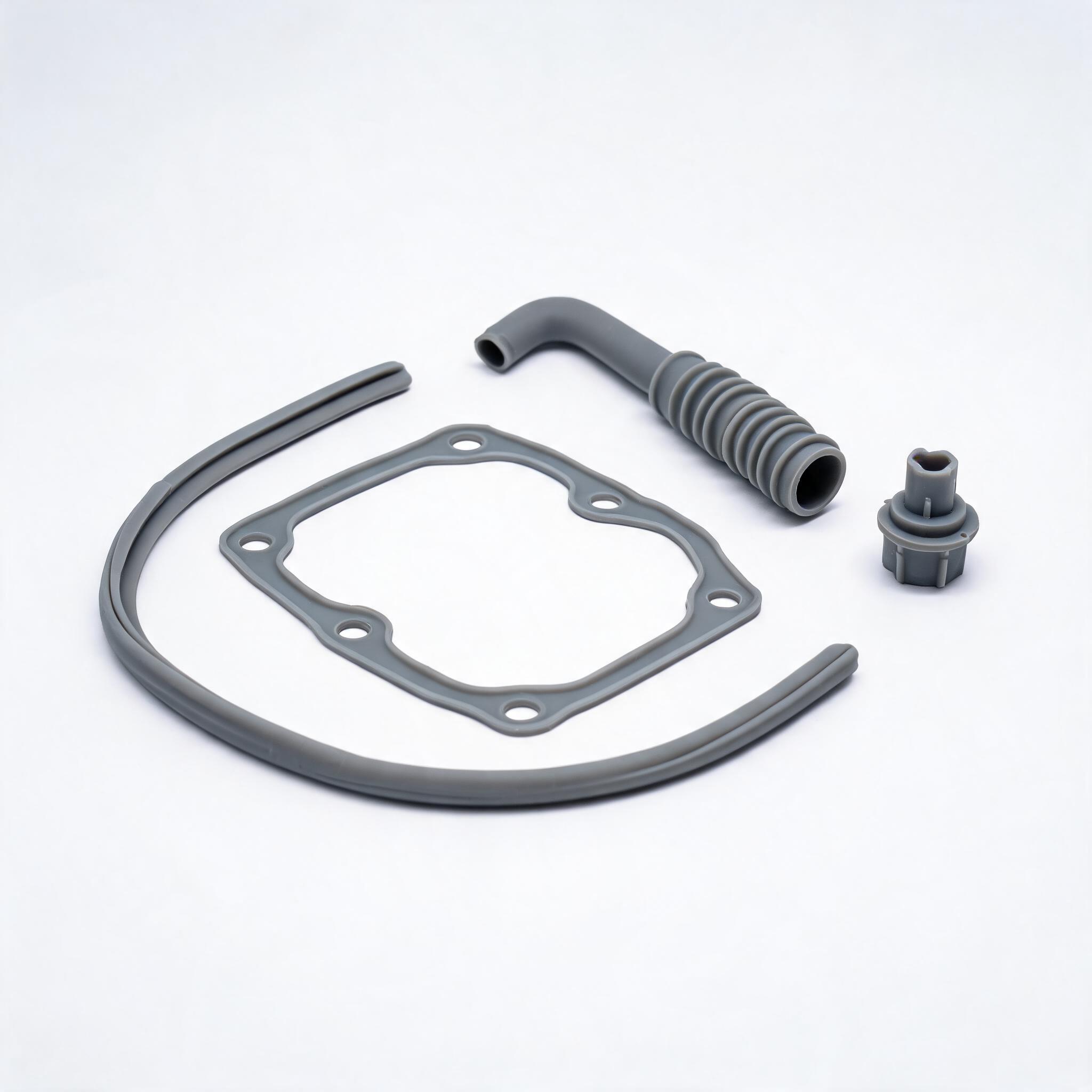
Injection molded with high-purity liquid silicone rubber, our automotive LSR components feature excellent high and low temperature resistance, aging resistance and sealing performance. Suitable for new energy automotive power systems, with strong stability and long service life, meeting strict automotive industry standards.
Material
Industrial LSR
Hardness
Shore A 30-70
Temperature
-40°C ~ +200°C
Colors
Black, Gray, Customizable
Certifications
Applications
# Automotive Liquid Silicone Rubber Components
Automotive Liquid Silicone Rubber (LSR) Components are precision-molded custom parts manufactured from high-purity two-part platinum-cured liquid silicone rubber, engineered to meet the stringent performance, safety, and durability requirements of the global automotive industry. Unlike traditional solid silicone rubber parts, our LSR components are produced through precision injection molding, enabling complex geometries, tight dimensional tolerances, and consistent mass production for original equipment manufacturer (OEM) and aftermarket automotive applications.
These components retain exceptional mechanical and chemical stability across extreme temperature fluctuations, resist degradation from automotive fluids, and maintain long-term elasticity under dynamic cyclic loading. Designed to address common pain points of automotive rubber parts—including premature aging, sealing failure, and performance degradation in harsh under-hood or cabin environments—our LSR components deliver 2–3 times longer service life compared to conventional organic rubber alternatives. We support full custom design and manufacturing, from low-volume prototype testing to high-volume mass production, with flexible material formulation adjustments to meet specific application requirements.
Our automotive LSR components are produced from FDA-compliant, platinum-cured liquid silicone rubber with the following base material characteristics:
Finished LSR components meet the following performance specifications for automotive use:
Our standard injection molding process delivers consistent finished components with the following attributes:
Unlike nitrile rubber (NBR) or ethylene propylene diene monomer (EPDM), our platinum-cured LSR components resist thermal oxidative degradation, ozone cracking, and UV exposure, eliminating hardening, cracking, or brittleness after 10+ years of service. The low compression set ensures consistent sealing performance for the full lifespan of the vehicle, reducing warranty claims and maintenance costs for manufacturers and end users.
All our LSR components meet strict global automotive interior emission standards including VDA 270, VDA 278, and REACH SVHC requirements, with extremely low fogging and volatile organic compound (VOC) emissions. This eliminates windshield fogging in cold weather and prevents unpleasant odors in the cabin, improving passenger comfort and meeting global regulatory requirements for vehicle interior air quality.
Liquid silicone injection molding enables the production of intricate component designs with undercuts, micro-channels, thin walls, and integrated features that are not feasible with solid silicone compression molding. This design flexibility allows automotive engineers to optimize component function, reduce assembly part count, and lower overall system weight for improved fuel efficiency.
Our LSR components resist degradation from common automotive fluids including motor oil, transmission fluid, coolant, brake fluid, gasoline, and windshield washer fluid. They also resist road salt, acid rain, and other environmental contaminants, making them ideal for under-chassis, under-hood, and exterior automotive applications.
Our closed-loop injection molding process with automated material mixing and dosing delivers exceptional part-to-part consistency, with a defect rate below 0.1% for high-volume production runs. This reduces assembly line downtime and ensures uniform performance across all production batches.
Our automotive LSR components are used across a wide range of vehicle systems:
For electric vehicle applications, our LSR components provide additional value as high-voltage insulation with excellent thermal stability, supporting the thermal management and safety requirements of next-generation EV battery systems.
Choose the appropriate LSR hardness based on your application requirements:
We offer fully custom component manufacturing based on your 2D drawings or 3D CAD models. Standard mold sizes accommodate components up to 400 × 400 mm, and multi-cavity molds are available for high-volume production to reduce per-part cost. For low-volume prototype testing, we offer rapid prototyping with 3D printed LSR or soft tooling, with lead times as short as 3 working days.
Select the appropriate material grade based on your application and regulatory requirements:
All our automotive LSR components are manufactured in compliance with IATF 16949:2016 quality management system standards, the global benchmark for automotive OEM production. We maintain full traceability of raw materials from incoming inspection through finished component shipping, with 100% dimensional and visual inspection for critical components and statistical process control (SPC) for high-volume production runs.
Our products hold the following international certifications:
We provide full material test reports (MTR), dimensional inspection reports, and certification documentation with every order to support OEM qualification and regulatory compliance. Our in-house testing laboratory performs routine performance testing including thermal cycling, compression set, fluid resistance, and fogging testing to ensure consistent product quality that meets or exceeds customer specifications.