
橡楚编辑部 5/29/2026 42 min read
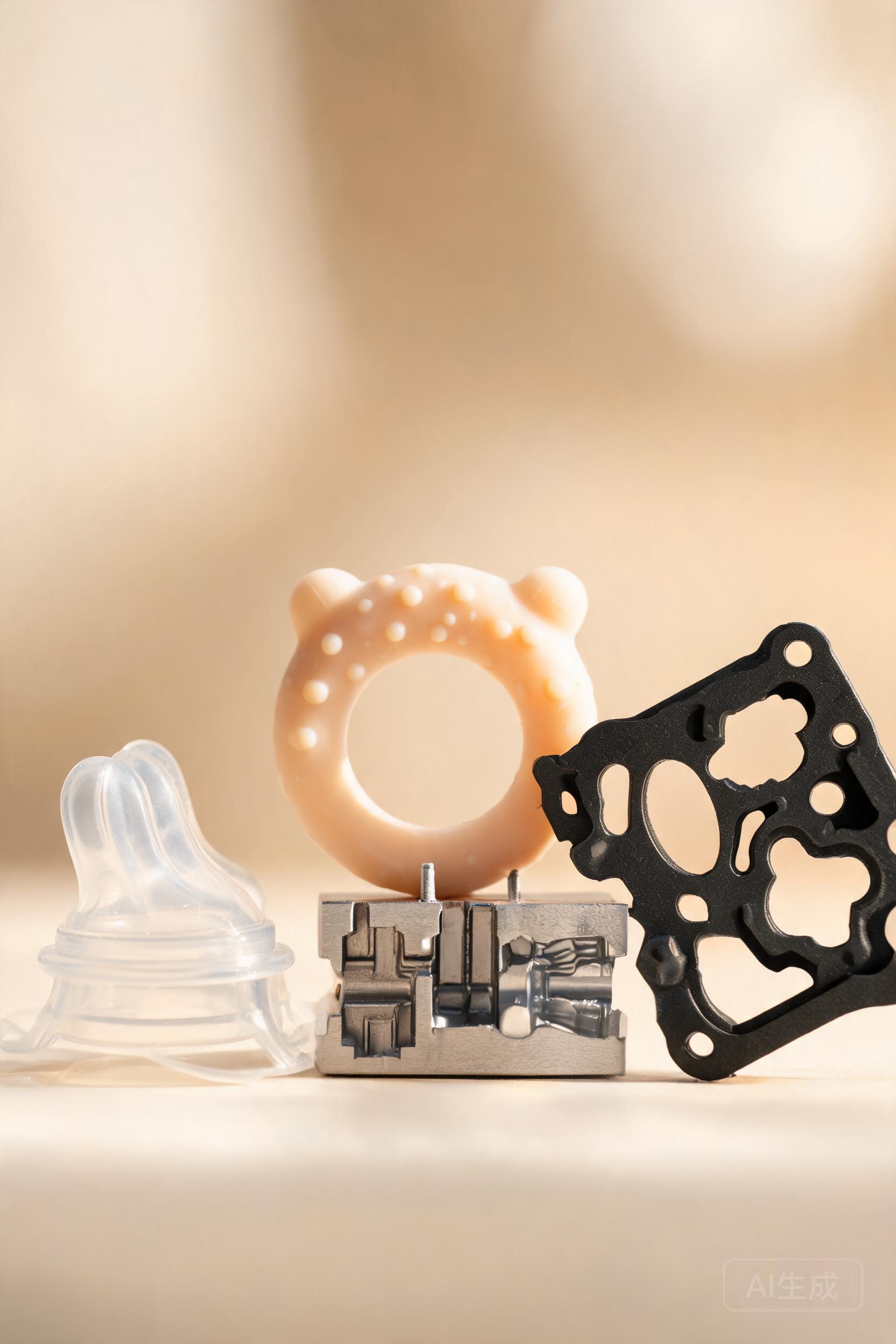
As a professional rubber and plastic product manufacturing factory in Hubei, Xiangchu can complete the R&D and production of rubber parts, seals, plastic parts and supporting molds in one stop, covering the needs of multiple industries. The whole chain from mold development to finished product delivery is independent and controllable, helping customers reduce costs, improve efficiency and shorten delivery cycles.
Global manufacturing supply chains continue to prioritize consolidation and vertical integration to reduce lead times, mitigate quality variation risks, and cut cross-supplier coordination costs. For industries ranging from automotive to medical devices, sourcing custom molded components—including liquid silicone rubber (LSR) rubber parts, precision seals, engineering plastic parts, and production-grade molds—often requires managing multiple separate suppliers, each with their own specification misalignments, communication lags, and quality control discrepancies. Xiangchu Hubei, a leading custom molding and manufacturing facility based in Central China, has addressed this pain point by building a fully integrated in-house capability that covers all four core product categories: rubber parts, seals, engineering plastic parts, and custom molds, delivering end-to-end solutions from product design to mass production under one roof. This article explores the technical capabilities, process integration advantages, quality control frameworks, and industry applications of Xiangchu Hubei’s one-stop supply model, highlighting how it addresses key manufacturing challenges for global OEMs and component buyers.
Xiangchu Hubei’s core competitive advantage lies in its full vertical integration across rubber compounding, plastic material processing, mold design and fabrication, and finished component molding. Unlike trading companies or specialized manufacturers that only focus on one product category, Xiangchu Hubei controls every step of the production process internally, eliminating the need for third-party outsourcing of critical processes.
Xiangchu Hubei’s product line spans all four high-demand component categories required by most industrial and consumer OEMs, with standardized and custom options available for each:
Each product category is supported by dedicated production workshops and technical teams, with cross-team collaboration embedded into the standard workflow. For example, when a customer requires an overmolded component that combines a plastic structural core with a rubber sealing overmold, the mold team works directly with both the rubber and plastic processing teams to design a single multi-shot mold that aligns with material shrinkage rates and molding parameters for both materials, eliminating the misalignment that often occurs when different suppliers produce the core, overmold, and mold separately.
Mold quality is the single most critical factor determining the dimensional accuracy, surface finish, and production consistency of molded rubber and plastic components. Xiangchu Hubei maintains a 3,200 square meter mold fabrication shop equipped with 5-axis CNC milling machines, CNC EDM (electrical discharge machining) machines, high-precision grinding machines, and coordinate measuring machines (CMM) for in-house mold production and repair.
Key technical capabilities of Xiangchu Hubei’s mold division include:
Unlike many component manufacturers that outsource mold fabrication to third-party shops, Xiangchu Hubei’s in-house capability allows for iterative design adjustments without communication delays or additional markup costs, reducing overall project lead times by an average of 20-30% for new product development.
The one-stop model offered by Xiangchu Hubei delivers measurable improvements in quality consistency, lead time reduction, and cost efficiency compared to multi-supplier sourcing models. By aligning design, material processing, mold fabrication, and finished component production under a single quality management system, Xiangchu eliminates many of the common pain points that arise from cross-supplier coordination.
New product development (NPD) for custom molded components typically requires sequential coordination between multiple suppliers: customers share product design with a mold shop, the mold shop produces the tool, then the tool is shipped to a rubber molder and a plastic molder for trial production, with any design adjustments requiring back-and-forth between all three parties. This process can take 8-16 weeks from design finalization to first article approval.
Table 2 compares typical lead times for a custom overmolded sealing component across sourcing models:
This lead time reduction is achieved through concurrent engineering: while the material team compounds a custom rubber formulation for a new seal product, the mold team can start design work based on preliminary product specifications, rather than waiting for material delivery from a third-party supplier. All iterations are completed internally, with no shipping time for tools between facilities, and any issues with mold performance or part quality can be resolved in hours rather than days.
When defects occur in molded components sourced from multiple suppliers, root cause analysis often devolves into finger-pointing: the component molder blames poor mold quality from the mold supplier, the mold supplier blames incorrect molding parameters from the component molder, and the customer is left to resolve the dispute. Under Xiangchu Hubei’s one-stop model, all processes are owned internally, so root cause identification and corrective action are completed far faster.
Xiangchu Hubei’s integrated quality management system (IATF 16949 for automotive, ISO 13485 for medical devices) tracks every process step from raw material incoming inspection through to finished product shipment, with full traceability for each mold cavity, production batch, and raw material lot. For example, if a dimensional variation is detected in a batch of O-ring seals, the quality team can immediately pull data from the mold fabrication process (to check for tool wear), raw material inspection (to check for compound viscosity variation), and molding process (to check for temperature and pressure variation) to identify the root cause and implement corrective action in 1-2 working days, compared to an average of 7-10 working days for multi-supplier sourcing.
Vertical integration eliminates the double markup that occurs when component manufacturers outsource mold fabrication, and reduces logistics costs associated with shipping molds and semi-finished components between suppliers. Xiangchu Hubei’s customers report an average total cost reduction of 12-18% for custom component projects compared to multi-supplier sourcing, with even greater savings for complex overmolded or multi-material components.
Additional cost savings come from reduced NPD risk: when working with Xiangchu Hubei, customers only need to qualify one supplier rather than three or four, reducing the time and resources spent on supplier audits, qualification testing, and ongoing quality management.
Xiangchu Hubei maintains a rigorous quality control and material compliance system that meets global industry standards for automotive, medical, food and beverage, and aerospace applications. All raw materials are sourced from globally recognized material suppliers (including Lanxess, Dow Corning, DuPont, and Basf) and undergo incoming inspection before entering production, with full material traceability maintained through the entire production process.
Xiangchu Hubei’s in-house material testing lab is equipped to conduct a full range of performance tests on rubber and plastic materials and finished components, ensuring compliance with global regulatory standards. Key testing capabilities include:
All finished components undergo 100% visual inspection for surface defects, with critical dimensional characteristics checked via CMM or optical measurement systems per sampling plans defined by customers or industry standards. For high-volume automotive applications, Xiangchu Hubei implements SPC (statistical process control) to track key process variables and detect variation before it results in non-conforming product.
For specialized applications that require unique material performance properties, Xiangchu Hubei maintains an in-house rubber compounding and material blending capability, allowing the team to adjust material formulations to meet specific customer requirements. This includes:
This in-house formulation capability eliminates the need for customers to source custom compounded rubber from third-party material suppliers, further reducing lead times and simplifying supply chain management.
Xiangchu Hubei’s one-stop supply model serves a diverse range of industries, from global automotive OEMs to medical device startups, with both low-volume prototype production and high-volume mass production capabilities ranging from 100 parts to 10,000,000 parts per year.
A leading European automotive OEM was previously sourcing rubber seals, plastic structural brackets, and production molds from three separate suppliers in China, leading to consistent 2-3 week delays in NPD for new engine platform programs and recurring quality issues with seal dimensional alignment. The OEM turned to Xiangchu Hubei to take over full responsibility for the entire program, from mold design through to mass production of all components.
Xiangchu Hubei’s team completed concurrent mold design and material testing, delivering first article approval in 6 weeks (compared to the previous 12 week average) and achieved a 99.8% first-pass quality yield in mass production, compared to 98.2% for the previous multi-supplier model. The OEM also reduced total component cost by 15% through elimination of cross-supplier markups and logistics costs.
A US-based medical device startup developing a new wearable insulin pump needed custom LSR sealing gaskets, plastic housing components, and production molds for clinical trial production. The startup had no experience managing multiple Chinese suppliers, and needed a single partner that could meet ISO 13485 quality requirements and deliver components in 8 weeks to meet clinical trial timelines.
Xiangchu Hubei designed and fabricated the multi-cavity LSR and injection molds internally, compounded USP Class VI LSR for the sealing gaskets, and delivered 5,000 sets of finished components in 7 weeks, meeting all biocompatibility and dimensional requirements. The startup has now extended the partnership to support mass production for commercial launch, with Xiangchu Hubei managing all component production under one roof.
A global industrial equipment manufacturer needed custom large-diameter hydraulic seals for a new line of heavy construction equipment, requiring matching metal-reinforced lip seals and plastic backing rings. The manufacturer previously sourced seals from a rubber specialist and plastic backing rings from a separate injection molder, leading to recurring fit issues that required rework on 5% of all components. After switching to Xiangchu Hubei’s one-stop supply, the fit issue was resolved within one design iteration, with 0% rework required in mass production and a 12% reduction in total component cost.
For OEMs and component buyers sourcing custom molded rubber parts, sealing components, plastic parts, and molds, the traditional model of working with multiple specialized suppliers creates unnecessary complexity, lead time delays, quality variation, and extra costs. Xiangchu Hubei’s integrated one-stop supply model addresses these pain points by bringing all core capabilities—from mold design and fabrication through to rubber and plastic compounding and finished component molding—under one roof, with a unified quality management system and technical team that aligns all processes to meet customer requirements.
With robust technical capabilities, rigorous quality control, and a track record of delivering for global industries ranging from automotive to medical devices, Xiangchu Hubei proves that a single factory can reliably handle the full scope of custom molded component projects, delivering faster lead times, better quality, and lower total costs than multi-supplier sourcing. As global manufacturing continues to move toward greater supply chain simplification and vertical integration, Xiangchu Hubei’s one-stop model sets a new standard for custom molding supply, offering customers the convenience of a single point of contact without compromising on technical depth or product quality.