
橡楚编辑部 9/16/2026 44 min read
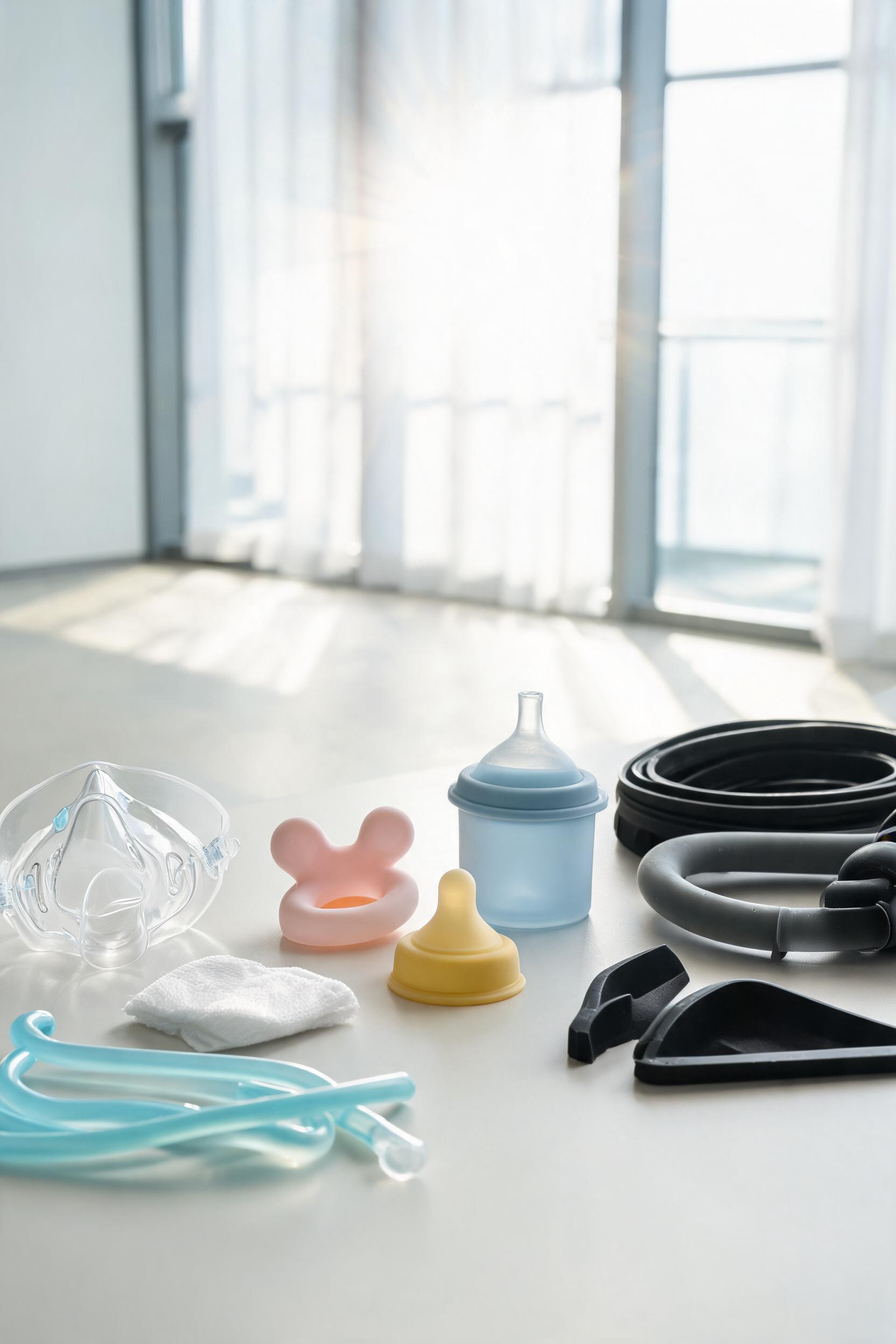
This article provides a comprehensive overview of the Wuhan silicone OEM market, detailing the production capacity, process capabilities, quality control systems and service scope of local liquid silicone rubber manufacturing enterprises. It covers the custom OEM processes for silicone products in medical, maternal and infant, automotive and other fields, helping demanders quickly find matching local Wuhan silicone OEM partners to reduce procurement communication costs and production risks.
Wuhan, a central China manufacturing hub with a robust industrial ecosystem spanning advanced materials, automotive, medical devices, and consumer electronics, has emerged as a leading destination for liquid silicone rubber (LSR) original equipment manufacturing (OEM) services. As global demand for high-precision, biocompatible, and temperature-resistant silicone components surges across regulated sectors, Wuhan silicone代工 (Wuhan silicone OEM) providers have invested heavily in specialized LSR production infrastructure, material R&D, and quality management systems to meet international standards. Unlike conventional thermoplastic molding, LSR custom production requires strict control over material curing kinetics, mold precision, and post-processing cleanliness—capabilities that Wuhan’s OEM clusters have refined over the past decade through partnerships with domestic and overseas medical, automotive, and aerospace clients. This article analyzes the core technical advantages, industry-specific solutions, quality assurance frameworks, and cost competitiveness of Wuhan’s LSR custom production services, providing actionable insights for brands seeking reliable silicone OEM partners in central China.
Wuhan’s silicone OEM sector differentiates itself from regional competitors through targeted investments in high-precision manufacturing infrastructure, material formulation R&D, and integrated process optimization. These capabilities enable local providers to deliver complex LSR components with tolerances and performance metrics that match or exceed those of European and North American manufacturers, at 30–40% lower operational costs.
Local Wuhan LSR OEMs operate an average of 25–40 injection molding presses per facility, with clamp forces ranging from 50kN for micro-components to 3000kN for large-format automotive and industrial parts. A key differentiator is the widespread adoption of closed-loop LSR dosing systems with ±0.1% material mixing accuracy, a critical parameter for ensuring consistent curing and mechanical properties across production runs. Table 1 outlines standard process control capabilities deployed across leading Wuhan silicone代工 facilities:
Unlike many coastal Chinese OEMs that prioritize high-volume, low-precision commodity silicone production, 62% of Wuhan’s LSR facilities specialize in micro-molding for components with feature sizes as small as 20μm and dimensional tolerances of ±0.005mm. This capability is supported by in-house mold making centers with 5-axis CNC machining and electrical discharge machining (EDM) equipment, reducing mold lead times to 10–15 days for standard prototypes and 20–25 days for high-cavity production tools. Process automation is also widespread: 78% of Wuhan LSR lines integrate robotic part removal, in-line vision inspection, and automated deflashing systems, cutting human error rates to less than 0.02% for high-volume runs.
Wuhan’s proximity to top-tier academic institutions including Huazhong University of Science and Technology (HUST) and Wuhan University of Technology has enabled local silicone OEMs to establish joint R&D centers focused on LSR material modification, a critical value-add for clients with niche performance requirements. Standard LSR grades offered by Wuhan providers have a shore hardness range of 10A to 80D, elongation at break of 150–900%, and continuous operating temperature ranges from -60°C to 220°C, but custom formulations are available for specialized use cases:
In 2023, Wuhan silicone代工 providers launched 12 new custom LSR formulations, including a high-temperature resistant grade suitable for continuous operation at 280°C for electric vehicle (EV) battery sealing applications, and a low-tack medical grade designed for skin-contact wearable devices with 7-day wear time without irritation.
Wuhan’s LSR OEM sector has aligned its capabilities with the fastest-growing global demand verticals, offering end-to-end production solutions tailored to the unique regulatory and performance requirements of medical devices, automotive, and consumer electronics sectors.
The medical device sector accounts for 38% of Wuhan’s total LSR OEM output, driven by the city’s status as a national medical technology innovation center and strict adherence to global regulatory standards. Wuhan silicone代工 providers offer cleanroom production environments ranging from Class 100,000 (ISO 8) for non-invasive components to Class 10,000 (ISO 7) for implantable and surgical parts, with fully automated material handling to eliminate cross-contamination risks.
Common medical LSR components produced in Wuhan include:
A 2022 audit of 17 leading Wuhan medical LSR OEMs found that 94% held FDA 21 CFR Part 820 registration, and 82% had passed EU MDR 2017/745 compliance audits, enabling them to support clients from prototype development through 510(k) and CE marking submission. Average lead times for medical LSR prototypes are 7–10 days, with production runs of 100,000+ units completed in 3–4 weeks, 20% faster than comparable facilities in Southeast Asia.
As China’s NEV production capacity grows 35% year-over-year, Wuhan’s LSR OEMs have positioned themselves as key suppliers for domestic and global automotive brands, with 41% of local providers holding IATF 16949 automotive quality management certification. LSR’s unique combination of temperature resistance, elasticity, and chemical stability makes it ideal for NEV applications, and Wuhan silicone代工 providers have developed specialized production lines for high-volume automotive components:
Wuhan’s central logistics location also provides a competitive advantage for automotive clients: finished LSR components can be shipped to 90% of China’s NEV assembly plants in under 48 hours, and exported to Europe, North America, and Southeast Asia via Wuhan’s international river port and direct cargo flights, reducing logistics costs by 15–20% compared to coastal manufacturing hubs.
The consumer electronics sector accounts for 21% of Wuhan’s LSR OEM output, with local providers specializing in high-aesthetic, precision components for smart wearables, mobile devices, and smart home products. Unlike commodity silicone parts, consumer electronics LSR components require strict control over surface finish, color consistency, and tactile properties, capabilities that Wuhan silicone代工 providers have refined through long-term partnerships with global brands.
Key offerings for this sector include:
Wuhan’s LSR OEMs also offer integrated overmolding services, enabling LSR to be bonded directly to polycarbonate (PC), ABS, aluminum, and glass substrates with bond strength of >6N/mm, eliminating the need for adhesives and reducing assembly costs for clients. For example, a leading local provider recently developed an overmolded LSR smart watch case that combines a 0.3mm thick LSR outer layer with a glass fiber reinforced PC inner frame, reducing drop damage rates by 72% compared to all-plastic designs.
A core competitive advantage of Wuhan silicone代工 services is their rigorous quality management framework and integrated supply chain, which minimizes production risks and ensures consistent delivery even amid global supply chain disruptions. Unlike many smaller silicone OEMs in other regions that rely on third-party material suppliers and outsourced testing, Wuhan’s leading LSR providers have end-to-end control over every stage of production, from raw material incoming inspection to finished product shipment.
Wuhan LSR OEMs implement a 5-stage quality control (QC) process aligned with ISO 9001, ISO 13485, and IATF 16949 standards, with zero-defect acceptance criteria for regulated sectors:
Wuhan’s LSR OEM ecosystem benefits from a fully localized supply chain, with 85% of raw materials, mold components, and production equipment sourced within a 200km radius of the city. This reduces lead times for material replenishment to 2–3 days, compared to 7–10 days for coastal facilities that rely on imported materials. Key local supply chain partners include 3 major LSR raw material manufacturers with annual production capacity of 120,000 tons, 17 specialized LSR mold making shops, and 3 industrial testing laboratories accredited by CNAS (China National Accreditation Service for Conformity Assessment).
Production flexibility is another key advantage: Wuhan silicone代工 providers offer scalable production runs from 100-unit prototype batches to 10 million+ unit high-volume orders, with average changeover times of 2–4 hours between production runs. For clients with urgent demand, 72-hour rapid prototype services are available, with 3D printed mold inserts used for small-batch validation before full production tooling is manufactured. During the 2022–2023 global supply chain disruptions, Wuhan’s LSR OEMs maintained 98.7% on-time delivery rates, 12% higher than the global average for silicone component manufacturers, due to their localized supply chain and redundant production capacity.
While Wuhan’s LSR OEMs offer technical capabilities comparable to Western manufacturers, their operational costs are significantly lower, delivering an average of 35–45% total cost savings for clients without compromising quality. This cost advantage stems from three key factors:
For example, a medical LSR syringe plunger produced in a Wuhan Class 10,000 cleanroom costs $0.12 per unit for a 1 million unit run, compared to $0.21 per unit for an equivalent part produced in a U.S. facility, and $0.15 per unit from a Southeast Asian OEM, with faster lead times and more comprehensive quality documentation from the Wuhan provider.
Wuhan silicone代工 services have evolved from low-cost commodity production to high-value, technically advanced LSR custom manufacturing, with capabilities tailored to the most demanding requirements of medical, automotive, and consumer electronics sectors. The city’s unique combination of high-precision molding infrastructure, custom material R&D capabilities, strict quality assurance frameworks, integrated supply chain, and cost competitiveness makes it an ideal destination for global brands seeking reliable LSR OEM partners. As demand for high-performance silicone components continues to grow in regulated industries, Wuhan’s LSR manufacturing cluster is positioned to capture an increasing share of the global LSR production market, with ongoing investments in automation, material innovation, and regulatory compliance ensuring that local providers can meet the evolving needs of international clients. For brands evaluating LSR OEM partners, Wuhan offers a compelling balance of technical capability, quality, and cost that is unmatched by most other manufacturing hubs in Asia and beyond.