
橡楚编辑部 5/19/2026 34 min read
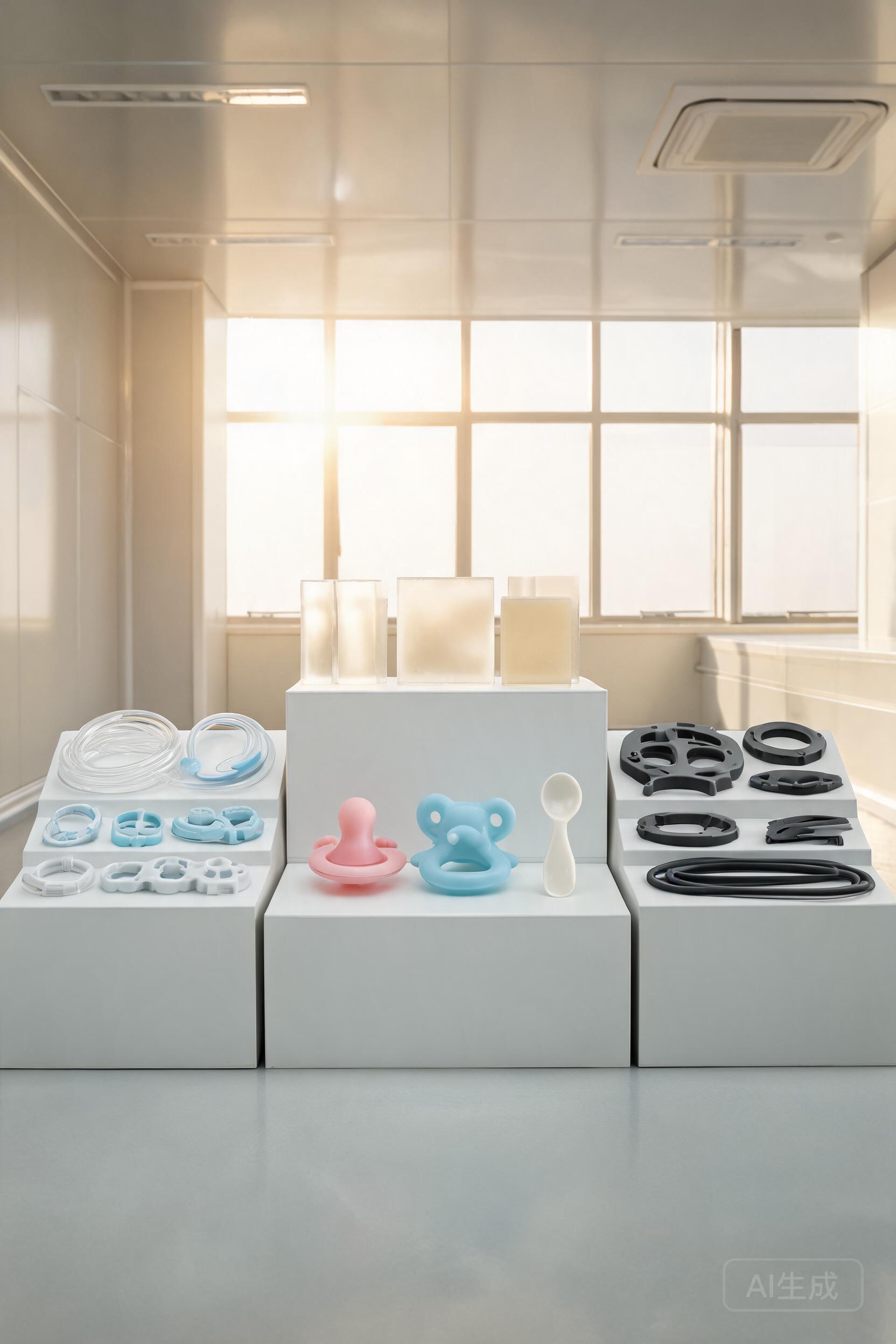
As a professional liquid silicone rubber processing service provider in the Wuhan Metropolitan Area, Xiangchu Technology has focused on capacity expansion, process optimization and quality control system upgrading in recent years. From high-precision mold development to automated mass production line layout, it has achieved a 30% increase in product delivery efficiency, a stable yield rate of over 99.5%, and an annual capacity of over 2,000 tons, providing full-chain LSR molding custom processing services for customers in medical, automotive, consumer electronics and other fields.
The global liquid silicone rubber (LSR) processing market is projected to grow at a 6.8% CAGR through 2030, driven by surging demand from medical device, automotive, consumer electronics, and food contact sectors. As China’s central region manufacturing hub, the Wuhan Metropolitan Area has emerged as a strategic LSR production cluster, leveraging its robust supply chain access, skilled technical labor pool, and integrated logistics networks connecting inland and coastal markets. Among regional providers, Xiangchu Technology stands out as a leading LSR contract manufacturer that has completed a comprehensive 2022–2024 upgrade of its quality management systems, production efficiency frameworks, and large-scale manufacturing capacity. This article provides a technical deep dive into Xiangchu’s upgrade initiatives, their measurable operational outcomes, and the competitive advantages they deliver for domestic and international OEM partners.
LSR components for medical, automotive, and food contact applications require compliance with strict global regulatory standards, making quality consistency the core competitive differentiator for contract processing providers. Xiangchu’s 18-month quality upgrade targeted end-to-end process control, material traceability, and third-party certification alignment to meet the most stringent client requirements.
LSR part performance is 70% determined by raw material quality and formulation stability, so Xiangchu first redesigned its incoming material inspection and pre-production validation workflows. The company now implements a 5-step incoming testing protocol for all LSR raw materials sourced from Dow, Wacker, and Momentive:
Xiangchu also established a dedicated formulation R&D lab to optimize material blends for specialized client needs. For medical device clients requiring low extractable LSR, the lab developed a post-cure heat treatment process that reduces volatile organic compound (VOC) content to <0.1% by weight, exceeding ISO 10993-4 requirements for blood-contacting components. For automotive clients requiring UV-stabilized LSR for exterior sealing applications, the lab’s customized formulations deliver 5,000 hours of QUV accelerated weathering resistance with <5% change in shore hardness and tensile strength.
To eliminate process variation during high-volume production, Xiangchu deployed a plant-wide statistical process control (SPC) system integrated with all injection molding machines. The system tracks 12 critical process parameters in real time, with automated alerts for out-of-tolerance conditions:
For final product inspection, Xiangchu implemented a 3-tier testing framework tailored to product application:
As of 2024, Xiangchu’s quality system holds ISO 9001:2015, ISO 13485:2016, IATF 16949:2016, and GMP Class 8 cleanroom production certifications, with a reported process capability index (CpK) of 1.67 for all mass-produced parts and a customer rejection rate of 0.08%, 75% lower than the industry average of 0.32% for mid-sized LSR processors.
For OEM partners, shorter lead times and faster time-to-market for new LSR components directly translate to increased market share and lower product development costs. Xiangchu’s efficiency upgrade focused on integrating digital manufacturing technologies, optimizing mold design and fabrication workflows, and streamlining supply chain coordination to cut both prototyping and mass production lead times.
Xiangchu deployed a digital twin platform for all LSR injection molding processes, creating a virtual replica of each production line that simulates material flow, curing behavior, and mold thermal dynamics before physical production begins. The platform reduces pre-production trial runs by an average of 60%: for a typical 32-cavity LSR seal mold, traditional process tuning requires 8–12 trial runs to eliminate defects, while Xiangchu’s digital twin simulation cuts this to 2–3 runs, reducing material waste during setup by 72%.
The company also upgraded its entire fleet of injection molding machines with servo-driven hydraulic systems and automated material feeding units. The new machines reduce energy consumption by 35% compared to older hydraulic models, while automated A/B component feeding systems eliminate manual mixing errors and reduce material changeover time from 2 hours to 15 minutes. For high-volume production runs, Xiangchu’s automated in-mold degating systems remove the need for manual post-processing, cutting per-part cycle time by 12% on average and eliminating 100% of post-molding trimming defects.
Table 1: Measurable Efficiency Improvements Post-Upgrade
Mold fabrication is the longest lead-time step in custom LSR part development, so Xiangchu established an in-house mold making center with 5-axis CNC machining, wire EDM, and laser texturing capabilities to reduce tooling lead times. The center’s modular mold design system uses standardized base plates and interchangeable cavity inserts, allowing clients to modify part designs without replacing the entire mold. For example, for a consumer electronics client producing multiple models of LSR waterproof seals, the modular system reduced tooling modification costs by 65% and cut tooling changeover time between models from 8 hours to 45 minutes.
Xiangchu also offers rapid tooling options for prototype and low-volume production: 3D-printed steel mold inserts with a 5,000-shot lifespan can be fabricated in 48 hours, while aluminum soft tools with a 100,000-shot lifespan are available in 7 days, compared to the industry average of 14–21 days for hard steel tools. For medical device clients undergoing clinical trials, this rapid tooling capability allows them to iterate design changes 2–3 times faster, cutting clinical trial preparation timelines by an average of 3 months.
As global LSR demand grows, OEM partners require contract manufacturers that can scale production capacity without compromising quality or cost competitiveness. Xiangchu’s 2023–2024 capacity expansion added 3,000 sq.m of GMP Class 8 cleanroom production space and 28 new high-precision LSR injection molding machines, bringing total annual production capacity to 150 million units across all application segments.
Xiangchu’s expanded production facility is divided into dedicated, segregated production zones to prevent cross-contamination between different industry segments, each with tailored equipment and quality control protocols:
All production zones operate 24/7 with 3 rotating shifts, and the company has reserved 5,000 sq.m of adjacent facility space for further expansion scheduled for 2025, which will add 24 additional machines and increase total annual capacity to 250 million units.
Located in the Wuhan Metropolitan Area, Xiangchu leverages the region’s integrated logistics network to deliver components to clients across China, Southeast Asia, Europe, and North America with competitive lead times:
To mitigate supply chain disruptions, Xiangchu maintains a 3-month safety stock of 12 common LSR formulations and has established dual sourcing agreements with 3 major material suppliers. For key automotive clients with just-in-time (JIT) production requirements, Xiangchu operates a dedicated consignment warehouse near client facilities, with 99.8% on-time delivery performance as of 2024. The company also offers localized engineering support for international clients, with English-speaking technical teams available to collaborate on design for manufacturing (DFM) optimization, reducing the need for costly cross-border travel during product development.
Xiangchu Technology’s 2022–2024 quality, efficiency, and capacity upgrade has positioned the Wuhan Metropolitan Area LSR processor as a competitive alternative to traditional coastal Chinese and European LSR contract manufacturers, offering global OEM partners a unique combination of regulatory compliance, fast lead times, scalable production, and cost competitiveness. The company’s 0.08% customer rejection rate, 5–7 day prototyping lead times, and 150 million unit annual capacity address the most pressing pain points of LSR component sourcing: quality inconsistency for regulated applications, long lead times for new product development, and limited scalability for high-demand products. As the global LSR market continues to grow, particularly for medical device and EV applications, Xiangchu’s upgraded facilities and technical capabilities make it a strategic partner for OEMs looking to diversify their supply chain and reduce time-to-market for innovative LSR components. The company’s upcoming 2025 expansion will further strengthen its position as a leading central China LSR processing hub, supporting even larger-scale production requirements for global clients.