
橡楚编辑部 6/14/2026 39 min read
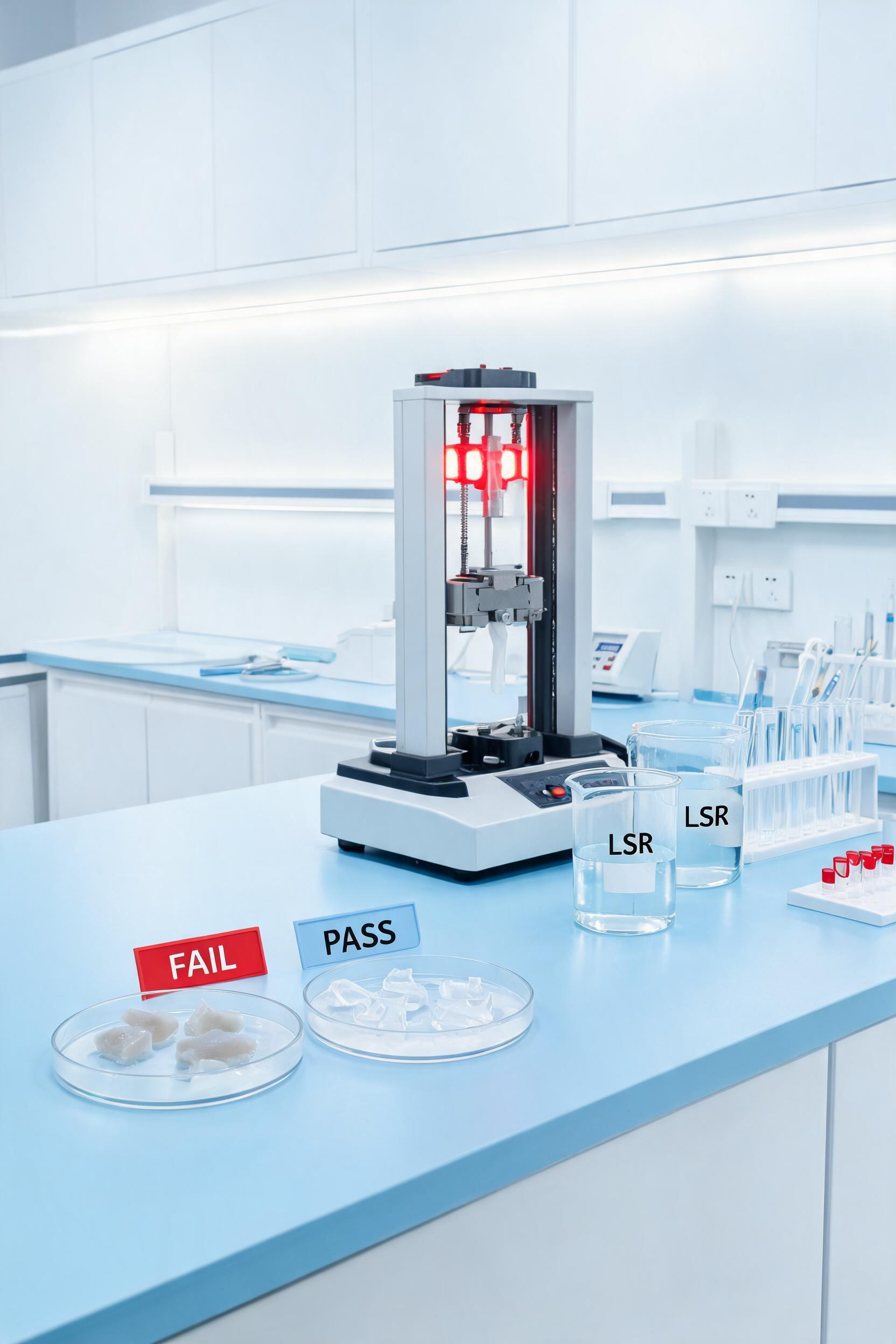
Many liquid silicone product manufacturers often encounter the problem that finished products cannot pass FDA/LFGB food contact testing, which is mostly related to improper material selection and non-standard control of vulcanization process. As a professional manufacturer of LSR products, Xiangchu (Hubei) Rubber Co., Ltd. is located in Ezhou, Hubei with ISO 9001 certification. This article will analyze the core influencing factors to help you control product compliance.
For over 70 years, silicone rubber has been a material of choice for food contact applications, thanks to its unique combination of thermal stability, chemical inertness, and mechanical flexibility. Today, liquid silicone rubber (LSR) products are ubiquitous in kitchenware, baby feeding products, food processing equipment seals, and medical devices, all of which require compliance with strict food safety regulations. Two of the most widely recognized global standards for food contact materials are the U.S. Food and Drug Administration (FDA) 21 CFR § 177.2600 regulation and the German *Lebensmittel- und Futtermittelgesetzbuch* (LFGB), which sets requirements for materials sold in the European Union.
Despite the inherent safety of high-quality silicone, a significant number of silicone products fail FDA and LFGB compliance tests every year. In 2022, the EU Rapid Alert System for Food and Feed (RASFF) reported 127 notifications of non-compliant silicone food contact products, 68% of which failed due to excessive overall migration or unacceptable volatile organic compound (VOC) levels. Most failures are not random defects — they stem from two core, controllable factors: inappropriate raw material selection and poorly controlled vulcanization (curing) processes.
At 橡楚(湖北)橡胶有限公司, a specialized manufacturer of Liquid Silicone Rubber (LSR) products based at 湖北省鄂州市鄂城区经济开发区凡口街道内河巷54号, we operate under an ISO 9001 certified quality management system to produce LSR products that meet strict global food safety requirements. In this article, we break down the technical root causes of FDA/LFGB test failures, focusing on the critical roles of material selection and vulcanization process control, to help brands, buyers, and manufacturers avoid costly compliance issues.
---
Before exploring common failure causes, it is important to clarify the specific mandatory testing requirements that silicone products must meet to gain FDA and LFGB approval. These regulations set quantitative limits for contaminants and extractables to ensure materials do not leach harmful substances into food.
FDA’s regulation for rubber articles intended for repeated food contact establishes the following core test parameters for silicone:
FDA also requires that all raw materials used in silicone production fall within the list of approved substances for food contact, with no unapproved additives or fillers.
LFGB has stricter requirements for initial and ongoing compliance, focusing on sensory properties and low molecular weight extractables in addition to overall migration:
Unlike FDA, LFGB requires that finished products do not pose any risk to human health even in long-term use, which makes it more sensitive to residual impurities from poor processing.
---
Raw silicone rubber accounts for 50-90% of the finished product composition, so the quality and composition of raw materials directly determines compliance. Many low-cost producers cut corners on material selection to reduce production costs, which almost always leads to test failure.
Pure LSR has a relatively high raw material cost, so many manufacturers add inorganic fillers to reduce material spend. While food-grade fumed silica is an approved filler that improves mechanical strength, unapproved or low-grade fillers introduce toxic impurities:
A 2021 study of 30 low-cost silicone kitchen products sold in the EU found that 47% of failed tests were directly linked to the use of unapproved low-grade fillers.
Silicone requires additives such as crosslinkers, catalysts, inhibitors, and color pigments to achieve the desired curing and physical properties. All additives used in food contact silicone must be approved by FDA and EU regulators:
At 橡楚(湖北)橡胶有限公司, we only use virgin food-grade LSR raw materials sourced from approved global suppliers, with all additives verified to meet FDA 21 CFR and LFGB requirements before use. Every batch of incoming raw material is tested for heavy metal content and initial extractable levels to ensure compliance before production begins.
Silicone rubber is a polymer made of repeating siloxane monomer units. The molecular weight distribution of the polymer directly impacts the amount of low molecular weight (LMW) siloxane oligomers (cyclic and linear D3-D10 oligomers) in the material. These LMW oligomers are not covalently bonded to the crosslinked polymer matrix, so they easily leach out during extraction testing.
Low-grade raw silicone often has higher levels of LMW oligomers because manufacturers skip the post-polymerization stripping process that removes excess oligomers to cut production costs. A typical food-grade LSR will have less than 0.5% LMW oligomer content, while unprocessed low-grade silicone can have 2-5% LMW oligomer content, which is sufficient to cause failure of both overall migration and VOC tests for both FDA and LFGB.
---
Even when using food-grade raw materials, improper vulcanization process control can leave residual impurities and uncrosslinked material in the finished product, leading to failed FDA/LFGB tests. Vulcanization is the process of crosslinking silicone polymer chains to form a stable elastic network, and it requires precise control of time, temperature, and pressure to be completed correctly.
Incomplete curing is one of the most common process-related causes of test failure. To increase production output and reduce energy costs, many manufacturers shorten curing time or lower curing temperature below the recommended level. When curing is incomplete:
For LSR injection molding, the recommended primary curing parameters for food contact products are typically 150-180°C for 1-5 minutes, depending on part thickness. The table below shows how incomplete curing impacts overall migration results for a 2mm thick silicone baby nipple tested to LFGB standards:
As shown, insufficient curing time directly leads to migration levels well above the 10 mg/dm² LFGB limit, even when using the same approved raw material.
Post-curing is a secondary heating process after primary molding, designed to remove volatile residual compounds and complete the crosslinking reaction. Many manufacturers skip this step entirely to save time and energy costs, which is a leading cause of FDA/LFGB failure.
Post-curing serves two critical functions for food contact silicone:
For example, when testing a silicone baking mat made from food-grade raw material, products without post-curing typically have a mass loss of 1.2-2.0% after 200°C heating (well above the 0.5% LFGB VOC limit), while the same product with proper 4-hour post-curing at 180°C has a mass loss of 0.2-0.3%, which meets the requirement.
Even when manufacturers follow nominal curing time and temperature guidelines, poor temperature uniformity in molds or curing ovens can lead to spotty incomplete curing. Parts of the product that cure at lower than required temperatures will retain excess extractables, leading to failure even if other areas of the same batch are fully cured.
Common causes of poor temperature uniformity include:
At 橡楚(湖北)橡胶有限公司, we calibrate all our molding and curing equipment on a monthly basis to ensure temperature uniformity within ±3°C across all work areas. All food contact LSR products undergo a mandatory 2-4 hour post-curing process depending on product thickness, to ensure all residual volatiles are removed and crosslinking is complete. Our ISO 9001 certified quality management system requires every production batch to have curing parameters recorded and retained for traceability.
---
While material selection and vulcanization are the two leading causes of failure, poor post-processing handling and quality control can also lead to non-compliance even when upstream processes are correct.
After curing, silicone products often require trimming, deflashing, and packaging. Poor handling during these steps can introduce external contaminants that cause test failure:
Many small manufacturers only test the first batch of a new product for compliance, and do not conduct ongoing testing for subsequent production batches. Raw material quality can vary between batches, and processing equipment drifts over time, which can lead to gradual changes in extractable levels that only are caught during final compliance testing.
Consistent compliance requires ongoing in-house testing of key parameters (such as VOC content and extractable residue) for every production batch, in addition to annual third-party testing to maintain FDA and LFGB validity.
---
FDA and LFGB test failures for silicone products are almost never caused by the inherent properties of silicone itself — they are almost always the result of cutting corners on raw material quality or vulcanization process control. Low-grade fillers, unapproved additives, incomplete curing, and skipping post-curing are the most common technical root causes of non-compliance, all of which are avoidable with proper process management and quality control.
For brands and buyers sourcing silicone food contact products, the key to avoiding costly compliance failures is to work with a manufacturer that prioritizes raw material verification and process control over short-term cost reduction. At 橡楚(湖北)橡胶有限公司, we specialize in producing high-quality Liquid Silicone Rubber (LSR) products for food contact and other demanding applications, operating from our facility at 湖北省鄂州市鄂城区经济开发区凡口街道内河巷54号 under an ISO 9001 certified quality system. We verify raw material compliance before every production run, control curing parameters with strict traceability, and require mandatory post-curing for all food contact LSR products to ensure consistent compliance with FDA and LFGB requirements.
If you have questions about LSR product compliance or would like to discuss your project requirements, please contact us at 18071171144 or email churubber@163.com.