
橡楚编辑部 6/18/2026 48 min read
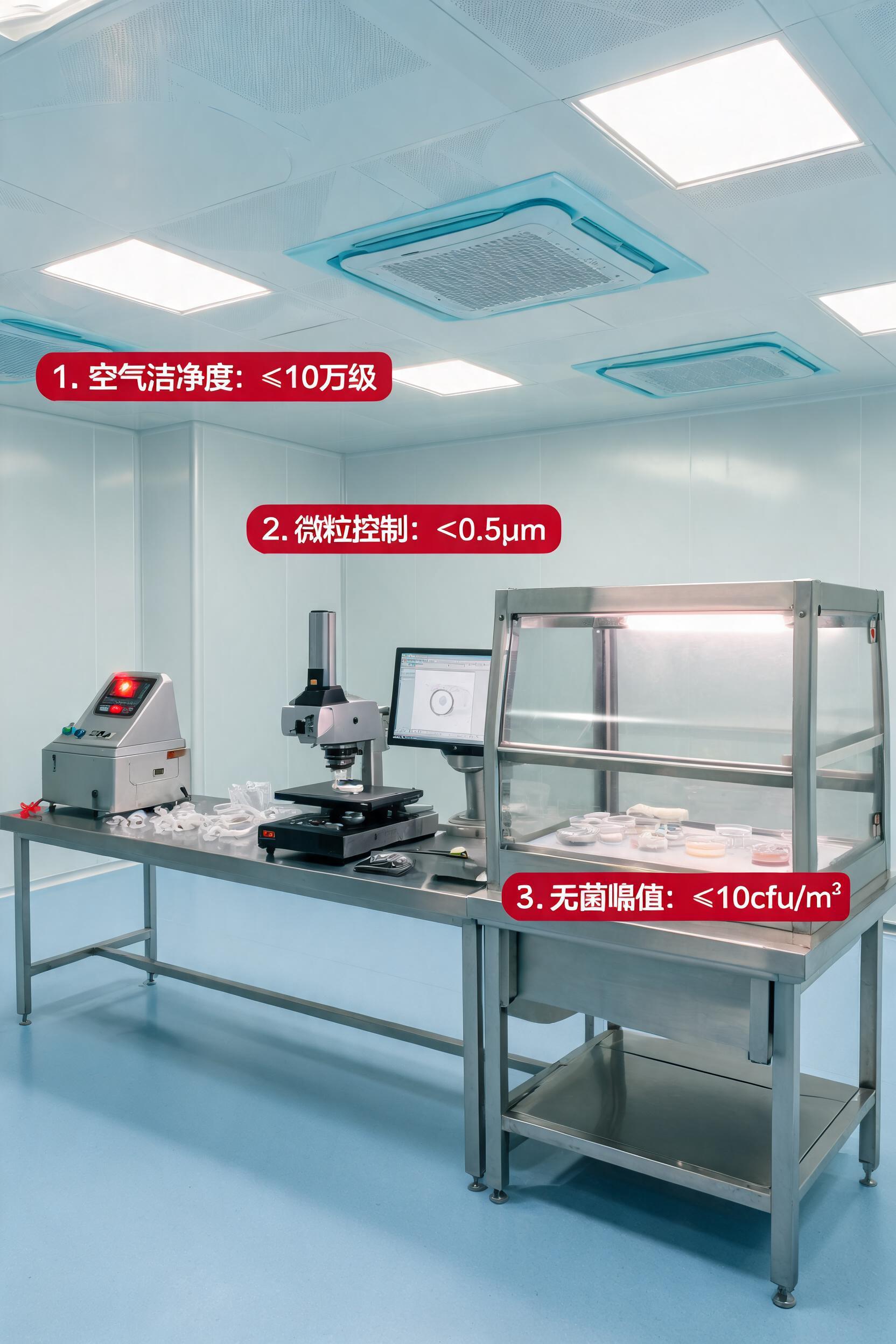
Medical grade liquid silicone rubber products have strict requirements for hygiene and safety, and production in a clean workshop is a mandatory requirement. This article reveals the hard standards of 100,000-class clean workshops for producing medical-grade silicone parts, explains why medical-grade silicone parts must be produced in clean workshops, and helps buyers understand the quality control requirements of LSR product production.
Liquid Silicone Rubber (LSR) has become one of the most widely used materials for medical devices and components, thanks to its inherent biocompatibility, low toxicity, chemical stability, and resistance to extreme temperatures and sterilization processes. Unlike general industrial silicone products, medical-grade silicone parts are designed to come into direct or indirect contact with human tissue, blood, mucous membranes, and internal bodily fluids during clinical use, from single-use surgical instruments and implantable devices to wearable medical sensors and drug delivery systems. Even trace amounts of particulate contamination, microbial pathogens, or residual chemical impurities can trigger severe adverse reactions ranging from localized inflammation and infection to long-term chronic toxicity or device failure.
Contamination control is therefore not an optional quality step for medical-grade LSR parts manufacturing—it is a non-negotiable requirement to meet global regulatory standards for medical devices, including FDA 21 CFR 820, ISO 10993 for biological evaluation, and EU MDR 2017/745. Clean room production is the core infrastructure that enables consistent, compliant production of safe medical silicone components. At 橡楚(湖北)橡胶有限公司, we operate a Class 100,000 (ISO 14644-1 Class 7) clean room dedicated exclusively to medical-grade LSR product manufacturing, located at 湖北省鄂州市鄂城区经济开发区凡口街道内河巷54号, and hold ISO 9001 certification for our quality management system. In this article, we explore the fundamental reasons why clean room production is mandatory for medical-grade silicone parts, and break down the three core mandatory standards that define a qualified 100,000-level clean room for LSR processing.
Medical-grade silicone parts are expected to meet far stricter safety and purity requirements than general industrial or consumer silicone products. Contamination can occur at every stage of LSR processing, from raw material storage and mixing to molding, post-processing, and final packaging. Understanding these risks helps explain why clean room production is an indispensable requirement, not a value-added extra.
Biological contamination refers to the presence of unwanted microorganisms, including bacteria, fungi, viruses, and microbial spores, on the surface or within the bulk of finished LSR parts. Uncontrolled production environments naturally carry high concentrations of airborne microorganisms: a typical non-clean room factory environment can have more than 10,000 colony-forming units (CFU) of microorganisms per cubic meter of air. When these microorganisms adhere to uncured LSR during the injection molding process, they become trapped within the cured silicone matrix, and cannot be fully removed even through post-production sterilization.
For medical applications, this poses severe clinical risks:
Even non-invasive medical silicone parts, such as wearable glucose sensor adhesives, carry a risk of skin irritation and infection from microbial contamination when used for extended periods on compromised skin.
Particulate contamination refers to solid microscopic particles from the production environment that become embedded in or attached to finished LSR parts. Common sources of particulate contamination in non-controlled production environments include fabric fibers from worker clothing, dust from concrete floors and unpainted walls, metal shavings from equipment, skin flakes, and residual dust from raw material packaging. LSR, as a low-viscosity liquid material before curing, readily captures these airborne particles during the injection molding and curing process, unlike solid plastic or rubber raw materials that are processed in a more enclosed system.
Particulate contamination causes two major problems for medical LSR parts:
The table below compares the typical particulate concentration in different production environments to illustrate the risk:
Biocompatibility is the core requirement for medical-grade LSR, defined as the ability of a material to perform with an appropriate host response in a specific application (per ISO 10993-1). Chemical contamination can compromise biocompatibility even when starting with certified medical-grade raw LSR material. Common sources of chemical contamination in non-clean production include volatile organic compounds (VOCs) from cleaning products, residual mold release agents from adjacent industrial production lines, fumes from non-food/medical grade lubricants used on equipment, and cross-contamination from non-medical grade silicone materials processed on the same equipment in an open environment.
Many of these chemical contaminants are hydrophobic and can leach out from the silicone matrix over time when in contact with bodily fluids. Even at very low concentrations, these contaminants can cause cytotoxicity, skin sensitization, or long-term carcinogenic effects, leading to failure in ISO 10993 biocompatibility testing. Clean room production implements strict controls on all chemicals used in the production process, preventing this type of unintended contamination that can ruin an entire production batch.
Clean room classification is standardized by the International Organization for Standardization in ISO 14644-1: Cleanrooms and associated controlled environments – Part 1: Classification of air cleanliness. A 100,000-class clean room corresponds to ISO 14644-1 Class 7, which is the most commonly used clean room level for non-implantable medical-grade LSR parts (implantable parts typically require 10,000-class or cleaner facilities). Unlike common misconceptions, a 100,000-class clean room is not just a sealed room with air filters—it requires integrated design, ongoing monitoring, and strict process controls to meet mandatory standards.
Airborne particulate concentration is the primary metric for clean room classification, and the foundation of contamination control for LSR production. In simple terms, a 100,000-class clean room is defined by the requirement that no more than 100,000 particles of 0.5 micrometers (μm) or larger are present in one cubic meter of air inside the room—this is 100 times cleaner than a typical non-clean industrial workshop.
To maintain this level of air cleanliness, 100,000-class clean rooms use a controlled positive pressure ventilation system with HEPA (High-Efficiency Particulate Air) filters. Key design features for LSR production clean rooms include:
For LSR injection molding processes, which generate minimal volatile fumes compared to other plastic manufacturing processes, this air exchange rate is sufficient to maintain consistent air cleanliness. We conduct daily particulate count testing at 橡楚(湖北)橡胶有限公司 to ensure our 100,000-class clean room consistently meets the air cleanliness standard.
Personnel are the largest source of contamination in any clean room: a single moving worker can generate up to 10 million particles ≥0.3μm per minute, from skin flakes, clothing fibers, and hair. Even with perfect air filtration, poor personnel process control can quickly render a clean room non-compliant. For medical-grade LSR production, 100,000-class clean rooms require strict mandatory protocols for personnel entry, movement, and hygiene.
Mandatory personnel control protocols include:
Surface contamination on equipment, worktables, and walls is another major source of contamination that is often overlooked. Particulates and microorganisms that settle on surfaces can become re-suspended in the air during production operations, or transfer directly to finished LSR parts during handling. 100,000-class clean rooms require mandatory regular sanitation and surface monitoring to control this risk.
Mandatory surface cleanliness standards include:
A 100,000-class clean room for medical-grade LSR production must meet three non-negotiable hard standards that go beyond basic air classification. These standards ensure that the clean room can consistently produce compliant medical-grade parts over time, rather than just meeting classification requirements during a one-time certification test.
The first and most fundamental hard standard is consistent compliance with maximum particle and microbial concentration limits, as defined below for a 100,000-class clean room:
For microbial contamination, the mandatory limits for 100,000-class clean rooms are:
These limits are not static requirements that only need to be met during initial clean room certification. For medical LSR production, continuous daily monitoring is required to track concentration levels, and any deviation outside the limits triggers immediate production shutdown, root cause analysis, and corrective action. At 橡楚(湖北)橡胶有限公司, we log daily particle count tests and weekly microbial tests, and maintain full records for regulatory inspection, in line with our ISO 9001 quality management system.
LSR is a moisture-cured material for most injection molding applications, meaning that the ambient humidity directly affects the curing rate and final physical properties of the finished part. Most medical-grade LSR compounds require a specific moisture level to initiate crosslinking during the heating process: too high or too low humidity can lead to incomplete curing, increased leachable residual monomers, or poor dimensional stability. In addition, high humidity promotes the growth of microorganisms on clean room surfaces, increasing the risk of biological contamination.
The second mandatory hard standard for a 100,000-class LSR clean room is strict continuous control of temperature and humidity, within the following ranges:
This controlled environment not only reduces microbial growth, but also ensures consistent curing of LSR across every production batch, reducing variation in physical properties and biocompatibility. Even small deviations in humidity (for example, exceeding 65% RH for multiple days) can lead to an increase in residual non-crosslinked siloxane monomers, which can cause failure in biocompatibility cytotoxicity testing. All climate control systems in our clean room at 橡楚(湖北)橡胶有限公司 are equipped with continuous digital monitoring and automatic alarm notifications for out-of-range conditions, to ensure consistent process conditions.
The third hard standard that many manufacturers do not meet is strict physical segregation of medical-grade LSR production from all non-medical production, and controlled material flow to prevent cross-contamination. A common non-compliant practice is to operate a small clean room area within a larger non-clean factory, without proper material flow protocols, allowing contaminated raw material packaging or non-medical tools to enter the clean room.
Mandatory requirements for material flow and segregation include:
This end-to-end segregation ensures that medical-grade LSR parts are never exposed to uncontrolled contamination at any stage of production, from raw material to finished product ready for sterilization.
Medical-grade LSR parts require clean room production because the safety and performance of these components depend on eliminating biological, particulate, and chemical contamination that can cause severe clinical harm and device failure. For most non-implantable medical-grade silicone components, a 100,000-class (ISO 14644-1 Class 7) clean room is the required level of contamination control, and it must meet three core mandatory hard standards: strict and continuously monitored particle and microbial concentration limits, controlled temperature and humidity for consistent LSR curing and contamination control, and fully segregated material flow to eliminate cross-contamination.
At 橡楚(湖北)橡胶有限公司, we specialize in custom manufacturing of medical-grade LSR components, and our 100,000-class clean room at 湖北省鄂州市鄂城区经济开发区凡口街道内河巷54号 is operated in full compliance with the standards outlined in this article, backed by our ISO 9001 quality management system. We understand that every medical device manufacturer relies on their component suppliers to maintain consistent contamination control to meet global regulatory requirements, and we prioritize clean room management and quality control as the core of our medical LSR product offering. For inquiries about custom medical-grade LSR parts, please contact us at 18071171144 or email us at churubber@163.com.