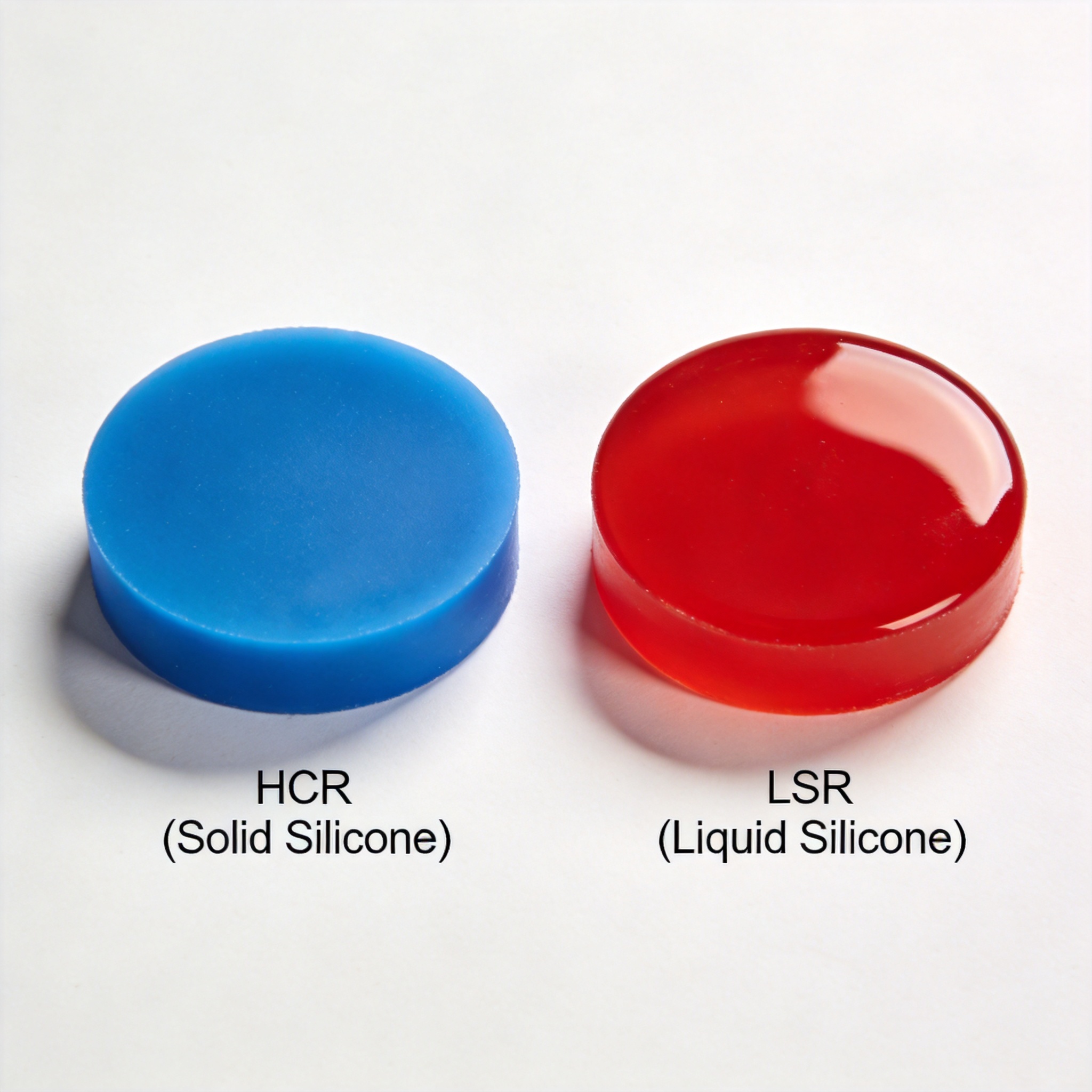
Choosing between solid silicone (HCR - High Consistency Rubber) and liquid silicone (LSR - Liquid Silicone Rubber) is a critical decision that affects product quality, production efficiency, and manufacturing costs. This comprehensive comparison will help you make the right choice for your application.
1. Material Overview
Solid Silicone (HCR)
Solid silicone, also known as High Consistency Rubber or gum stock, is a high-molecular-weight silicone elastomer supplied in thick sheets or blocks. It requires mechanical mastication before processing.
Characteristics:
- High molecular weight (> 300,000 g/mol)
- Putty-like consistency at room temperature
- Requires mechanical shearing to process
- Available in wide hardness range (20-90 Shore A)
Liquid Silicone (LSR)
Liquid silicone is a low-viscosity, two-component addition-cure silicone system that flows readily at room temperature.
Characteristics:
- Low molecular weight
- Pourable liquid consistency
- A/B components mixed in 1:1 ratio
- Available in hardness range (5-80 Shore A)
2. Physical Properties Comparison
PropertySolid Silicone (HCR)Liquid Silicone (LSR)
AppearanceThick sheets/blocksPourable liquid
Viscosity> 100,000 Pa·s100-10,000 Pa·s
Cure SystemPeroxide or PlatinumPlatinum (addition)
Cure Time5-15 minutes10-60 seconds
Shrinkage2-4%1-3%
Hardness Range20-90 Shore A5-80 Shore A
Tensile Strength6-12 MPa5-10 MPa
Elongation100-800%200-900%
3. Processing Methods
3.1 Solid Silicone Processing
Compression Molding
- Most common method for solid silicone
- Material placed in open mold cavity
- Mold closed under hydraulic pressure (5-30 MPa)
- Cure at 150-200°C for 5-15 minutes
- Best for: Simple geometries, low-volume production
Extrusion
- Solid silicone forced through die to create continuous profiles
- Used for tubes, hoses, gaskets, and cords
- Vulcanization in continuous hot-air oven
- Best for: Long continuous shapes
Transfer Molding
- Material pre-loaded into transfer pot
- Forced through runners into closed mold
- Better precision than compression molding
- Best for: Multi-cavity parts, insert molding
3.2 Liquid Silicone Processing
Injection Molding
- A/B components automatically metered and mixed
- Mixed LSR injected into heated mold
- Rapid cure at 150-200°C (10-60 seconds)
- Fully automated production
- Best for: High-volume, precision parts
4. Cost Analysis
Tooling Costs
- Compression molds (HCR): Lower initial cost ($5,000-$30,000)
- Injection molds (LSR): Higher initial cost ($15,000-$80,000)
Production Costs
- HCR: Higher per-unit cost due to manual operations
- LSR: Lower per-unit cost at high volumes due to automation
Break-even Analysis
VolumeRecommended Process
< 10,000 pcs/yearSolid silicone (compression)
10,000-100,000 pcs/yearDepends on part complexity
> 100,000 pcs/yearLiquid silicone (injection)
5. Application Selection Guide
Choose Solid Silicone When:
- Low production volumes (< 10,000 units)
- Large part sizes (> 500mm)
- Simple geometries without tight tolerances
- Custom compound formulations needed
- Extruded profiles (tubes, hoses, cords)
- Budget constraints on tooling
Choose Liquid Silicone When:
- High production volumes (> 50,000 units)
- Precision parts with tight tolerances (±0.02mm)
- Complex geometries (undercuts, thin walls)
- Medical or food-grade products
- Multi-material overmolding required
- Minimal flash requirement
- Consistent batch-to-batch quality needed
6. Industry-Specific Recommendations
Medical & Healthcare
→ LSR preferred: Biocompatibility consistency, cleanroom compatibility, precision
Automotive
→ Both suitable: LSR for precision seals, HCR for large gaskets and hoses
Consumer Electronics
→ LSR preferred: Precision keypads, waterproof seals, miniaturized components
Food & Baby
→ LSR preferred: FDA/LFGB compliance, automation for hygiene, product consistency
Industrial
→ HCR preferred: Large seals, custom formulations, extruded profiles
Conclusion
There is no universally superior choice between solid and liquid silicone. The optimal selection depends on your specific requirements for volume, precision, cost, and application. Many manufacturers use both processes to cover their complete product range. Consult with an experienced silicone manufacturer to determine the best approach for your project.