
橡楚编辑部 7/10/2026 47 min read
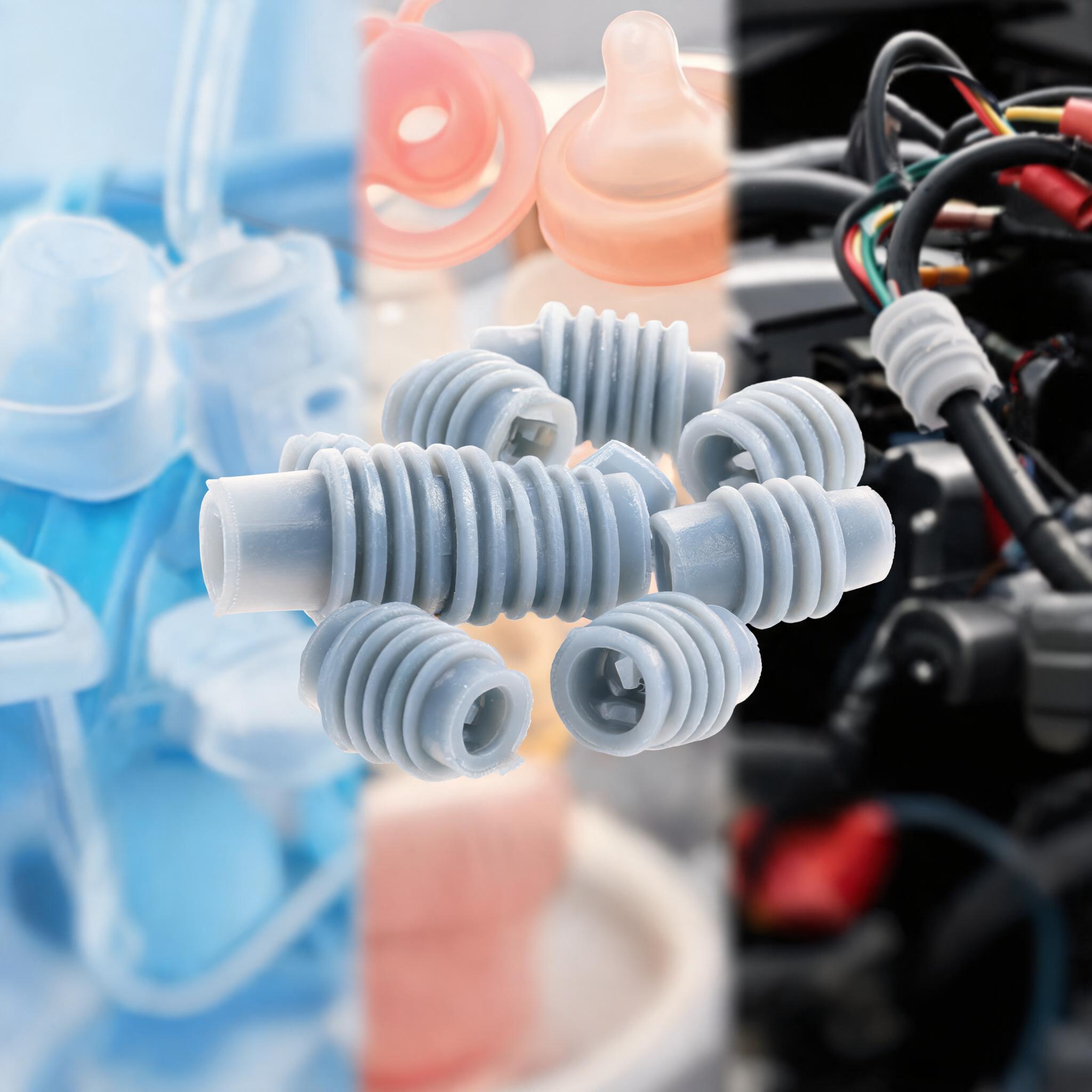
Silicone sealing sleeves for wire harness connectors are core protective components widely used in automotive, electronics, industrial equipment and other fields. Relying on the excellent high and low temperature resistance, aging resistance, insulation and waterproof properties of liquid silicone rubber, they can effectively block water vapor and dust from entering the interior of connectors, avoiding faults such as line short circuits and poor contact. This article systematically sorts out the performance requirements, material selection points, LSR injection molding process points and quality testing standards of this type of sealing sleeves, helping upstream and downstream enterprises optimize product selection and production management.
Silicone sealing sleeves for wire harness connectors are critical passive components that protect electrical and electronic systems by establishing a robust barrier between internal electrical contact interfaces and external environmental stressors. As automotive electrification, industrial automation, and renewable energy infrastructure expand, the demand for high-performance sealing solutions has surged, with liquid silicone rubber (LSR) emerging as the dominant material for these sleeves due to its unique combination of thermal stability, elastic resilience, and chemical resistance. Unlike thermoplastic elastomers (TPE) or neoprene alternatives, LSR-based sealing sleeves maintain consistent performance across extreme temperature fluctuations, exposure to automotive fluids, and long-term cyclic stress, reducing field failure rates by up to 75% in high-vibration applications according to 2023 data from the Society of Automotive Engineers (SAE). This analysis examines material property optimization, design engineering, performance validation, and application-specific customization of silicone sealing sleeves for wire harness connectors, providing actionable insights for component engineers and system designers.
The performance of silicone sealing sleeves is directly determined by the formulation of the LSR base polymer, crosslinking systems, and functional additives tailored to target operating conditions. Unlike commodity silicone materials, LSR for connector sealing is a two-part, platinum-catalyzed elastomer with a polydimethylsiloxane (PDMS) backbone, modified to balance mechanical resilience, environmental resistance, and processing efficiency.
LSR formulations for sealing sleeves are engineered to meet tiered performance thresholds aligned with industry-specific standards, with core properties defined as follows:
The high-tier requirements are non-negotiable for automotive powertrain and charging system applications, where sealing failure can lead to short circuits, signal loss, or thermal runaway. Unlike TPE alternatives, optimized LSR formulations retain 90% of their tensile strength after 1000 hours of 150°C thermal aging, compared to 40% retention for TPE grades of equivalent hardness.
Base LSR formulations are modified with targeted additives to address extreme operating stressors unique to niche applications:
A high-performance silicone sealing sleeve requires an integrated structural design that balances sealing reliability, assembly efficiency, and long-term durability, paired with precision LSR molding processes that eliminate defects that could compromise sealing performance. Even the most optimized LSR formulation will fail to meet performance requirements if the structural design is flawed or the molding process introduces dimensional inconsistencies or micro-defects.
The structural design of silicone sealing sleeves is centered on three core functional requirements: static sealing between the sleeve and connector housing, dynamic sealing between the sleeve and wire insulation, and retention of the sleeve during assembly and operation.
The static interface between the sleeve and connector housing relies on controlled interference fit, typically designed to 10–25% of the sleeve’s wall thickness, depending on harness operating conditions. For example, a 2mm wall sleeve for automotive applications uses a 0.3mm interference (15% of wall thickness) to achieve a 0.2–0.5 MPa contact pressure across the sealing interface. A multi-lip design is standard for high-vibration applications: each lip with a 0.15–0.2mm radius to concentrate contact pressure at the lip edge, reducing leakage risk from particulate ingress. The number of sealing lips is determined by ingress protection (IP) requirements: 2 lips for IP67, 3 lips for IP6K9K, which is required for automotive under-hood applications exposed to high-pressure steam cleaning.
The dynamic interface between the sleeve and wire insulation is designed to accommodate wire diameter tolerances of ±0.1mm and thermal expansion differences between the silicone sleeve and copper wire. The inner diameter of the sleeve’s wire bore is designed to be 0.2–0.3mm smaller than the nominal wire insulation diameter, creating a radial compression of 10–15% on the wire insulation. For multi-core wire harnesses, the sleeve incorporates individual wire bores with integrated isolation ribs to prevent cross-wire leakage, with rib thickness of 0.4–0.6mm to maintain structural integrity during wire insertion.
To prevent the sleeve from dislodging during connector mating or vibration, integrated retention features are incorporated into the sleeve design:
LSR’s low viscosity (10,000–100,000 cP) before curing allows for high-precision molding of complex micro-structures, but requires strict process control to avoid defects such as flash, incomplete filling, and cure inconsistency.
The key process parameters for LSR injection molding of sealing sleeves are controlled within tight tolerances to ensure consistent part quality:
Strict control of barrel temperature is critical to prevent premature curing of LSR before injection, which causes incomplete filling of micro sealing lips. Degassing is required to eliminate micro-bubbles in the mixed LSR, which would create leak paths in the cured sleeve.
After molding, silicone sealing sleeves undergo several secondary processing steps to ensure performance:
Before deployment in end applications, silicone sealing sleeves undergo a rigorous series of performance validation tests to ensure they meet or exceed industry standards and application-specific requirements. Accelerated life testing is used to predict long-term performance in the field, reducing product development cycles by up to 12 months compared to real-world field testing.
The core validation tests for silicone sealing sleeves are aligned with global industry standards for wire harness connectors, with pass/fail criteria defined for each test:
For EV high-voltage connector sealing sleeves, additional partial discharge testing is required, with a pass criterion of <10 pC partial discharge at 1.5 times the rated operating voltage, to prevent insulation failure at operating voltages up to 800V DC.
Accelerated life testing uses elevated stress levels (temperature, vibration, fluid exposure) to simulate long-term field performance in a compressed time frame. The most widely used Arrhenius model is applied to predict the service life of silicone sealing sleeves, based on the relationship between temperature and the rate of chemical degradation of the LSR material.
The Arrhenius equation for lifetime prediction:
$$L = L_0 \times e^{(E_a/R \times (1/T - 1/T_0))$$
Where:
For example, a high-performance LSR sealing sleeve with an activation energy of 90 kJ/mol tested to have a lifetime of 1000 hours at 180°C has a predicted lifetime of 18,000 hours (over 2 years of continuous operation) at 125°C, which meets the automotive industry requirement of 15 years / 250,000 km of vehicle service life.
Field validation data from 2022–2023 shows that LSR sealing sleeves have a field failure rate of 12 parts per million (ppm) in automotive under-hood applications, compared to 128 ppm for TPE sealing sleeves, a 91% reduction in failure rate. For renewable energy inverter harness connectors deployed in desert environments with ambient temperatures up to 55°C, LSR sealing sleeves have demonstrated zero failures after 5 years of operation, compared to a 3.2% failure rate for EPDM rubber sleeves.
As end applications for wire harness connectors expand into more extreme operating environments, silicone sealing sleeve manufacturers are developing specialized solutions tailored to the unique requirements of high-growth industries, with ongoing material and structural innovations driving the next generation of sealing performance.
Different industries have unique requirements for silicone sealing sleeves, requiring tailored formulation and design adjustments:
EV high-voltage harness connectors (for battery packs, motors, and charging systems) require LSR sealing sleeves with high dielectric strength (>25 kV/mm), flame retardancy (UL 94 V-0), and resistance to thermal runaway events up to 300°C for 10 minutes. Customized LSR formulations with ceramic fillers are being developed to maintain sealing integrity during thermal runaway events, preventing the spread of flame and toxic gases from escaping the connector interface. For 800V EV charging connectors, sealing sleeves are designed with integrated electromagnetic interference (EMI) shielding layers, combining LSR with conductive silver-plated aluminum fillers to achieve 60 dB of shielding effectiveness from 30 MHz to 1 GHz, eliminating the need for separate EMI gaskets and reducing component count by 30%.
Industrial robot harness connectors, which are subjected to millions of flex cycles, require LSR sealing sleeves with high tear strength (>30 kN/m) and low compression set (<15% after 1000 hours at 100°C). Custom bellows-style sealing sleeves with a corrugated structure are designed to accommodate flexing with minimal stress on the sealing interface, achieving >10 million flex cycles without cracking or loss of sealing performance. For food and beverage industry connectors, LSR sealing sleeves are formulated to meet FDA 21 CFR 177.2600 and EU 10/2011 food contact standards, with no toxic additives and resistance to cleaning chemicals such as sodium hypochlorite and hydrogen peroxide.
Solar inverter and wind turbine harness connectors require LSR sealing sleeves with resistance to UV radiation, ozone, and extreme temperature fluctuations from -40°C to +85°C for 25 years of service life. UV-stabilized LSR formulations with carbon black or titanium dioxide additives retain 90% of their mechanical properties after 10,000 hours of UV exposure per ASTM G154, compared to 50% retention for non-stabilized LSR. For offshore wind turbine connectors, salt spray resistance is a critical requirement, with LSR sealing sleeves formulated to resist <5% volume change after 1000 hours of salt spray exposure per ASTM B117.
Several emerging trends are shaping the future of silicone sealing sleeves for wire harness connectors:
Silicone sealing sleeves for wire harness connectors are critical components that ensure the reliability and safety of electrical and electronic systems across a wide range of industries, with LSR as the dominant material due to its unmatched combination of thermal stability, elastic resilience, and chemical resistance. The performance of these sleeves is determined by a combination of optimized LSR formulation, precision structural design, strict molding process control, and rigorous performance validation. As automotive electrification, industrial automation, and renewable energy infrastructure continue to expand, the demand