
橡楚编辑部 7/29/2026 48 min read
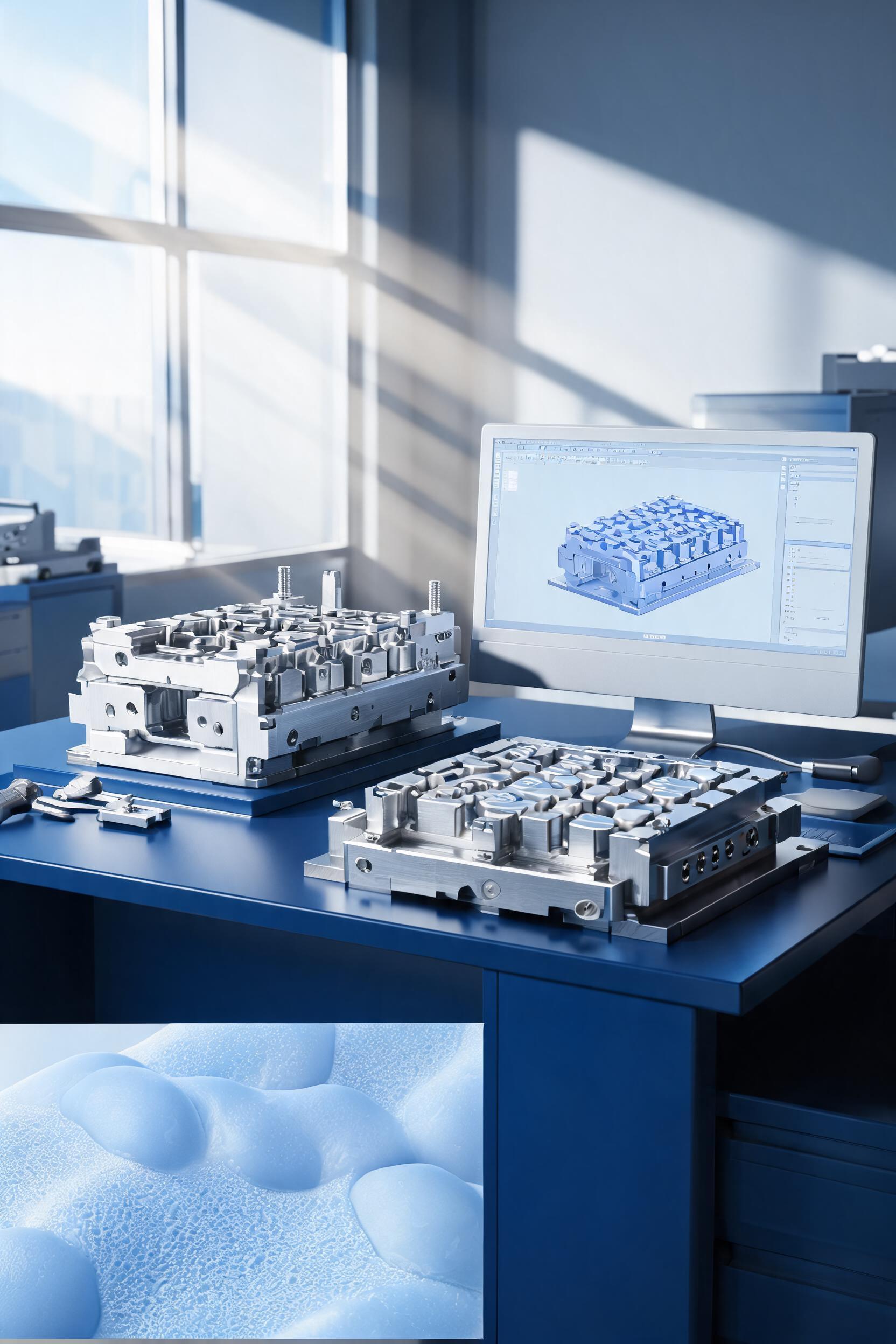
This article systematically sorts out the full process of silicone keypad mold opening, covering core links including pre-production product evaluation, mold structure design, processing technology selection, trial mold debugging and acceptance. It explains key technical points such as dimensional accuracy control, demolding optimization, and wear resistance improvement in detail, and summarizes solutions to common mold opening defects, helping enterprises reduce mold opening costs, shorten development cycles, and improve the yield of mass-produced silicone keypads.
Silicone keypad mold opening (硅胶按键开模) is the core process of manufacturing liquid silicone rubber (LSR) keypads, directly determining the dimensional accuracy, surface quality, functional performance, and production efficiency of final products. LSR keypads are widely used in consumer electronics, industrial control equipment, medical devices, and automotive interiors due to their excellent elasticity, temperature resistance, chemical stability, and tactile feedback. Unlike thermoplastic injection molds, LSR keypad molds require specialized design for material curing characteristics, low viscosity flow behavior, and demolding requirements, making the mold opening process a high-precision, multi-stage engineering task. A poorly executed mold opening process can lead to defects such as flash, incomplete filling, uneven key travel, poor conductivity, and shortened mold lifespan, increasing production costs by 20–35% and delaying time-to-market by 4–8 weeks. This guide systematically breaks down the full silicone keypad mold opening workflow, from design validation to post-sampling optimization, with technical parameters, tolerance standards, and defect mitigation strategies to help engineering teams achieve high yield, high reliability keypad production.
The success of silicone keypad mold opening depends on 60% of pre-design work, as design flaws identified after mold manufacturing often require costly rework or even full mold scrapping. This stage focuses on aligning product functional requirements with mold processing feasibility, eliminating potential risks before machining begins.
First, the mold engineering team must collaborate with the product design team to clarify all functional and dimensional requirements, and conduct a feasibility review for LSR processing. The core indicators that need to be confirmed include:
For keypads with integrated conductive elements, the design team must also verify the alignment tolerance between the conductive contact area on the mold and the key center: the maximum allowable offset is 0.05 mm, otherwise actuation failure or inconsistent conductivity may occur. For backlit keypads, the mold design must reserve a 0.1 mm thick light-transmitting area on the key top, and avoid draft angles in this region to prevent uneven light diffusion.
Material selection directly affects mold structure design and processing parameters, and needs to be determined based on product application scenarios and production volume requirements.
For LSR materials, common grades for keypads and their applicable scenarios are shown below:
For mold steel selection, the choice depends on production batch size and surface requirements:
For keypads requiring laser etching or spray coating, the mold cavity surface needs to be subjected to texturing or polishing treatment before processing, and the surface roughness grade must be confirmed with the post-processing team in advance.
Mold structure design is the core link of silicone keypad mold opening, which needs to balance LSR flow characteristics, curing efficiency, demolding convenience, and production cost. Unlike thermoplastic molds, LSR keypad molds require special design for cold runner systems, venting structures, and ejection mechanisms to adapt to the low viscosity and thermal curing properties of LSR.
The basic structure of an LSR keypad mold includes a cavity plate, core plate, runner system, venting structure, ejection system, and temperature control system, with three key design points:
First, the runner system design. LSR has low viscosity (1,000–10,000 cP at injection temperature), so the runner system should adopt a cold runner design to avoid premature curing of LSR in the runner. For multi-cavity molds, the runner length difference between each cavity should be controlled within 5% to ensure consistent filling pressure and reduce dimensional deviation between different keypads. The gate diameter is usually 0.2–0.8 mm: a smaller gate reduces gate marks on the product surface, but increases injection pressure requirements; a larger gate is suitable for large-size keypads with high filling volume. For high-precision keypads, valve gates can be used to accurately control the injection volume, reducing flash and material waste by 15–20% compared to open gates.
Second, the venting structure design. LSR curing will release a small amount of low molecular weight byproducts, and air entrainment during injection can easily lead to incomplete filling and surface voids. The venting groove of the keypad mold is usually set at the end of the filling flow path, with a depth of 0.01–0.03 mm and a width of 5–10 mm: if the venting groove is too deep, it will cause flash; if it is too shallow, the venting effect will be insufficient. For keypads with complex structures (such as multi-layer webbing or embedded conductive elements), additional venting pins can be added at the webbing gap, with a fit clearance of 0.005 mm between the venting pin and the mold hole to achieve venting without flash.
Third, the demolding and ejection system design. LSR has high adhesion, so the mold surface needs to have a draft angle of 1–3°: for key side walls, a draft angle of 1.5° is recommended; for the outer edge of the keypad base, a draft angle of 2–3° is recommended to avoid tearing during demolding. The ejection system usually adopts an ejector pin plate structure, with the ejector pins arranged at the edge of the keypad base and the bottom of non-functional areas, to avoid leaving ejector marks on the key top or webbing area. For keypads with ultra-thin webbing (≤0.2 mm), air ejection can be used: the core plate is provided with micro air holes, and compressed air of 0.3–0.5 MPa is introduced during demolding to evenly separate the keypad from the mold surface, reducing the demolding defect rate by more than 30%.
After the mold design is completed, the machining process directly determines the final accuracy of the mold, and requires multi-stage quality control to ensure that the machining deviation is within the allowable range.
First, rough machining: use CNC milling to process the basic shape of the cavity and core plate, with a machining allowance of 0.3–0.5 mm reserved for subsequent finishing. For H13 and S136 steel, pre-heat treatment is required before rough machining to reduce internal stress and avoid deformation during subsequent processing.
Second, finishing: use high-speed CNC machining center (spindle speed ≥12,000 rpm) for fine milling, followed by electrical discharge machining (EDM) for complex structures such as webbing grooves, character grooves, and conductive contact positioning holes. The machining accuracy of EDM needs to reach ±0.01 mm, and the surface roughness after EDM is Ra ≤0.8 μm, which can reduce the subsequent polishing workload. For multi-cavity molds, each cavity needs to be measured by a coordinate measuring machine (CMM) after finishing, and the dimensional deviation of the key molding area must be ≤0.02 mm to ensure the interchangeability of products from different cavities.
Third, surface treatment: according to the product surface requirements, perform polishing, texturing, or coating treatment on the cavity surface. For matte keypads, sandblasting or chemical texturing is used, with the texturing depth controlled at 0.02–0.05 mm to ensure consistent surface roughness across the entire cavity. For high-gloss keypads, mirror polishing is required to reach Ra ≤0.1 μm, and a nano-diamond coating can be applied to the cavity surface to reduce LSR adhesion and extend mold life by 20–30%.
After all parts are processed, pre-assembly is required: check the fit clearance between the cavity and core plate (the maximum allowable clearance is 0.005 mm to avoid flash during production), the smoothness of the ejection system movement, and the sealing of the runner system. Any deviation found during pre-assembly requires rework of the parts before proceeding to the trial sampling stage.
Mold trial (T0 sampling) is the key stage to verify the rationality of mold design and machining quality, and to adjust the injection molding process parameters to achieve mass production yield standards. The entire trial process needs to follow a standardized process to avoid missing potential defects.
The T0 sampling process is divided into 5 steps to ensure comprehensive data collection:
After the mold is modified according to the T0 trial results, T1 and T2 trials are required to verify the stability of the modification effect and process parameters, and then conduct batch production validation.
For batch validation, 500–1000 consecutive samples are produced under the optimized process parameters, and the yield rate is counted. For consumer electronics keypads, the qualified yield rate needs to reach ≥95%; for medical and automotive keypads, the yield rate needs to reach ≥98% to meet the mass production requirements. In addition, the mold running stability needs to be tested: after continuous production for 72 hours, check whether the cavity surface has wear, whether the ejection system is operating smoothly, and whether the dimensional deviation of the product exceeds the standard. For molds with wear-resistant coating, the wear amount of the cavity surface after 10,000 shots should be ≤0.002 mm to ensure long-term production accuracy.
After passing the batch validation, the mold is officially accepted, and the final delivery materials include:
Proper maintenance after mold opening can extend the mold lifespan by 30–50%, reduce production downtime, and ensure long-term stable product quality. LSR keypad molds have special maintenance requirements due to the characteristics of LSR curing and material adhesion.
During daily production, the following maintenance operations need to be performed according to the usage frequency:
When the mold is not in use for a long time, the following storage measures need to be taken:
For molds that have reached the end of their designed lifespan, partial refurbishment can be carried out to extend their service life: re-polish or re-coat the worn cavity, replace the worn ejector pins and positioning pins, and re-machine the webbing groove area with large dimensional deviation. The refurbishment cost