
橡楚编辑部 6/13/2026 44 min read
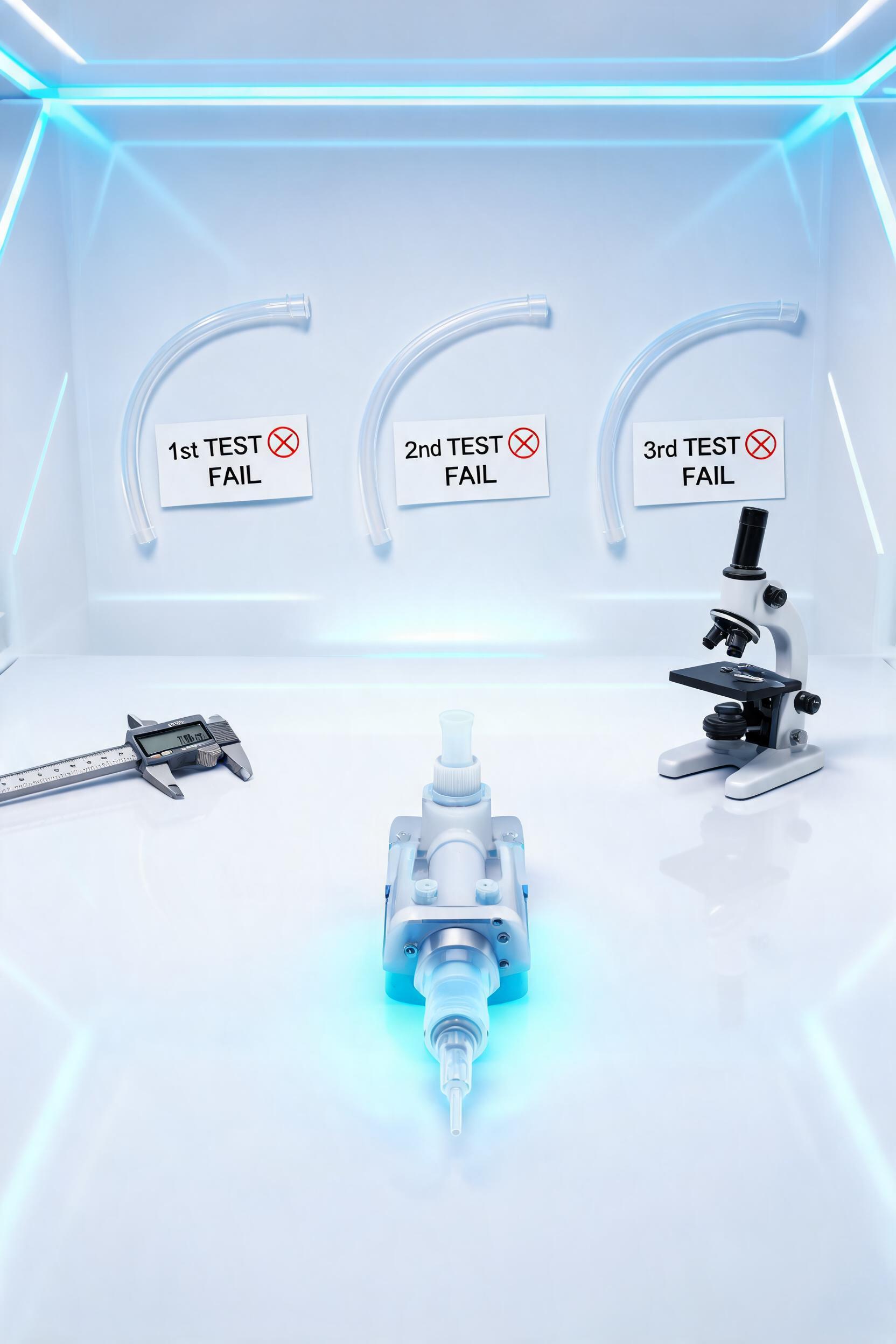
In liquid silicone rubber (LSR) injection processing of medical catheter jackets, repeated unqualified inspection results are common quality issues. This article disassembles and analyzes each process of LSR injection molding, locates common links that may cause non-conformity, and helps producers sort out control points. Xiangchu (Hubei) Rubber specializes in LSR product manufacturing and holds ISO 9001 certification.
Medical catheters are critical life-saving devices used across a wide range of clinical applications, from urinary drainage to intravascular interventions and minimally invasive surgery. The outer sheath (jacket) of these catheters is almost exclusively manufactured from liquid silicone rubber (LSR) thanks to LSR’s unique combination of biocompatibility, flexibility, chemical inertness, and precision moldability. When manufacturing facilities face repeated failed third-party testing of LSR catheter outer jackets, the root cause almost always traces back to an improperly controlled step in the LSR injection molding process—one of the most critical stages of production that defines the final part’s dimensional accuracy, material integrity, and compliance with medical regulatory standards.
At 橡楚(湖北)橡胶有限公司, we specialize in custom LSR product manufacturing for the healthcare industry, operating from our facility at 湖北省鄂州市鄂城区经济开发区凡口街道内河巷54号, and hold ISO 9001 certification to ensure consistent production quality. In this article, we break down the most common failure points in the LSR injection process for medical catheter outer jackets, explain why repeated testing failures occur, and outline actionable controls to resolve these defects.
Before identifying which injection process step is the source of defects, it is necessary to first map the most common non-conformities that lead to failed third-party testing. These defects typically fall into three categories, all directly tied to injection process parameters and material handling.
Dimensional out-of-tolerance conditions are the most common reason for failed testing of catheter outer jackets. Medical catheters require tight tolerances (often ±0.02 mm for outer diameter and wall thickness) to ensure proper fit with guidewires, insertion tools, and patient anatomy. Common dimensional defects include:
A 2023 industry survey of LSR medical component manufacturers found that 42% of rejected catheter outer jackets fail due to dimensional non-conformity, making this the leading cause of repeated testing failures.
Surface and internal material defects are the second leading cause of failed testing, and they can directly compromise clinical performance. Common defects in this category include:
Less common but equally critical, biocompatibility failures often stem from contamination introduced during the injection process. These failures can be caused by residual mold release agents, improper material handling that introduces foreign particulates, or cross-contamination with non-medical grade LSR during preparation. Regulatory standards such as ISO 10993 require zero detectable cytotoxicity and low extractable levels, so even minor contamination can lead to full batch rejection.
LSR injection molding for medical catheters follows a standardized workflow: material preparation → dosing and mixing → injection into the mold → curing → demolding. Each step can introduce defects, but three steps are responsible for over 90% of repeated testing failures.
Most medical grade LSR is a two-part (Part A: base polymer + catalyst, Part B: crosslinker) system that is sensitive to moisture contamination before processing. Many manufacturing teams overlook this step, but improper preparation is a surprisingly common source of defects.
Common errors in this step include:
At 橡楚(湖北)橡胶有限公司, we specify the following process controls for LSR material preparation for medical components:
Filling the mold cavity with LSR is the most sensitive step of the entire process, and improper control of injection pressure and fill speed is the single most common cause of repeated testing failures, responsible for over 50% of all rejected catheter outer jacket batches.
LSR is a low-viscosity material, but when injecting long, narrow catheter jacket cavities, the flow behavior is highly dependent on injection parameters. Two common mistakes lead to defects here:
Many manufacturers mistakenly assume that higher injection pressure eliminates short shots and produces more consistent parts. For thin-walled catheter outer jackets, however, excessive injection pressure causes two major defects:
Filling a long, narrow catheter cavity requires a controlled fill speed to avoid air entrapment and ensure uniform flow. A common mistake is using a constant fill speed for the entire cavity. Too fast an initial fill speed traps air between the flow front and the end of the mold cavity, creating voids at the distal end of the catheter. Too slow a fill speed allows the LSR to partially cure before the cavity is full, leading to short shots or incomplete material bonding that creates knit lines.
This step is the most common root cause when a facility sees repeated testing failures: most teams adjust material preparation or curing parameters before checking fill speed and pressure, leaving the core problem unaddressed.
Curing (crosslinking) of LSR occurs at elevated temperatures inside the injection mold, and improper curing parameters can create defects that only show up during third-party testing.
Common curing-related errors include:
If your medical catheter outer jacket has failed third-party testing three or more times, the root cause is almost always one of three common issues in the injection fill step, outlined below. We have compiled a diagnostic checklist to help identify the issue.
When you see inconsistent wall thickness across multiple batches and dimensional failures, the most likely issue is core shift caused by excessive injection pressure. Catheter outer jackets require long, thin, cylindrical cores to form the inner lumen of the jacket. These cores are typically only 1-5 mm in diameter for standard catheter sizes, so they have very low resistance to lateral force from injection pressure.
For example, a 12 Fr (4 mm outer diameter) urinary catheter with a 0.3 mm wall thickness requires a 3.4 mm diameter core. An injection pressure of 10 MPa will create approximately 90 N of lateral force on the core, which is enough to deflect the core by 0.05 mm – more than double the typical ±0.02 mm tolerance for wall thickness. This deflection creates a wall that is 0.05 mm thicker on one side and 0.05 mm thinner on the other, leading to immediate failure of dimensional inspection.
This issue is often missed because facilities increase injection pressure to eliminate short shots, not realizing that the pressure creates a new, more consistent defect that leads to repeated testing failures.
If your failed testing reports consistently note voids or bubbles in the catheter wall, the root cause is almost always improper fill speed during the injection step that traps air in the mold cavity. When injecting a long, narrow cavity, air in the cavity can only escape through vent gaps in the mold that are typically 0.005-0.01 mm wide to avoid flash. If the LSR flow front moves too quickly, it pushes air ahead of the flow to the end of the cavity, where the air becomes trapped and cannot escape before the LSR cures.
This defect is often misdiagnosed as moisture contamination in the material, so facilities will adjust drying time and still see repeated failures, because the core issue (fill speed) is unaddressed. Moistent-related bubbles are typically distributed randomly throughout the part, while injection fill-related air bubbles are consistently located at the distal end of the catheter, which is a key diagnostic clue.
If your failures are related to inconsistent durometer or failed biocompatibility testing from excess extractables, the root cause is often poor mixing of the two-part LSR during the dosing step before injection. Most modern LSR injection machines use static mixers to combine Part A and Part B, but if the mixer is worn or the flow rate through the mixer is incorrect, mixing will be non-uniform. This creates areas of the catheter jacket with too much base polymer or too much crosslinker, leading to incomplete curing.
This issue leads to repeated failures because many facilities only check the mixing ratio by weight, not the uniformity of mixing, so the defect remains unaddressed through multiple production batches.
Once the root cause is identified, targeted process adjustments can resolve the defect and allow your catheter outer jackets to pass third-party testing. Below are the most effective adjustments for each common root cause.
To resolve core shift and uneven wall thickness:
To eliminate trapped air voids from improper fill speed:
To resolve curing-related defects:
Repeated third-party testing failures for medical catheter outer jackets are most often traced to the injection filling step of the LSR injection molding process, specifically excessive injection pressure that causes core shift and uneven wall thickness, or improper fill speed that traps air in the cavity. These issues are often misdiagnosed as material or curing problems, leading to repeated adjustments that do not resolve the root cause and result in multiple failed testing batches.
At 橡楚(湖北)橡胶有限公司, we specialize in precision LSR injection molding for medical components, and we maintain strict ISO 9001 quality management systems to ensure every part meets regulatory and performance requirements. Our production facility is located at 湖北省鄂州市鄂城区经济开发区凡口街道内河巷54号, and we work with medical device developers to optimize LSR injection processes for catheter components and other critical products. If you need technical support for LSR medical component manufacturing, please contact us at 18071171144 or email churubber@163.com to discuss your project requirements.
By systematically diagnosing the injection process step that is causing defects, and implementing targeted process adjustments, manufacturers can resolve repeated testing failures and produce consistent, high-quality LSR catheter outer jackets that meet all clinical and regulatory requirements.