
橡楚编辑部 6/18/2026 50 min read
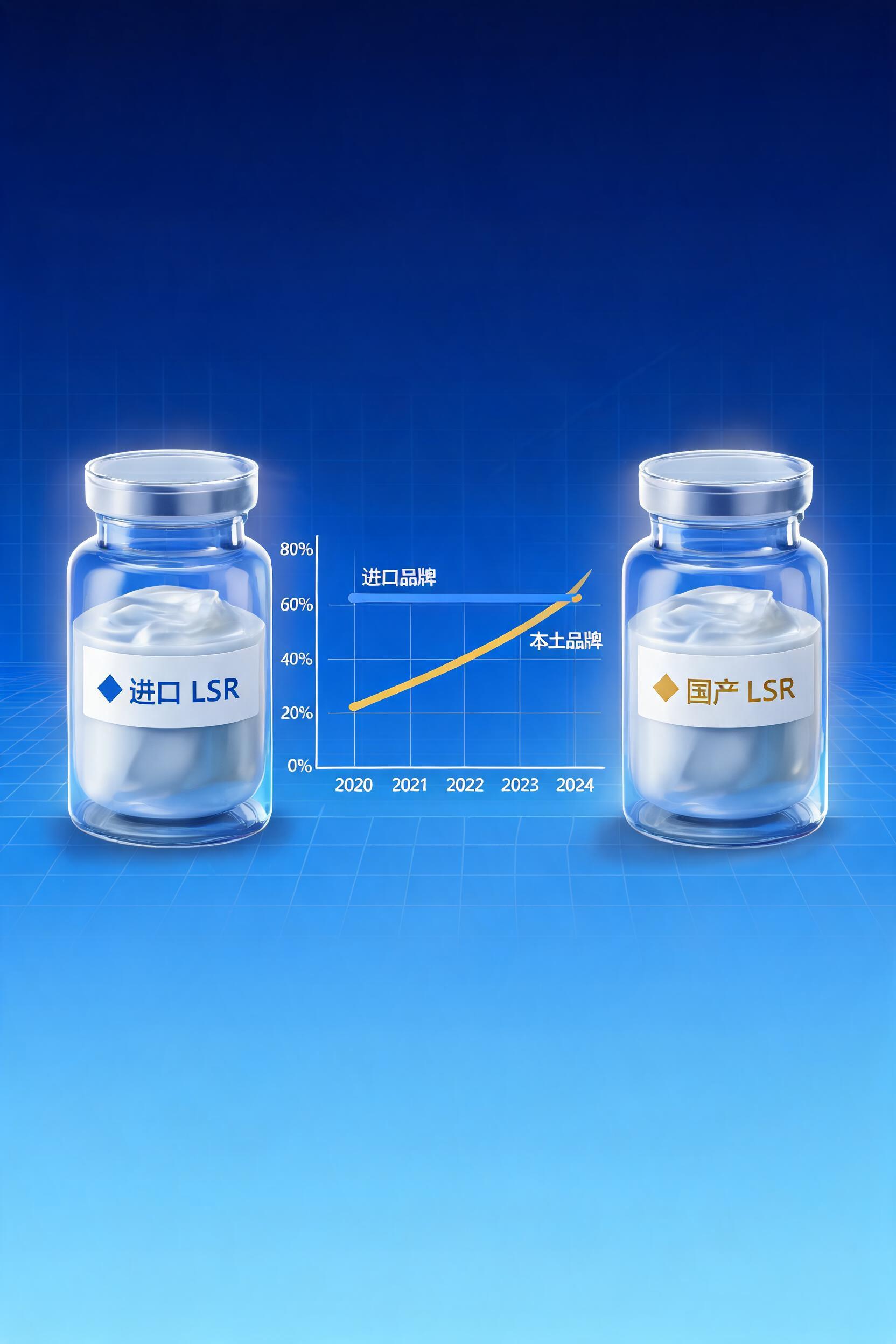
Against the background of global organic silicon industry changes and the rise of local LSR brands, new standards are emerging in the liquid silicone rubber OEM industry. Xiangchu (Hubei) Rubber Co., Ltd. is located in Ezhou City, Hubei Province, with ISO 9001 certification. We focus on LSR products manufacturing, and explore feasible paths to balance import stability and localization substitution.
The global organic silicon industry has entered a period of unprecedented structural change over the past five years. Geopolitical trade frictions, supply chain disruptions caused by the COVID-19 pandemic, and rising demand for localized manufacturing across medical, consumer electronics, automotive, and new energy sectors have upended long-standing market dynamics. For decades, original equipment manufacturers (OEMs) and brand owners around the world relied on a small set of multinational LSR suppliers for high-precision molded components, prioritizing consistent material quality and process stability over cost and lead time. Today, that model is shifting.
As local LSR material producers and component manufacturers gain technical capacity across Asia, the question is no longer whether to pursue localized alternative suppliers, but how to find an OEM partner that can deliver the same level of quality and consistency associated with imported solutions while unlocking the cost and supply chain advantages of domestic production. At橡楚(湖北)橡胶有限公司, a specialized LSR OEM manufacturer based in 湖北省鄂州市鄂城区经济开发区凡口街道内河巷54号, we have spent the last decade refining our processes to meet this new market demand. This article explores the core changes reshaping the organic silicon industry, the emerging new standards for LSR OEM manufacturing, and how我们 balance the requirement for进口-level quality stability with the growing demand for国产化替代.
The structural shift in the organic silicon industry stems from three interconnected drivers that have created pressure for change across the entire LSR supply chain. Understanding these changes is the first step to defining the new OEM standards that manufacturers must meet to serve modern global customers.
Prior to 2020, the global LSR component supply chain operated on a relatively centralized model. High-precision LSR molding for medical devices, automotive sensors, and consumer electronics waterproofing was dominated by a handful of multinational suppliers based in North America, Western Europe, and Japan, with raw material supply similarly concentrated among 5 major global chemical producers. The 2020 COVID-19 lockdowns exposed critical vulnerabilities in this model: port closures and shipping delays pushed lead times for LSR components from 4-6 weeks to 12-16 weeks, while ocean freight costs increased by more than 300% for trans-Pacific routes.
This disruption forced OEMs to re-evaluate their single-source supply chain strategies. A 2023 industry survey by the Global Silicones Council found that 78% of medical device and automotive OEMs have added at least one regional LSR supplier to their supply chain since 2021, with the primary goals of reducing lead time volatility and cutting logistics costs.
As demand for localized supply grows, domestic LSR producers and component manufacturers in China have made significant technical progress, closing the quality gap with multinational incumbents. Ten years ago, domestic LSR materials suffered from consistent issues: inconsistent cross-linking density, high volatile organic compound (VOC) content, and poor aging resistance that made them unsuitable for high-reliability applications like medical implants or automotive powertrain components. Today, domestic raw material producers have refined their purification and polymerization processes, bringing performance parameters in line with imported materials for 90% of common industrial applications.
This growth in local raw material capacity has created the foundation for local LSR OEM brands to emerge. Unlike contract manufacturers that rely entirely on imported materials to deliver quality, the new generation of local LSR OEMs can source qualified materials locally while maintaining the process controls to match international quality standards.
Across every major LSR end-use sector, OEMs face growing pressure to reduce product costs without sacrificing quality. In the consumer electronics sector, falling average selling prices for smartphones and wearable devices have forced brands to cut component costs by 10-15% per product generation. In the automotive sector, the shift to electric vehicles (EVs) requires dozens of additional LSR components per vehicle, putting pressure on manufacturers to reduce per-component costs to hit overall vehicle price targets.
Imported LSR components typically carry a 30-50% price premium over locally produced alternatives, even when quality is identical, due to higher labor, logistics, and overhead costs. This price gap has made国产化替代 an urgent priority for OEMs looking to maintain profit margins. However, the majority of local LSR manufacturers have not yet been able to match the process consistency and quality control standards of multinational suppliers, creating a gap in the market that 橡楚(湖北)橡胶 has worked to fill.
The shift in the market has created a new set of requirements for LSR OEM partners, replacing the old binary choice between expensive, stable imported solutions and low-cost, inconsistent local alternatives. Modern OEMs need a partner that can meet five interconnected new standards, which we have integrated into our core operating model at橡楚(湖北)橡胶.
The first core standard of the new LSR OEM model is the ability to validate and process both imported and domestic LSR materials to the same quality outcome. Many local manufacturers struggle to deliver consistent quality when switching between material sources, due to lack of in-house material testing capabilities. Many multinational OEMs, by contrast, only process their own branded materials, forcing customers to pay a premium for material that meets their specifications.
At橡楚(湖北)橡胶, we have implemented a two-step incoming material validation process that ensures consistent performance regardless of material source. This process includes:
This process allows us to work with customers to use qualified domestic LSR materials when cost is a priority, or switch to imported materials if required by specific application regulations, without changing our final quality output.
The second core new standard is full production traceability that meets global regulatory requirements for high-reliability sectors. For medical device and automotive customers, full traceability of every component, from raw material lot to final shipment, is non-negotiable. Many local LSR manufacturers lack the process documentation systems to deliver this level of traceability, while imported OEMs charge a significant premium for compliance documentation.
As an ISO 9001 certified LSR manufacturer, we have built our quality management system around full traceability for every production run. Every component we produce can be traced back to:
We maintain all documentation for a minimum of 7 years after production, in line with requirements from the U.S. FDA and IATF 16949 automotive quality standards. This allows our export customers to meet their own regulatory requirements without additional third-party testing or documentation costs.
The third core new standard is the ability to scale production flexibly from small prototype batches to full mass production, without re-validating the entire process. Many OEMs work with separate suppliers for prototyping and mass production, which leads to process variation and additional qualification costs. Multinational OEMs typically require high MOQs for mass production, which makes it difficult for new product development projects with small initial volumes.
At橡楚(湖北)橡胶, we have invested in equipment that supports flexible production across all volume ranges: we operate 3 small-volume precision injection molding machines for prototype and low-volume production (MOQ starting at 100 pieces) and 8 high-volume automated molding machines for mass production (up to 10 million pieces per month). We use the same material validation and process control standards for all volume ranges, so when a customer moves from prototyping to mass production, no re-qualification of the part is required, reducing lead time for new product launches by an average of 2-3 weeks.
At橡楚(湖北)橡胶, our core strategic positioning is to be the LSR OEM partner that bridges the gap between imported quality and the benefits of国产化替代. We have implemented three core operational strategies to deliver on this promise, building on our 10+ years of specialized experience in LSR molding.
The foundation of our ability to deliver consistent quality matching imported standards is a standardized process control framework that covers every step of production, from mold design to final packaging. Many local LSR manufacturers rely on operator experience to adjust molding parameters, which leads to batch-to-batch variation. We have standardized every process parameter for every part we produce, eliminating human error as a source of quality variation.
Our process control framework includes the following key steps, with tolerance limits set to match international leading standards:
All our injection molding machines are equipped with real-time parameter monitoring systems that automatically stop production if any parameter deviates outside our tolerance limits. This ensures that no out-of-spec parts enter the final testing process, reducing our overall defect rate to an average of 0.32% across all production batches, which matches the average defect rate of multinational LSR OEMs.
To maintain our process standards, we conduct quarterly internal process audits and annual third-party audits to maintain our ISO 9001 certification. All our production supervisors and quality engineers receive annual training on international quality control standards, ensuring that our process knowledge stays aligned with global best practices.
To support both imported quality requirements and国产化替代 demand, we have built a dual-supply-chain material management system that maintains qualified material sources from both domestic and imported suppliers, with rigorous validation to ensure performance parity. We work with 3 leading domestic LSR material producers and 2 major multinational LSR material producers, all of which have pre-validated material grades for different applications.
When a customer approaches us with a new project, we work with them to select the material source that best matches their requirements for cost, performance, and regulation:
This flexibility means that we can support customers as they transition gradually to国产化替代, starting with lower-risk components and moving to higher-reliability components as they build confidence in domestic material performance. We do not force customers to use domestic materials if they have specific requirements for imported sources, which makes us a flexible partner for supply chain transition.
One of the core benefits of国产化替代 is cost reduction, but many local manufacturers cut costs by reducing quality control standards or using lower-grade raw materials. At橡楚(湖北)橡胶, we achieve cost reduction through operational efficiency and local supply chain advantages, not through cutting quality. Our location in 湖北省鄂州市鄂城区经济开发区 gives us access to a skilled manufacturing workforce at lower labor costs than major coastal industrial centers, and our proximity to major domestic LSR material production hubs reduces raw material logistics costs.
Compared to imported LSR components from European or North American OEMs, we can deliver the same quality components at a 20-30% lower total cost, including all logistics and shipping costs to export destinations. The breakdown of our cost advantage is as follows:
We pass 90% of these cost savings on to our customers, while maintaining the same process control and quality standards as imported OEMs. This allows our customers to achieve significant cost reduction through国产化替代 without taking on additional quality risk.
Even with a qualified OEM partner, the transition from imported LSR components to localized alternatives comes with common challenges that customers need to address. At橡楚(湖北)橡胶, we have developed structured processes to help customers overcome these challenges, making the transition smooth and low-risk.
For regulated applications like medical devices or automotive safety components, changing material suppliers requires full re-qualification of the component, which can be time-consuming and costly. To reduce this burden, we work with customers during the design and material selection phase to provide all required material test data and process documentation, so customers can integrate the data into their own qualification submissions. We can also coordinate with third-party testing laboratories to conduct any required additional testing, reducing the administrative burden on the customer.
A common issue when moving production from a multinational OEM to a local OEM is quality variation when scaling from small trial batches to full mass production. At橡楚(湖北)橡胶, we eliminate this issue by using the same process control framework and quality standards for all production volumes, from 100-piece prototypes to 10-million-piece mass production runs. We also produce a trial batch of 1000-5000 parts for full customer qualification before starting full mass production, so any process adjustments can be made before large volumes are produced.
One of the core reasons customers pursue国产化替代 is to improve supply chain continuity. We maintain a minimum 2-week inventory of pre-approved raw materials for all active production jobs, and we have alternative pre-approved material suppliers for every common LSR grade, so if one supplier experiences a production disruption, we can switch to an alternative supplier without changing component performance or delaying delivery. Our average on-time delivery rate over the past 3 years is 99.6%, which matches the on-time performance of leading multinational LSR OEMs.
The organic silicon industry's current structural change has created a clear demand for a new type of LSR OEM partner: one that can deliver the quality consistency and regulatory compliance traditionally associated with imported solutions, while unlocking the cost and supply chain benefits of国产化替代. This is not an either/or proposition: modern OEMs need a partner that can balance both, adapting to the specific needs of each application and each customer's supply chain strategy.
At橡楚(湖北)橡胶有限公司, based in 湖北省鄂州市鄂城区经济开发区凡口街道内河巷54号, we have built our entire business around this new standard. As an ISO 9001 certified specialized LSR manufacturer, we combine international-standard process control, a flexible dual material supply chain, and operational efficiency to deliver high-quality LSR components that meet our export customers' requirements for quality, cost, and delivery. Whether you are looking to transition part of your LSR component supply to a localized alternative to reduce cost and supply chain risk, or you need a reliable OEM partner that can work with both imported and domestic materials to meet your specific requirements, we are ready to support your project.
For inquiries about LSR OEM services, please contact us at +86 18071171144 or email us at churubber@163.com.