
橡楚编辑部 7/16/2026 45 min read
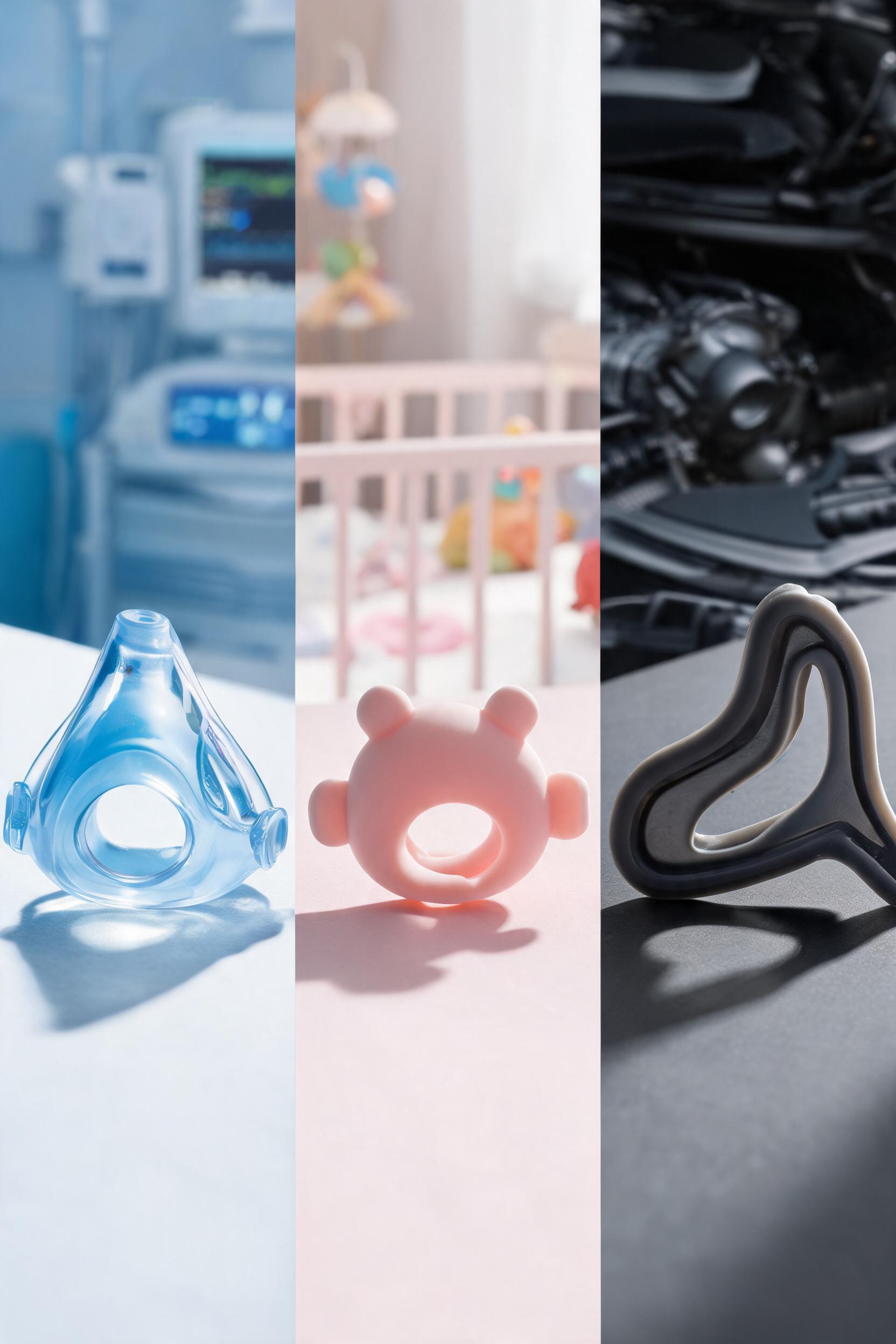
Liquid silicone rubber (LSR) parts for medical devices have become core supporting components of high-end medical equipment such as respiratory devices, interventional instruments and surgical tools due to their excellent biocompatibility, disinfection resistance and high stability. This article sorts out the material properties and mainstream application scenarios of such parts, and explains the quality control points in the production process combined with regulatory requirements such as ISO13485 and FDA, helping medical component manufacturers improve product compliance.
Liquid Silicone Rubber (LSR) has emerged as a dominant material for critical medical device components over the past two decades, outperforming traditional materials such as polyvinyl chloride (PVC), thermoplastic elastomers (TPE), and natural rubber in high-risk clinical scenarios. Medical-grade LSR is a two-part, platinum-catalyzed elastomer formulated to meet strict biocompatibility and performance requirements, making it uniquely suited for applications that demand long-term tissue contact, sterilization resistance, and precision manufacturing. The global market for medical LSR parts is projected to reach $2.7 billion by 2028, driven by rising demand for minimally invasive surgical tools, wearable diagnostic devices, and implantable components. This article analyzes the core material properties of medical LSR parts, their leading clinical applications, and the global regulatory compliance frameworks that govern their production and use, with a focus on technical specifications that differentiate medical-grade LSR from industrial or consumer-grade variants.
Medical LSR parts are engineered to address unmet clinical needs that cannot be fulfilled by conventional polymers, with inherent properties tailored to the rigors of healthcare environments. These features are consistent across molded, extruded, and 3D-printed LSR components, and are validated through standardized material testing protocols prior to regulatory approval.
Medical-grade LSR is composed of polydimethylsiloxane (PDMS) polymers, reinforcing fumed silica fillers, and platinum-based curing agents, with no added plasticizers, phthalates, or latex allergens that pose patient safety risks. The material’s crosslinked molecular structure creates a stable elastomeric network that retains its properties across extreme conditions common in medical settings.
Key mechanical performance parameters for medical LSR are outlined in Table 1, comparing values across three common durometer grades used in device manufacturing:
Notably, medical LSR exhibits 3x higher elongation at break than medical-grade TPE and 15x lower compression set than plasticized PVC after repeated autoclaving, making it ideal for dynamic sealing applications such as syringe plungers and surgical instrument valves. The material’s low water absorption and non-porous surface also prevent bacterial colonization: independent testing per ISO 22196 shows that medical LSR surfaces reduce Staphylococcus aureus and Escherichia coli viability by 99.2% and 98.7% respectively, even without added antimicrobial coatings.
LSR’s low viscosity (1,000–10,000 cP before curing) enables high-precision injection molding of complex geometries with tolerances as tight as ±0.005 mm, a level of accuracy unattainable with most thermoplastic elastomers for high-volume production. The cold-runner injection molding process for medical LSR eliminates material waste by 95% compared to hot-runner thermoplastic processes, as uncured LSR in the runner system can be reused for subsequent production runs, reducing manufacturing costs for single-use device components.
Design flexibility is a key advantage of medical LSR parts, with support for:
For low-volume or patient-specific components, additive manufacturing of medical LSR via direct ink writing (DIW) has recently been validated to produce parts with 92% of the mechanical strength of molded LSR, enabling on-demand production of custom surgical seals and prosthetic components for personalized medicine applications.
Medical LSR parts are compatible with all common hospital sterilization methods, with no measurable degradation in mechanical or biocompatibility properties after repeated sterilization cycles, a critical advantage over thermoplastics that degrade after 5–10 autoclave cycles. Table 2 outlines sterilization compatibility for medical LSR:
LSR also exhibits exceptional resistance to common medical chemicals, including isopropyl alcohol, povidone-iodine, hydrogen peroxide, and most chemotherapy drugs, with less than 0.5% weight change after 7 days of immersion per ISO 175 testing. This resistance prevents leaching of material components into patient fluids and degradation of parts during clinical cleaning and disinfection, reducing the risk of adverse patient reactions.
The unique combination of biocompatibility, precision, and durability has led to the adoption of medical LSR parts across nearly every segment of medical device manufacturing, from low-risk single-use consumables to high-risk long-term implants.
Implantable medical LSR parts are designed for short-term (less than 30 days) or long-term (more than 30 days) contact with internal tissues, blood, and organs, and require the highest level of biocompatibility validation. Leading applications include:
All implantable LSR parts undergo extensive biocompatibility testing including ISO 10993-5 (cytotoxicity), ISO 10993-6 (local tissue reaction), and ISO 10993-18 (chemical characterization) to ensure safety for long-term patient use.
LSR parts are ubiquitous in surgical and interventional settings, where precision and reliability directly impact patient outcomes. Common applications include:
Single-use LSR surgical components eliminate the risk of cross-contamination between patients, and can be disposed of with standard medical waste without releasing toxic byproducts during incineration, unlike PVC components that release dioxins when burned.
The growth of digital health and point-of-care diagnostics has driven increased demand for LSR parts that balance biocompatibility, flexibility, and user comfort for long-term skin contact. Key applications include:
Medical LSR parts are classified as medical device components by global regulatory bodies, with strict requirements for material traceability, process validation, and post-market surveillance to ensure patient safety. Compliance frameworks vary by region, but share core requirements for biocompatibility, manufacturing consistency, and performance validation.
The two primary regulatory bodies governing medical LSR parts are the U.S. Food and Drug Administration (FDA) and the European Medicines Agency (EMA), with additional requirements in markets including China, Japan, and Brazil.
To ensure consistent compliance with regulatory requirements, medical LSR part manufacturers implement strict quality control protocols across the entire production lifecycle, from raw material incoming inspection to finished part performance testing.
For implantable LSR parts, additional testing includes accelerated aging testing per ASTM F1980 to validate 5–10 year shelf life, and fatigue testing to simulate 10+ years of in vivo performance, with no measurable degradation in mechanical properties required for regulatory approval.
Medical LSR parts have revolutionized medical device design, offering a unique combination of biocompatibility, precision, and durability that addresses unmet clinical needs across implantable, surgical, and wearable diagnostic applications. The material’s inherent resistance to sterilization, low protein adsorption, and ability to be molded into micro-scale, complex geometries have enabled the development of minimally invasive surgical tools, long-term implants with improved patient outcomes, and wearable diagnostic devices that support remote patient monitoring.
As regulatory requirements continue to evolve, particularly for high-risk implantable and combination drug-delivery devices, medical LSR manufacturers are investing in advanced material formulations, including antimicrobial LSR, biodegradable LSR for temporary implants, and LSR composites with enhanced radiopacity for imaging visibility. These innovations, combined with ongoing improvements in additive manufacturing for custom LSR parts, will expand the use of medical LSR components in personalized medicine and point-of-care diagnostics in the coming decade.
For medical device manufacturers, partnering with LSR suppliers with proven expertise in regulatory compliance and medical-grade process validation is critical to reducing time-to-market for new devices and ensuring long-term patient safety. As the global healthcare industry continues to prioritize minimally invasive care and patient-centric device design, medical LSR parts will remain a core material for next-generation medical device innovation.