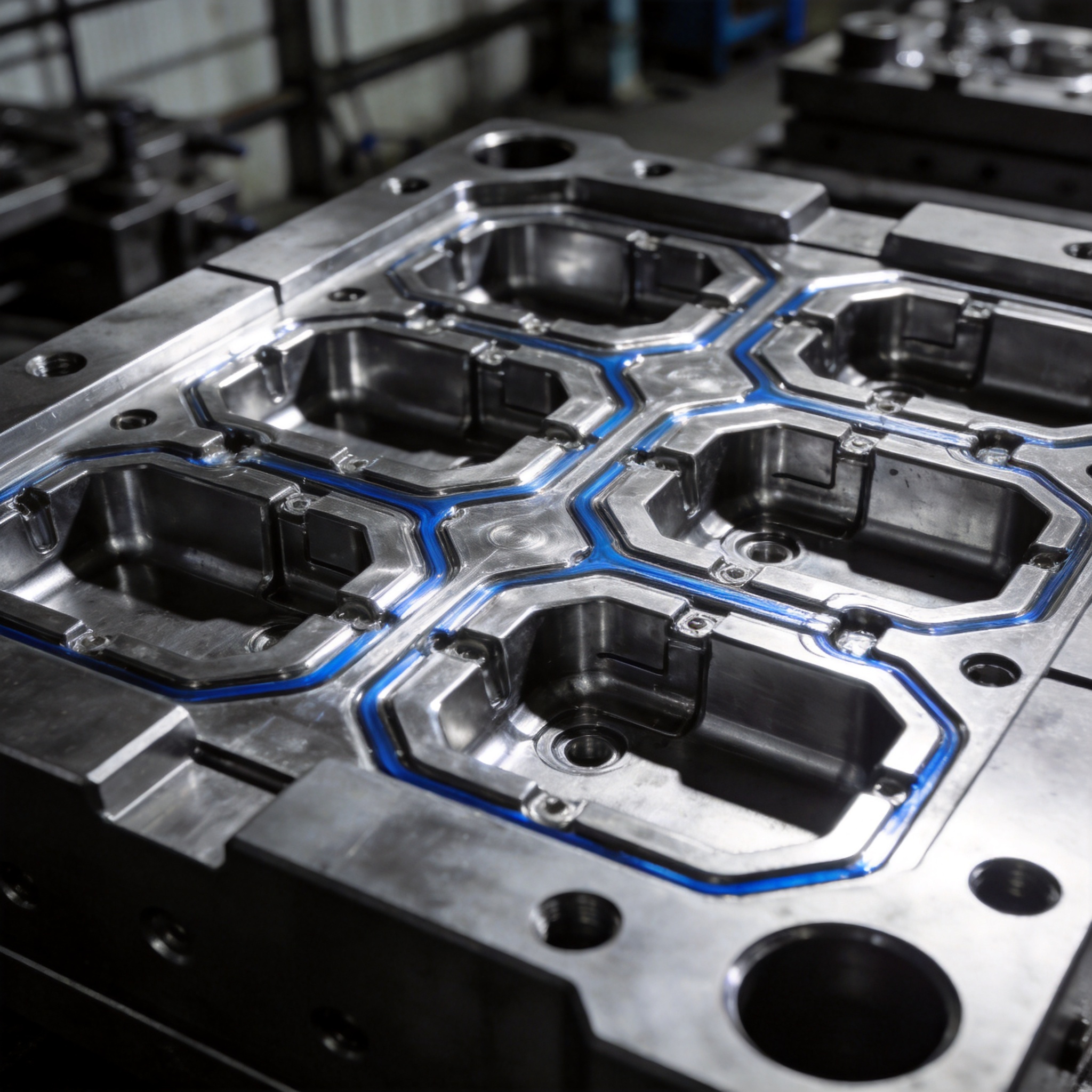
LSR mold design differs significantly from conventional thermoplastic molds, requiring specialized design in cold runners, venting, demolding, and cavity precision.
1. LSR Mold Design Characteristics
1.1 Differences from Thermoplastic Molds
LSR molds use cold runners (low temperature) instead of hot runners, molds need heating (150-200 degrees) instead of cooling, material shrinkage is 2-5% (higher than thermoplastic 0.5-2.5%), venting requirements are extremely high, demolding uses air blow/robots, and flash control is extremely strict.
1.2 LSR Flow Characteristics
Extremely low viscosity (1000-5000 Pa·s), can fill 0.01mm gaps, highly prone to flash, requires extremely precise parting line fit.
2. Cold Runner System Design
2.1 Design Principles
- Runner temperature controlled at 5-30 degrees
- Avoid dead corners and stagnation zones
- Minimize runner volume (reduce waste)
- Symmetrical layout for filling balance
2.2 Cold Runner Manifold
- Independent cooling circuits
- Thermal insulation between cold runner and hot mold
- Needle valve gates (common)
- Open gates (for thin-wall products)
3. Gate Design
3.1 Gate Type Selection
- Pinpoint gate: Minimal mark, for high-appearance products
- Film gate: For thin-wall large-area products
- Submarine gate: Auto-separation, for automation
- Direct gate: For large thick-wall products
3.2 Gate Dimensions
Gate diameter 0.3-1.5mm, gate length as short as possible, gate position on non-appearance/non-functional surface.
4. Venting Design
4.1 Importance
LSR has extremely low viscosity and fast fill speed. Poor venting causes burning, short shots, and surface defects (bubbles, splay marks).
4.2 Venting Methods
- Parting line vents: Depth 0.005-0.02mm, Width 5-10mm
- Insert venting: Vent pins/vent inserts
- Vacuum venting: Fully enclosed mold with vacuum pump
- Porous metal venting: Special material vent inserts
4.3 Vent Positions
Fill end points, weld line locations, blind hole bottoms, thick-to-thin wall transitions.
5. Cavity Precision Design
5.1 Dimensional Accuracy
- Cavity machining accuracy: plus or minus 0.005mm
- Fitting surface accuracy: plus or minus 0.003mm
- Parting line gap: less than 0.005mm
5.2 Surface Treatment
- Polishing: Mirror finish (Ra less than 0.05 micrometers) for optical products
- Sandblasting: Matte effect
- Texturing: Etching/EDM texture
- Coating: Hard chrome/nickel plating
5.3 Shrinkage Compensation
LSR shrinkage 2-5%, consider flow vs. transverse direction differences, compensation = finished dimension x (1 + shrinkage rate).
6. Demolding Design
- Air blow: Most common method
- Robotic removal: For precision products
- Rotary demolding: For threaded products
- Collapsible core: For undercut structures
- Minimum draft: 0.5 degrees (polished), recommended 1-3 degrees
7. Temperature Control System
- Heating rods + thermocouples (common)
- Oil circuit heating via mold temperature controller
- Induction heating (fast response)
- Independent temperature control per cavity
- Multi-point thermocouple monitoring
Conclusion
LSR precision mold design is comprehensive engineering. Cold runner design, venting systems, and cavity precision are the three core elements determining LSR mold quality.