
橡楚编辑部 5/18/2026 40 min read
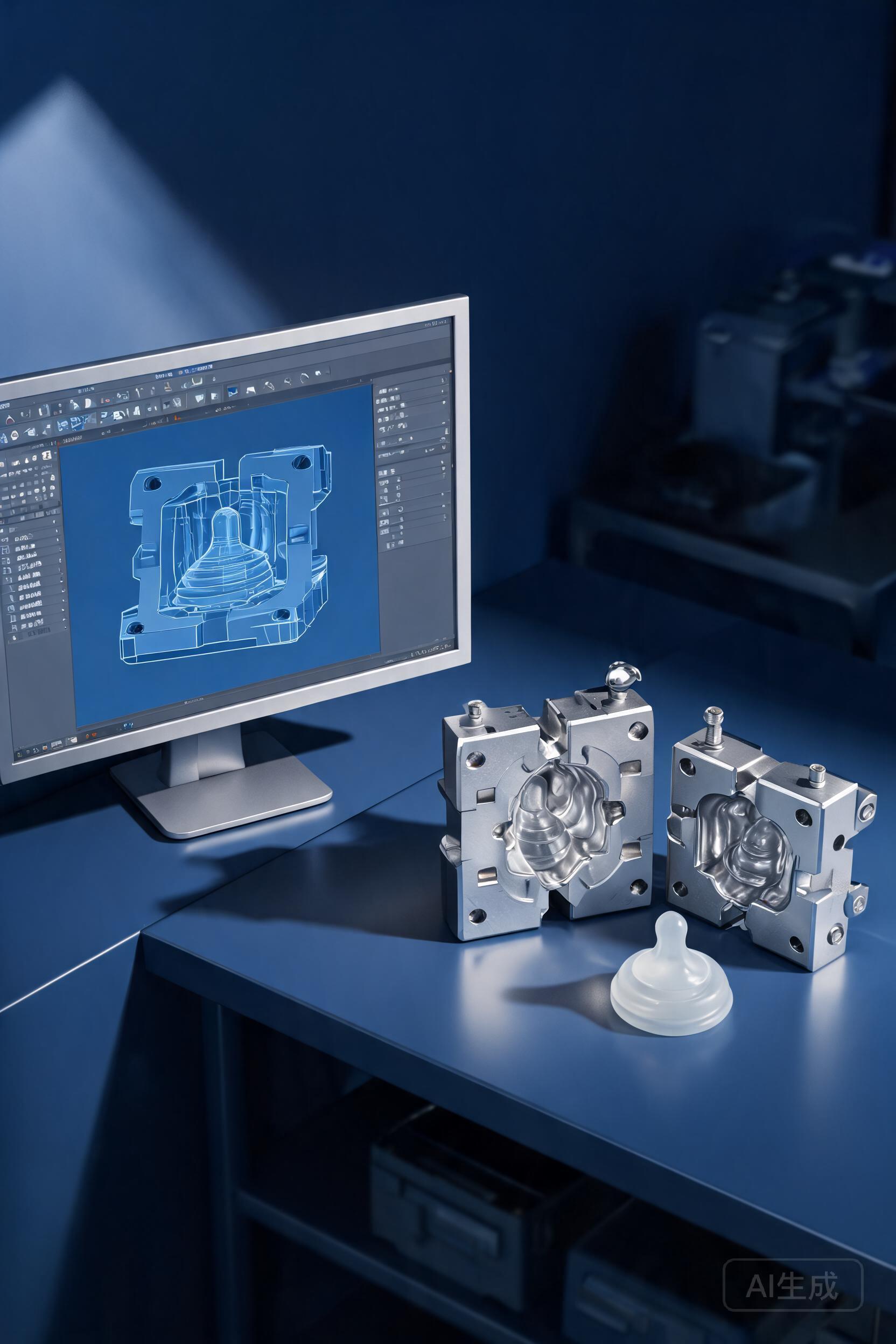
The manufacturing precision of liquid silicone rubber (LSR) nipple molds directly determines the dimensional consistency, surface finish, and safety of finished nipple products. The complete manufacturing process includes six core links: mold design evaluation, raw material selection, precision machining, surface polishing, assembly test molding, and quality inspection. This article breaks down the technical points of each link to help enterprises master quality control key points and reduce defective rate in mass production.
LSR (Liquid Silicone Rubber) nipples are a staple in infant feeding products, valued for their exceptional biocompatibility, temperature resistance (-60°C to 220°C), elasticity, and resistance to tear and wear. The performance, dimensional accuracy, and surface quality of these nipples are almost entirely dependent on the precision of their manufacturing molds. A high-quality LSR nipple mold can produce up to 500,000 defect-free parts before requiring maintenance, while a poorly fabricated mold may suffer from flash, dimensional deviation, or uneven venting after just 10,000 cycles. This article provides a technical deep dive into the end-to-end manufacturing process of LSR nipple molds, covering design optimization, material selection, precision machining, surface treatment, assembly, and validation.
The foundation of a reliable LSR nipple mold is rigorous upfront design and material selection, as LSR’s low viscosity (1,000–100,000 cP during injection) and high curing shrinkage (1.5%–3.0% for food-grade LSR) create unique constraints not present in thermoplastic molding.
LSR nipple designs must balance functional requirements (sucking resistance, anti-colic features, flow rate) with moldability. The first step is to define the nipple’s critical features: the teat tip (with 1–4 flow holes of 0.1–0.5 mm diameter), the anti-colic valve (usually a 0.2–0.3 mm thick slit), the base flange (for attachment to baby bottles), and the texture surface (often 2–5 μm Ra matte finish to mimic human skin).
Key mold design parameters are calculated based on these features:
Mold designers also integrate simulation tools such as Moldflow LSR module to predict flow front progression, curing time, and venting efficiency. For example, simulation of a 32-cavity mold may identify that cavities near the injection inlet fill 0.3s faster than edge cavities, prompting adjustments to runner length and diameter to balance fill time across all cavities to within ±0.05s.
LSR nipple molds are exposed to repeated thermal cycling (150–200°C during curing, ambient temperature during demolding), mechanical abrasion from LSR filler particles, and regular cleaning with alkaline food-safe detergents. Material selection must meet both mechanical performance and global food contact regulations (FDA 21 CFR Part 177.2600, EU 10/2011, GB 4806.9).
The most commonly used mold materials are:
For high-volume production molds (≥300,000 cycle lifespan), S136 is the industry standard, as its 13% chromium content forms a passive oxide layer that prevents rust and chemical degradation from LSR curing agents and cleaning solutions. For low-volume prototype molds, P20 steel (30–35 HRC) may be used to reduce cost, though its lifespan is limited to ~50,000 cycles.
Once the design is finalized and materials are sourced, mold components are fabricated via a sequence of precision machining processes, with tolerance control as tight as ±0.002 mm for critical features.
The first machining stage removes 80–90% of excess material to form the basic shape of the mold base, cavity inserts, and core inserts. CNC 3-axis milling machines with high-speed spindles (12,000–18,000 RPM) are used for this step, with cemented carbide end mills coated in TiAlN to reduce wear.
Key parameters for rough machining:
After rough machining, components undergo stress relief annealing at 600–650°C for 4–6 hours, followed by slow cooling to eliminate residual machining stresses that could cause dimensional shifting during heat treatment or use. Semi-finish machining then brings components within 0.1 mm of final dimensions, with uniform stock left for hard machining post-heat treatment.
Heat treatment is performed next to achieve the required hardness: for S136 inserts, vacuum quenching at 1,020–1,050°C followed by double tempering at 200–250°C achieves a hardness of 48–52 HRC, with dimensional change controlled to less than 0.05% to minimize post-heat-treatment machining effort.
The teat tip flow holes, anti-colic valve slits, and nipple texture require ultra-precision machining to meet functional requirements. Three primary processes are used for this stage:
After finishing, all components are inspected via coordinate measuring machine (CMM) and optical profilometer to verify dimensional accuracy. For a 32-cavity mold, every cavity and core insert is measured against 28 critical dimensional parameters, with a pass rate requirement of 100% before moving to surface treatment.
Surface treatment enhances mold durability, release performance, and corrosion resistance, while precision assembly ensures all components align correctly to avoid flash or dimensional deviation.
Even with high-quality S136 steel, uncoated mold surfaces suffer from LSR adhesion (causing part tearing during demolding) and abrasion from fumed silica fillers in LSR. Two primary surface treatments are applied:
For molds designed to produce colored LSR nipples, a passivation treatment is applied after coating to prevent pigment buildup in surface micro-pores, which could cause cross-contamination between color runs.
LSR nipple molds have extremely tight alignment requirements, as even 0.01 mm of misalignment between cavity and core inserts will cause flash on the nipple flange or uneven wall thickness. The assembly process follows a strict sequence:
Once fully assembled, the mold undergoes a dry cycle test, running 100 closed cycles without LSR injection to verify temperature stability, alignment, and ejection function under operating conditions.
Before the mold is released for production, it must undergo rigorous validation to ensure it meets all performance and safety requirements.
Trial molding is performed on a dedicated LSR injection molding machine with a screw diameter of 25–35 mm, suitable for low-viscosity LSR processing. The standard trial process uses food-grade 40 Shore A LSR with the following processing parameters:
A minimum of 1,000 test parts are produced during the trial, with samples taken every 100 parts for inspection. Key performance metrics evaluated include:
For high-volume production molds, accelerated durability testing is performed to confirm lifespan: the mold is run for 10,000 continuous cycles, with dimensional and defect rate inspections performed at 5,000 and 10,000 cycles. A mold passes durability testing if defect rates remain below 0.2% and dimensional deviation is less than 0.03 mm after 10,000 cycles.
Finally, all molds and test parts undergo compliance testing to meet global infant product regulations:
A full validation report, including all dimensional, performance, and compliance data, is provided to the customer before the mold is shipped for production use.
The manufacturing process of LSR nipple molds is a highly precise, multi-stage workflow that combines design optimization, advanced machining, surface engineering, and rigorous validation to meet the strict requirements of infant feeding products. From initial design calculations that account for LSR’s unique curing and shrinkage properties, to micro-EDM of 0.1 mm flow holes, to DLC coating that extends mold lifespan to 500,000 cycles, every step is engineered to ensure dimensional consistency, food safety, and production efficiency. As demand for higher-performance LSR nipples (such as custom flow rates and advanced anti-colic designs) grows, mold manufacturing processes will continue to evolve, with emerging technologies such as additive manufacturing of conformal cooling channels and in-mold sensor integration further improving production efficiency and part quality. For manufacturers, investing in high-quality LSR nipple molds not only reduces production waste and maintenance costs but also ensures compliance with global safety standards, a critical factor in the highly regulated infant care industry.