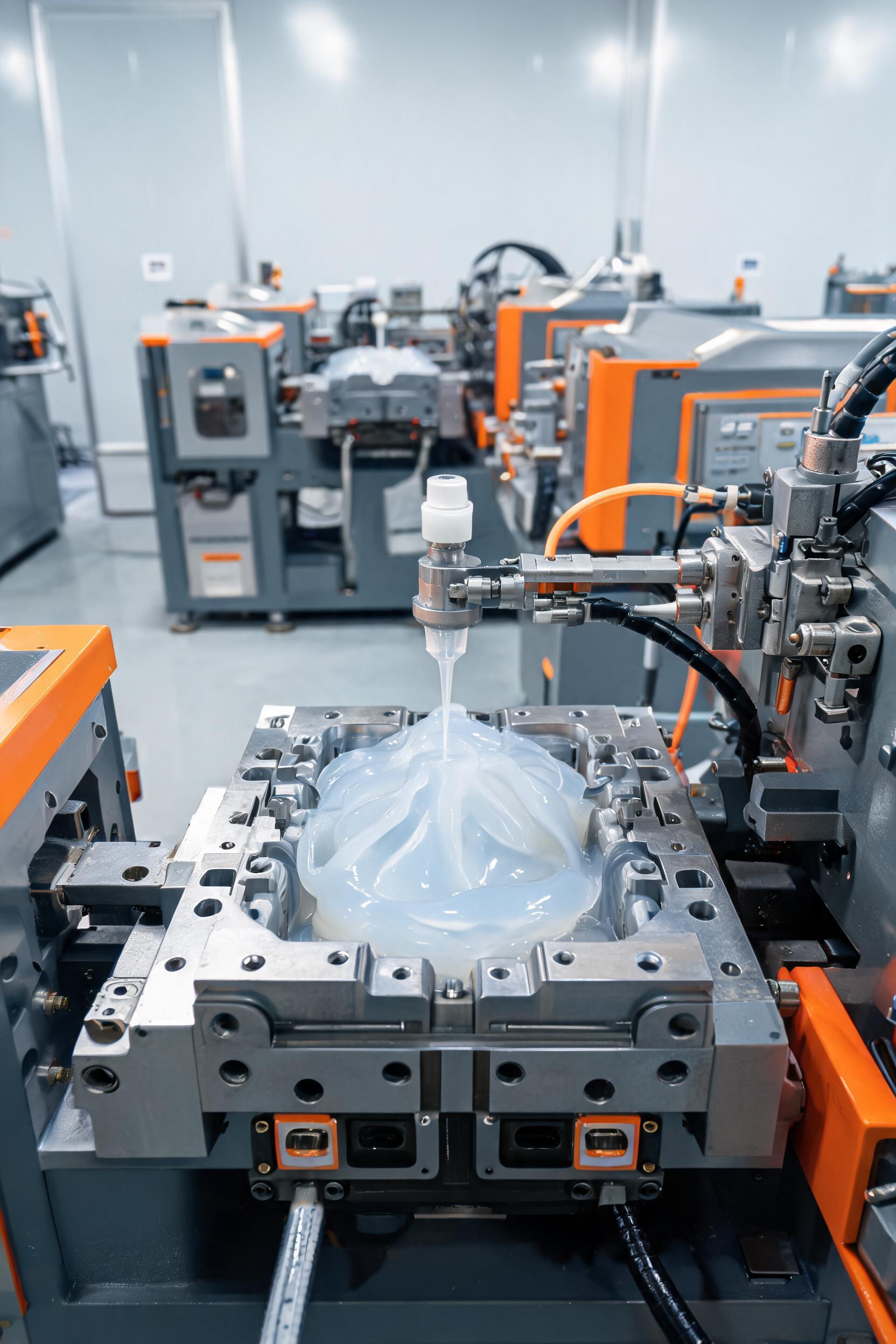
Liquid silicone rubber (LSR) is a high-purity, biocompatible elastomer widely used in medical implants, pharmaceutical packaging, food contact components, and semiconductor manufacturing consumables. For these high-sensitivity applications, even 0.5μm particulate contamination, residual volatile organic compounds (VOCs), or trace heavy metal impurities can lead to product failure, regulatory non-compliance, or end-user safety risks. Liquid silicone rubber clean production is a systematic engineering approach that integrates environmental control, material management, process optimization, and quality verification to eliminate contamination sources throughout the LSR manufacturing lifecycle. Unlike conventional thermoplastic processing, LSR’s cross-linking curing reaction is irreversible, and contamination introduced at any stage cannot be removed through post-processing, making proactive control far more critical than corrective measures. This article details the standardized specifications and core control points of LSR clean production, providing actionable guidance for manufacturers to meet ISO 13485, FDA 21 CFR Part 177.2600, and SEMI F21 regulatory requirements.
Clean Production Facility Design and Environmental Control Specifications
The foundation of LSR clean production lies in a purpose-built facility that maintains consistent, contamination-free environmental conditions across all production zones. Facility design must follow a zoning principle that separates high-contamination prep areas from low-contamination production and packaging areas, with unidirectional material and personnel flow to prevent cross-contamination.
Cleanroom Classification and Zoning Requirements
LSR clean production facilities are divided into four core zones, each with distinct ISO 14644-1 air cleanliness classifications tailored to the contamination sensitivity of the processes performed:
ZoneISO Cleanliness ClassMaximum Allowable Particles/m³ (≥0.5μm)Controlled Pressure DifferentialTypical Processes
Raw Material Storage & Pre-ProcessingISO 8352,000+5 Pa relative to non-clean areasRaw material decanting, base polymer and curing agent pre-blending
Molding ProductionISO 735,200+10 Pa relative to ISO 8 zoneLSR injection molding, compression molding, demolding
Post-Processing & InspectionISO 735,200+8 Pa relative to ISO 8 zoneDeflash, visual inspection, dimensional measurement
Final PackagingISO 5 (for medical/ semiconductor products) / ISO 7 (for food contact)3,520 (ISO 5) / 35,200 (ISO 7)+15 Pa relative to adjacent zonesSealing, labeling, sterile barrier packaging
All zones require unidirectional airflow, with HEPA filter coverage of 100% in ISO 5 and ISO 7 zones, and 60% coverage in ISO 8 zones. Air changes per hour (ACH) are set to 60–90 for ISO 5, 30–60 for ISO 7, and 20–30 for ISO 8, with continuous monitoring of particle count, temperature, and humidity via fixed sensors positioned at 1m above production work surfaces. For facilities producing implantable LSR medical devices, additional bio-burden control is required: ISO 5 zones must maintain a maximum allowable bio-burden of <1 CFU/m³, with quarterly third-party air quality verification.
Personnel and Material Flow Control Protocols
Human activity is responsible for 70–80% of particulate contamination in cleanrooms, so strict access and gowning protocols are non-negotiable for LSR clean production:
- Personnel Entry Procedure: All staff must pass through a three-stage airlock system:
- Pre-airlock: Remove street clothing, put on disposable shoe covers, hairnets, and beard covers, and wash hands with pH-neutral, low-residue antimicrobial soap.
- Gowning room: Don non-shedding cleanroom garments (polyester/spandex blend with static-dissipative coating), face masks, goggles, and nitrile gloves (powder-free, 6mil thickness, tested for <1μg/cm² extractable silicone and heavy metals).
- Air shower: 30-second air shower with 25m/s air velocity to remove loose surface particles, with no rotating or bending during the cycle to avoid dislodging additional particles.
Personnel are prohibited from wearing jewelry, using cosmetics, or bringing any non-cleanroom approved items (including paper, pens, and personal electronics) into controlled zones. All staff must complete 40 hours of cleanroom operation training and pass a gowning qualification test (verified via surface particle count on garments after gowning) before independent operation.
- Material Transfer Procedure: All materials entering clean zones must pass through a dedicated pass-through box with interlocking doors and integrated UV-C disinfection (254nm wavelength, 30-minute exposure cycle for non-heat-sensitive materials). Raw LSR materials are transferred in sealed, static-dissipative HDPE containers, with outer packaging removed and surfaces wiped with 70% isopropyl alcohol (IPA) before entering the ISO 8 zone. Finished products are only transferred out of production zones through dedicated exit pass-through boxes to avoid cross-contamination with incoming materials.
Raw Material and Auxiliary Supply Chain Control
LSR formulations typically consist of 90–95% poly(dimethylsiloxane) (PDMS) base polymer, 2–5% platinum-based curing catalyst, 1–3% fumed silica reinforcing filler, and optional additives (pigments, release agents, biocides). Contamination in any of these components can compromise final product purity, so end-to-end supply chain control is a core control point of liquid silicone rubber clean production.
LSR Raw Material Purity Specifications and Incoming Inspection
Medical, food, and semiconductor-grade LSR raw materials must meet strict purity thresholds, with incoming inspection performed for every batch before entering production:
ComponentKey Purity ParameterAcceptance Limit (Medical Grade)Acceptance Limit (Semiconductor Grade)Test Method
Base PDMS PolymerVolatile Organic Compounds (VOCs)≤0.1% by weight≤0.05% by weightASTM E1826 Thermal Desorption GC-MS
Heavy Metal Content (As, Pb, Cd, Hg)≤1ppm total≤0.1ppm totalICP-MS
Platinum CatalystResidual Uncomplexed Platinum≤0.5ppm≤0.1ppmAtomic Absorption Spectroscopy (AAS)
Fumed Silica FillerSurface Impurity Content≤10ppm total metal ions≤1ppm total metal ionsX-ray Fluorescence (XRF)
All ComponentsParticulate Contamination (≥1μm)≤10 particles/g≤1 particle/gLiquid Particle Counter (LPC) after solvent extraction
For custom-formulated LSR batches, all pre-blending operations must be performed in sealed, jacketed stainless steel mixers with polished 316L stainless steel internal surfaces (Ra ≤0.4μm) to avoid metal particle shedding. Mixers are purged with 99.999% purity nitrogen during blending to prevent moisture contamination, which can cause micro-voids during curing. After blending, each batch is stored in sealed, grounded static-dissipative containers at 15–25°C, with a maximum shelf life of 30 days before processing to avoid catalyst deactivation.
Auxiliary Material Compatibility and Purity Control
Auxiliary materials used in LSR production, including molds, release agents, and process consumables, are often overlooked sources of contamination. All auxiliary supplies must meet clean production compatibility requirements:
- Mold Materials: Molds for clean LSR production are manufactured from 420SS or S136 stainless steel, with mirror polishing (Ra ≤0.2μm) and optional diamond-like carbon (DLC) coating to reduce material adhesion and eliminate the need for external release agents. Mold cooling channels are electro-polished internally to prevent corrosion and microbial growth, with bi-annual leak testing and flushing with deionized (DI) water to remove residual sediment.
- Release Agents: For applications where mold coatings are insufficient, only water-based, non-silicone release agents with <0.5% VOC content and no detectable heavy metals are approved. Release agent application is performed via automated electrostatic spray guns with controlled deposition rates (≤0.1mg/cm² per cycle) to avoid excessive residue transfer to LSR parts. Each batch of release agent is tested for extractable content before use, with acceptance criteria of <1μg/cm² residual on cured LSR surfaces.
- Process Consumables: Gloves, wiping cloths, and dispensing needles used in production are single-use, non-shedding, and pre-validated for low extractables. Polyester cleanroom wipers are pre-washed with DI water and IPA to eliminate residual surfactants, with a maximum allowable particle count of <10 particles (≥0.5μm) per wiper. Dispensing equipment uses food-grade PTFE or PFA tubing, replaced every 30 production days to avoid cross-contamination between different LSR formulations.
Production Process Contamination Control Points
LSR processing involves low-viscosity material handling, high-pressure injection, and thermal curing, each stage presenting unique contamination risks. Process control must be proactive, with real-time monitoring to prevent contamination rather than detecting it after curing.
Metering, Mixing, and Injection Process Control
The two-component LSR metering and mixing system is the highest-risk point for particulate and cross-formulation contamination, requiring strict process parameters:
- Metering System Calibration: Closed-loop, servo-driven metering pumps are used to maintain a 1:1 (±0.5%) mixing ratio of base polymer to curing agent, with daily calibration performed via gravimetric measurement of dispensed material. For medical-grade production, in-line viscometers monitor material viscosity in real time, with an alarm triggered if viscosity deviates by >5% from the baseline, indicating potential contamination or catalyst degradation.
- Static Mixer Design: Disposable static mixers with 12–16 mixing elements are used for medical and semiconductor LSR production, replaced after every 8 hours of operation or when switching between material batches/colors to avoid cross-contamination. For high-purity applications, mixers are pre-rinsed with pure base polymer before production, with the first 500g of dispensed material discarded to eliminate any residual manufacturing residues from the mixer.
- Injection Molding Parameter Control: LSR is injected at a pressure of 80–150 bar, with a screw speed of 50–100 RPM to minimize shear heating (which can cause premature curing and micro-particulate generation). The barrel is maintained at 15–25°C via a closed-loop water cooling system to prevent partial cross-linking of LSR before injection. Each production run begins with a 10-shot purge of the injection barrel, with purge samples inspected for particulate content before full production commences.
Curing, Demolding, and Post-Processing Control
LSR curing is an exothermic cross-linking reaction, with process parameters directly impacting residual volatile content and surface contamination:
- Curing Cycle Validation: Curing temperatures are typically set between 120–180°C, with hold times of 30–120 seconds depending on part wall thickness. For medical implants, post-curing is performed in a forced-air convection oven under ISO 5 airflow at 200°C for 2–4 hours to reduce residual VOCs to <0.05% by weight. Ovens are dedicated to LSR curing only, with no shared use with other polymer materials to avoid cross-contamination. Oven air is filtered via HEPA filters, with quarterly testing for residual volatile contaminants.
- Automated Demolding Systems: Manual demolding is prohibited for high-purity LSR products, as contact with gloves can introduce particulate and extractable contamination. Instead, automated robotic systems with soft, PEEK or medical-grade silicone end effectors are used to remove parts from molds, with no contact between the end effector and critical functional surfaces of the part. Demolding stations are equipped with local exhaust ventilation (LEV) systems to capture any loose particles or volatile fumes generated during demolding.
- Zero-Waste Post-Processing: Mechanical deflashing (including tumbling, sandblasting, and manual trimming) is prohibited for clean LSR production, as these processes generate large volumes of particulate contamination. Instead, molds are designed with precision flash gates (≤0.05mm thickness) that produce minimal flash, which is removed via cryogenic deflashing with liquid nitrogen-cooled polycarbonate media, followed by ultrasonic cleaning in DI water (18.2 MΩ·cm resistivity) for 10 minutes to remove residual media particles. Cleaned parts are dried under filtered, heated nitrogen (99.999% purity) to avoid water spot formation.
Quality Verification and Continuous Improvement
Even with strict environmental and process controls, regular quality verification is required to ensure consistent compliance with clean production standards. A closed-loop continuous improvement system is essential to address emerging contamination risks and adapt to changing regulatory requirements.
In-Line and Finished Product Quality Testing
Liquid silicone rubber clean production requires a multi-stage testing regime to detect contamination at the earliest possible stage:
- In-Line Monitoring: Real-time particle counters are installed at the outlet of the mixing system and above each molding press, sampling air every 10 seconds. If particle count (≥0.5μm) exceeds 10 particles/L, production is paused immediately, and root cause analysis is performed. In-line thermal imaging cameras monitor mold surface temperature during curing, with ±1°C accuracy, to detect cold spots that can lead to incomplete curing and increased residual volatiles.
- Finished Product Purity Testing: For every production batch, 5 sample parts are selected for extractables and leachables (E&L) testing, per ISO 10993-12 for medical products and FDA 21 CFR Part 177 for food contact products. Testing includes 24-hour extraction in DI water, 3% acetic acid, and 50% ethanol at 40°C, with analysis for total organic carbon (TOC), heavy metal content, and non-volatile residue (NVR). Acceptance criteria include TOC ≤0.1mg/L, NVR ≤0.5mg/L, and heavy metals ≤1ppm total. For semiconductor LSR consumables, additional surface metal ion testing is performed via total reflection X-ray fluorescence (TXRF), with a maximum allowable surface concentration of 1×10¹⁰ atoms/cm² for all transition metals.
- Packaging Integrity Testing: Final packaging for sterile LSR products undergoes bubble leak testing per ASTM F2096, with a maximum allowable leak rate of 1×10⁻⁶ mbar·L/s to ensure no contamination enters the packaging during storage and transport. Packaging is labeled with a unique batch number and traceability code, linking the finished product to raw material batches, production parameters, and quality test results.
Non-Conformance Management and Continuous Improvement
All contamination events are documented and addressed via a corrective and preventive action (CAPA) system, with root cause analysis performed using the 5-Whys or fishbone diagram methodology. Common root causes of contamination include HEPA filter failure, operator gowning errors, and raw material batch variability, with corrective actions prioritized based on risk severity.
- Trend Analysis: Quarterly trend analysis is performed on particle count data, non-conformance rates, and customer feedback to identify systemic issues. For example, a steady increase in particulate contamination in an ISO 7 zone may indicate HEPA filter degradation, prompting early replacement before a critical failure occurs.
- Regulatory Update Review: Annual reviews of relevant regulatory standards (including ISO 14644, FDA food contact guidelines, and SEMI semiconductor standards) are conducted to update clean production specifications as requirements evolve. All process changes are validated via a 3-batch pilot run, with full purity testing before full-scale implementation.
- Personnel Refresher Training: All cleanroom staff complete 8 hours of annual refresher training, including updated contamination control protocols and hands-on gowning requalification. Training effectiveness is measured via quarterly audits of operator compliance with standard operating procedures (SOPs).
Conclusion
Liquid silicone rubber clean production is a systematic, multi-layered control framework that integrates facility design, supply chain management, process optimization, and ongoing quality verification to deliver LSR products with consistent purity and compliance. The core control points outlined in this specification—from ISO-classified cleanroom environmental control to real-time in-line process monitoring and post-production extractables testing—enable manufacturers to meet the strictest requirements for medical, food contact, and semiconductor applications. As demand for high-purity LSR components continues to grow, manufacturers that implement these standardized clean production practices will not only ensure regulatory compliance but also gain a competitive advantage in high-value, safety-critical market segments. Regular validation and continuous improvement of clean production systems remain essential to address emerging contamination risks and align with evolving global regulatory standards.