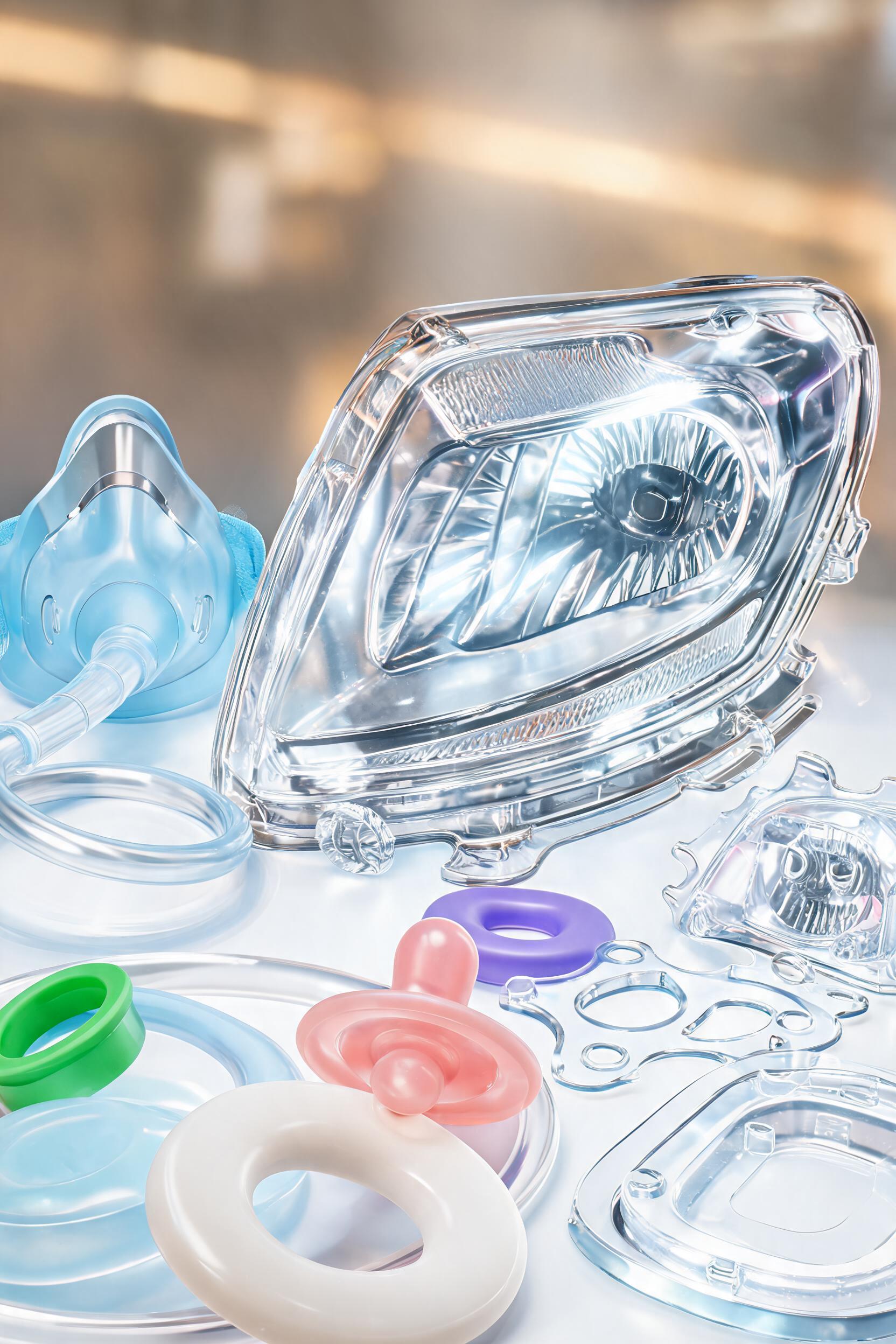
As automotive lighting systems evolve from basic halogen assemblies to adaptive LED, matrix LED, and LiDAR-integrated smart lighting solutions, the demand for high-performance optical components has grown exponentially. Traditional optical materials such as polycarbonate (PC) and polymethyl methacrylate (PMMA) struggle to meet the combined requirements of thermal stability, UV resistance, and design flexibility for next-generation lighting systems. Light transmitting liquid silicone rubber (LSR) has emerged as a transformative alternative, offering a unique balance of optical, mechanical, and environmental properties that address critical limitations of rigid thermoplastics. This article provides a comprehensive technical analysis of light transmitting LSR auto light parts, covering material performance metrics, manufacturing process optimization, optical design considerations, and real-world application validation in modern automotive lighting systems.
Core Material Performance of Light Transmitting LSR for Automotive Lighting Applications
Light transmitting LSR is a two-component, platinum-catalyzed silicone elastomer formulated with high-purity raw materials to minimize light scattering and absorption. Unlike general-purpose LSR, grades designed for auto light applications undergo strict purification processes to eliminate volatile organic compounds (VOCs), residual catalysts, and particulate contaminants that could degrade optical performance over time.
Key Optical Performance Parameters
The optical performance of light transmitting LSR is quantified by standardized metrics that directly impact lighting system efficiency and regulatory compliance. Table 1 compares core optical properties of light transmitting LSR against conventional optical thermoplastics used in auto light applications:
ParameterLight Transmitting LSROptical Grade PCOptical Grade PMMA
Visible Light Transmittance (380–780 nm, 2 mm thickness)92–94%88–90%91–93%
Haze (2 mm thickness)0.8–1.5%1.0–2.0%0.5–1.2%
Refractive Index (@ 589 nm)1.41–1.431.58–1.591.49
Yellowing Index (ΔYI after 1000 hours UV exposure @ 60°C)≤0.3≤2.5≤4.0
IR Transmittance (850–940 nm, 2 mm thickness)90–92%82–85%88–90%
For automotive lighting applications, the low yellowing index of LSR is particularly critical: modern LED headlamps operate at junction temperatures of 120–150°C, and prolonged UV exposure from sunlight and LED emission can cause thermoplastics to yellow, reducing light output by 15–20% over 5 years of service. Light transmitting LSR maintains >90% of its initial transmittance after 5000 hours of accelerated aging at 150°C, meeting the 15-year service life requirement for premium automotive platforms.
Specialized LSR grades are also formulated for tunable haze performance: diffuser grades with controlled haze values of 30–90% are used for rear combination lamp (RCL) and daytime running light (DRL) applications, eliminating visible LED hotspots without excessive light loss. These grades incorporate uniformly dispersed nano-silica fillers (100–200 nm diameter) that scatter light evenly, with a transmittance drop of less than 5% even at 80% haze, outperforming frosted PC diffusers which typically exhibit a 10–12% transmittance loss at equivalent haze levels.
Mechanical and Environmental Resistance Properties
Beyond optical performance, light transmitting LSR offers mechanical and environmental resilience that addresses common failure modes of thermoplastic auto light components:
- Thermal stability: LSR retains its elastomeric properties across a temperature range of -60°C to 200°C, with no thermal deformation or cracking even under extreme cold start conditions or prolonged high-power LED operation. In contrast, PC has a glass transition temperature (Tg) of 140–150°C, leading to warpage in high-power headlamp applications where local temperatures can reach 160°C during continuous operation.
- Sealing performance: With a Shore A hardness range of 30–70, LSR can be molded into integrated optical-sealing components, eliminating the need for separate gaskets between optical elements and lamp housings. Compression set of light transmitting LSR is ≤10% after 22 hours of compression at 125°C (per ISO 815), ensuring long-term IP67/IP6K9K ingress protection for lighting assemblies.
- Chemical resistance: LSR is inert to automotive fluids including windshield washer fluid, engine oils, and road de-icing salts, with no surface cracking or hazing after 1000 hours of immersion. PC and PMMA, by contrast, are susceptible to stress cracking when exposed to alkaline de-icing solutions, leading to premature optical degradation.
- Impact resistance: Even at low temperatures, LSR exhibits high elongation at break (200–400%) and can withstand stone impacts of up to 2 J without cracking, a critical advantage for external light components exposed to road debris. Rigid thermoplastics are prone to cracking under similar impact loads, which can compromise lamp sealing and lead to moisture ingress.
Precision Manufacturing Processes for Light Transmitting LSR Auto Light Parts
The manufacturing of light transmitting LSR auto light parts requires strict process control to preserve optical purity, minimize dimensional variation, and eliminate defects that could impact light output. Unlike thermoplastic injection molding, LSR processing involves cross-linking rather than melting, requiring specialized equipment and process parameter optimization.
Cleanroom Injection Molding Process Control
Optical LSR components must be manufactured in ISO Class 7 or higher cleanroom environments to prevent particulate contamination, which can cause visible light scattering or focal point defects in the final assembly. The core process steps and control parameters are outlined below:
- Material preparation: The two LSR components (A and B) are mixed in a 1:1 ratio using a static mixer, with a mixing accuracy tolerance of ±0.5% to ensure consistent cross-linking. Specialized degassing systems are integrated into the material feeding line to remove entrained air bubbles, which would cause visible voids in the molded part.
- Mold design and temperature control: Optical LSR molds are manufactured with polished steel inserts (Ra ≤ 0.02 µm for clear optical surfaces) to ensure high surface finish accuracy. Mold temperature is maintained at 170–190°C across the cavity, with a temperature uniformity tolerance of ±2°C to prevent uneven curing that could lead to residual stress or birefringence. For complex lens geometries with micro-prism or micro-lens arrays, mold inserts are fabricated via ultra-precision diamond turning to achieve dimensional accuracy of ±1 µm on optical features.
- Injection and curing parameters: Injection speed is controlled at 5–15 cm³/s to avoid shear-induced degradation of the silicone polymer, which can cause yellowing or micro-bubbles. Injection pressure ranges from 80–120 bar, with a holding pressure of 40–60 bar applied during the curing phase to compensate for material shrinkage (typically 2–3% for optical LSR grades). Curing time is calibrated based on part thickness: 10–15 seconds per mm of wall thickness, ensuring full cross-linking without over-curing that could reduce transmittance.
- Post-molding processing: After demolding, parts undergo a post-curing process at 180–200°C for 2–4 hours in a forced-air oven to remove residual low-molecular-weight siloxanes. This step is critical for automotive lighting applications, as unremoved siloxanes can outgas and condense on the inner surface of the lamp outer lens, causing visible hazing over time. Post-curing also reduces residual stress in the part, minimizing birefringence that could distort light output patterns.
Multi-Component and Insert Molding Integration
A key advantage of LSR processing is the ability to overmold onto rigid substrates, enabling the production of integrated optical components that reduce assembly complexity and improve sealing performance. Common integration approaches for auto light parts include:
- LSR overmolding onto thermoplastic substrates: LSR adheres strongly to pre-treated PC, PBT, and aluminum substrates without the need for adhesives, allowing the production of integrated lens-housing or lens-heatsink components. For example, adaptive headlamp light guides can be overmolded directly onto PC mounting brackets, reducing part count by 30% and eliminating alignment errors between the light guide and LED source. The bond strength between LSR and properly surface-treated PC exceeds 3 N/mm, ensuring structural integrity across the full operating temperature range.
- Dual-hardness LSR molding: For components requiring both optical performance and sealing functionality, dual-shot LSR molding can combine a high-transmittance 50 Shore A LSR for the optical section with a 70 Shore A LSR for the sealing flange in a single molding cycle. This eliminates the need for secondary gasket assembly, reducing the risk of ingress points for moisture and dust.
- Micro-structure replication: Light transmitting LSR’s low viscosity before curing allows it to replicate micro-optical features as small as 2 µm with high fidelity. This is particularly valuable for smart lighting components such as diffractive optical elements (DOEs) for matrix headlamps and LiDAR window anti-reflective (AR) micro-structures. Replicated micro-prism arrays on LSR DRL diffusers can achieve a 92% light extraction efficiency, 10% higher than equivalent PC structures due to LSR’s lower refractive index and reduced internal reflection.
Optical Design and System Integration Considerations
Integrating light transmitting LSR components into automotive lighting systems requires specific design adjustments to account for LSR’s unique optical and mechanical properties, ensuring compliance with global regulatory standards such as ECE R112 (headlamps) and SAE J592 (rear lamps).
Optical Design Optimization for LSR Properties
The lower refractive index of LSR (1.41–1.43) compared to PC (1.58) impacts optical design parameters, requiring modified lens geometry to achieve desired light distribution patterns:
- Lens curvature adjustment: For collimating lenses used in low-beam headlamps, the lower refractive index of LSR requires a 12–15% increase in lens curvature to achieve the same focal length as an equivalent PC lens. Optical simulation tools such as Zemax and TracePro are used to model LSR’s wavelength-dependent refractive index, ensuring that chromatic aberration is minimized across the visible spectrum for white LED sources.
- Anti-reflective (AR) coating compatibility: LSR can be coated with silicon dioxide (SiO₂) and titanium dioxide (TiO₂) AR coatings via plasma-enhanced chemical vapor deposition (PECVD), reducing surface reflection loss from ~4% per surface to <0.5% across the visible spectrum. Unlike PC, LSR’s high thermal stability allows coating processes at temperatures up to 150°C, improving coating adhesion and durability. AR-coated LSR lenses achieve a total transmittance of >98% at 550 nm, increasing overall lighting system efficiency by 7–10% compared to uncoated PC lenses.
- Diffuser design for uniform light output: For RCL and DRL applications, LSR diffusers with tunable haze can be optimized via particle size and loading adjustments to achieve the required uniformity ratio (minimum luminance / maximum luminance) of ≥0.8 across the illuminated surface, eliminating visible LED hotspots even at a lens-to-LED distance of just 10 mm. This allows for slimmer, more aerodynamic lamp designs that were not feasible with traditional thermoplastic diffusers, which typically require a 20–30 mm distance to achieve equivalent uniformity.
Regulatory Compliance and Durability Validation
Light transmitting LSR auto light parts must undergo rigorous testing to meet global automotive safety and performance standards. Key validation tests include:
- Photometric performance testing: Lenses and light guides are tested in a goniophotometer to verify that light distribution patterns meet ECE or SAE requirements, with no visible dark spots or uneven intensity distribution. For headlamp lenses, the cutoff line sharpness must be ≤0.25° to avoid glare for oncoming drivers, a metric that LSR components consistently meet due to high molding precision and low birefringence.
- Environmental aging validation: Parts are subjected to accelerated aging tests including:
- 5000 hours of thermal cycling between -40°C and 125°C, with no cracking, delamination, or transmittance loss >2%
- 3000 hours of UV exposure (Xenon arc lamp, 0.55 W/m² @ 340 nm) with ΔYI ≤0.5 and transmittance loss ≤1%
- High-pressure water jet testing (IP6K9K) at 80–100 bar pressure, with no water ingress or optical degradation
- Chemical compatibility testing: Parts are exposed to common automotive chemicals for 168 hours at 23°C, with no surface cracking, hazing, or adhesion loss for overmolded components.
Emerging Applications in Smart Automotive Lighting Systems
The unique properties of light transmitting LSR are enabling new functionalities in next-generation smart lighting systems, beyond traditional static lens and diffuser applications.
LiDAR Integration Components for Autonomous Driving
For SAE Level 3+ autonomous vehicles, LiDAR sensors are often integrated into headlamp and rear lamp assemblies to reduce aerodynamic drag and improve aesthetic design. Light transmitting LSR is the material of choice for LiDAR protective windows, offering:
- >90% transmittance across the 850–940 nm LiDAR operating wavelength range, with minimal signal attenuation
- High resistance to road debris impact and stone chipping, with no cracking that could distort LiDAR point clouds
- Tunable optical filtering properties: LSR can be compounded with infrared-transmitting, visible-light-absorbing dyes to block visible light glare from the vehicle’s own headlamps, reducing LiDAR sensor noise by 30–40% compared to clear PC windows.
Adaptive Matrix Headlamp Light Guides
Matrix LED headlamp systems use individually controllable LED pixels to dynamically adjust light distribution, dimming specific zones to avoid glare for oncoming drivers while maintaining maximum illumination of the road. Light transmitting LSR light guides offer better thermal stability and light uniformity than PC alternatives, allowing for higher LED power densities and thinner light guide designs. LSR light guides with integrated micro-lens arrays can achieve a pixel pitch of just 1.5 mm, enabling high-resolution adaptive lighting patterns with over 1000 individually controllable pixels per headlamp.
Conclusion
Light transmitting LSR has established itself as a critical material for modern automotive lighting systems, addressing the limitations of traditional thermoplastics in terms of thermal stability, UV resistance, and design flexibility. With optical performance matching or exceeding PC and PMMA, combined with unmatched mechanical and environmental resilience, LSR is enabling the development of slimmer, more efficient, and more durable lighting components for both conventional and smart autonomous vehicle platforms. As manufacturing processes continue to improve, with higher precision micro-replication and lower production costs, light transmitting LSR is expected to capture over 40% of the automotive optical component market by 2030, particularly in premium and electric vehicle platforms where long service life and high performance are prioritized. Future development of high-refractive-index LSR grades (n>1.5) will further expand its application scope, enabling even more compact and efficient lighting system designs that support the ongoing evolution of automotive technology.