Introduction
Hubei province has emerged as a core hub for liquid silicone rubber (LSR) and high-performance silicone manufacturing in central China, supported by its strategic geographic location, robust industrial supply chain, and access to advanced material R&D resources from top-tier local universities including Huazhong University of Science and Technology and Wuhan University of Technology. For global brands seeking reliable, cost-competitive silicone original equipment manufacturing (OEM) services, Hubei-based providers offer end-to-end solutions spanning material formulation, precision molding, post-processing, and quality assurance tailored to medical, automotive, consumer electronics, and industrial application requirements.
This guide provides a comprehensive breakdown of Hubei silicone OEM capabilities, regulatory compliance frameworks, cost optimization levers, and partnership best practices, drawing on 2024 industry data from the Hubei Rubber and Plastic Industry Association, which reports the province is home to 127 registered silicone manufacturing facilities with a combined annual production capacity of 320,000 metric tons of cured silicone components, 42% of which is dedicated to export orders for North American, European, and Southeast Asian markets.
Core Capabilities of Hubei Silicone OEM Providers
Hubei’s silicone OEM ecosystem is distinguished by its vertical integration, with most mid-to-large sized providers controlling every stage of production from raw material compounding to final packaging, reducing supply chain lead times and quality variability compared to contract manufacturers that source materials externally. The province’s investment in smart manufacturing infrastructure over the past five years, totaling RMB 17.2 billion (USD 2.4 billion) as of 2024, has further elevated production precision and scalability.
Material Formulation and Customization Expertise
Unlike many coastal silicone OEMs that rely on pre-compounded silicone raw materials, 68% of Hubei’s leading providers operate in-house material R&D labs, allowing them to develop custom silicone formulations tailored to specific application performance requirements. Table 1 outlines common custom formulation capabilities and typical use cases for Hubei-produced silicone materials:
Material Property RangeTypical ApplicationCompliance Standard Met
Shore Hardness 0A-90A, including ultra-soft 00-20 to 00-80 durometer variantsWearable medical electrodes, baby pacifiers, skin-contact fitness accessoriesISO 10993-5, GB 4806.11
Temperature resistance from -60°C to 320°C, with optional thermal conductivity of 1.2-5.0 W/m·KElectric vehicle (EV) battery sealing gaskets, power electronics heat dissipation padsUL 94 V-0, IATF 16949
Tensile strength 5-12 MPa, elongation at break 300-800%, tear resistance 15-50 kN/mIndustrial pipeline seals, hydraulic system diaphragmsFDA 21 CFR 177.2600
Hydrophobic coating with water contact angle >110°, or antimicrobial additive with 99.9% E. coli inhibition rateBathroom fixtures, food processing equipment componentsNSF/ANSI 51, EN 14350
Hubei’s proximity to domestic silicone raw material suppliers in Jiangsu and Sichuan also allows OEMs to source 107 base rubber, fumed silica, and curing agents at 8-12% lower cost than facilities in Guangdong or Zhejiang, with raw material lead times reduced by 3-5 days on average.
Precision Molding and Mass Production Capacity
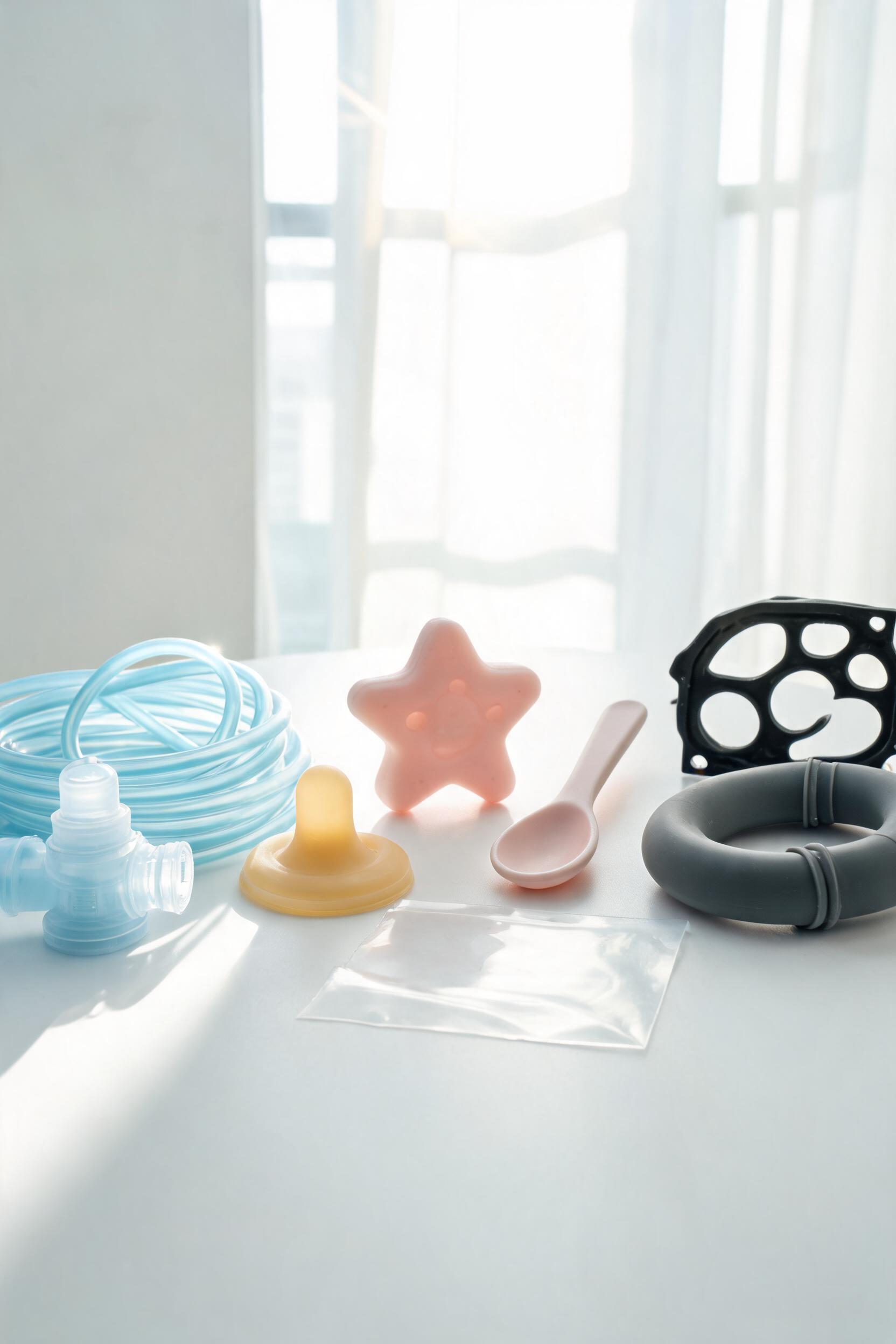
Hubei silicone OEMs specialize in four primary molding processes, with scalable capacity to support both low-volume prototype runs and high-volume annual orders exceeding 10 million units:
- Liquid Silicone Rubber (LSR) Injection Molding: 92% of mid-to-large Hubei providers operate LSR injection lines with clamping forces ranging from 50 to 650 tons, equipped with closed-loop material dosing systems that achieve ±0.05% material mixing accuracy. Typical part tolerance for LSR molding is ±0.02 mm for micro-components (≤10 mm) and ±0.1 mm for parts larger than 100 mm, making this process ideal for medical catheter components, smart watch seals, and automotive sensor housings. Average LSR production capacity per facility is 120,000 parts per day for standard-sized components.
- Compression Molding: Used for large-format silicone parts such as solar panel gaskets and industrial roller covers, Hubei providers operate compression presses with platen sizes up to 2.5m × 3m, supporting part weights of up to 15 kg per unit. Compression molding lead times are 3-5 days longer than LSR injection for equivalent volumes, but offer 15-20% lower tooling costs for low-to-medium volume orders (1,000-50,000 units annually).
- Extrusion: Hubei OEMs produce custom extruded silicone profiles, tubing, and cords with diameter ranges from 0.5 mm to 150 mm, with inline cutting and vulcanization systems that achieve ±0.1 mm dimensional accuracy for continuous lengths up to 1,000 meters. Extruded products account for 28% of Hubei’s total silicone OEM output, primarily for construction sealing and EV thermal management applications.
- Overmolding: 76% of Hubei providers offer overmolding services that bond silicone to rigid substrates including PC, ABS, PPSU, aluminum, and stainless steel, with adhesion strength of 3-8 MPa depending on substrate material. This capability is in high demand for consumer electronics products such as waterproof phone cases and kitchen appliance handles, where soft-touch silicone surfaces are combined with rigid structural components.
Many leading Hubei silicone OEMs have also adopted MES (Manufacturing Execution System) software that tracks production data in real time, reducing defect rates to an average of 0.35% for high-volume LSR orders, 22% lower than the national average for Chinese silicone manufacturers according to 2024 industry benchmark data.
Post-Processing and Value-Added Services
To reduce customer supply chain complexity, Hubei silicone OEMs offer a full suite of post-processing services that eliminate the need for third-party vendors:
- Finishing: Deflashing via cryogenic tumbling, laser trimming, or manual trimming for high-precision parts, with automated optical inspection (AOI) systems that detect residual flash as small as 0.01 mm. Surface treatment options include plasma activation for improved adhesion, silk-screen printing, and laser marking with permanent, abrasion-resistant logos or part numbers.
- Assembly: Many providers offer sub-assembly services, such as inserting metal fasteners into silicone gaskets, bonding silicone components to plastic housings, or packaging finished parts into customer-specified retail packaging. For medical device clients, assembly is often performed in Class 100,000 cleanrooms to prevent contamination.
- Testing and Validation: In-house labs conduct full performance testing including tensile strength, elongation, compression set, temperature cycling, UV resistance, and biocompatibility testing, with test reports recognized by most global regulatory bodies. For automotive clients, OEMs can conduct 1,000-hour accelerated aging tests to validate component lifespan for 10-year vehicle service life requirements.
Regulatory Compliance and Quality Assurance for Hubei Silicone OEM
One of the most significant advantages of partnering with Hubei silicone OEMs is their established track record of compliance with global market regulatory requirements, a result of the provincial government’s targeted support for export-oriented manufacturing and strict industry oversight. As of 2024, 79% of Hubei’s medium-to-large silicone OEMs hold ISO 13485 medical device quality management certification, 62% hold IATF 16949 automotive certification, and 94% hold ISO 9001 general quality certification.
Industry-Specific Compliance Frameworks
Hubei silicone OEMs have developed specialized quality control workflows tailored to the regulatory requirements of high-demand export markets:
Medical and Healthcare Application Compliance
For silicone medical components (catheters, surgical instrument handles, wound dressings, implantable parts), Hubei OEMs adhere to the following standards by default for export orders:
- ISO 10993 series biocompatibility testing (cytotoxicity, skin irritation, sensitization, hemocompatibility for blood-contact parts)
- FDA 21 CFR Part 820 quality system regulation, with 21 CFR 177.2600 food contact/medical grade material compliance
- EU MDR (Medical Device Regulation) 2017/745 requirements, including technical file documentation support for customer CE marking submissions
- China GB 4806.11 food contact silicone standard for baby products and medical food delivery components
All medical component production is conducted in dedicated Class 10,000 or Class 100,000 cleanrooms, with batch traceability systems that track every unit from raw material lot number to final shipping destination. Hubei OEMs also support sterilization validation for ethylene oxide (EO), gamma irradiation, and autoclave sterilization methods, providing sterilization qualification reports for customer regulatory submissions.
Automotive and Industrial Application Compliance
For silicone components used in automotive and industrial settings, Hubei OEMs comply with global automotive and industrial safety standards:
- IATF 16949:2016 quality management system, with PPAP (Production Part Approval Process) documentation support for tier 1 and tier 2 automotive suppliers
- UL 94 flammability certification for silicone components used in EV battery packs and power electronics, with default V-0 rating for high-risk applications
- RoHS 2.0 and REACH compliance for EU markets, with testing for restricted substances including phthalates, heavy metals, and polycyclic aromatic hydrocarbons (PAHs)
- IP67/IP68 waterproof sealing validation for automotive sensor housings and outdoor industrial components, with pressure decay testing conducted on 100% of high-volume production parts
As of 2024, Hubei silicone OEMs supply 14% of the domestic Chinese EV market’s silicone sealing and thermal management components, with clients including BYD, NIO, and CATL, giving them extensive experience meeting the strict quality and traceability requirements of the global automotive industry.
Quality Control Protocols and Batch Traceability
Hubei silicone OEMs implement a five-stage quality control process for every order, eliminating quality variability and ensuring full traceability:
- Incoming Raw Material Inspection: Every lot of raw silicone, curing agents, and additives is tested for viscosity, Shore hardness, and curing performance before being released to production, with rejected materials returned to suppliers within 24 hours. Raw material lot numbers are logged into the MES system and linked to every production batch.
- First Article Inspection (FAI): Before mass production begins, 10-20 sample parts are produced and tested for dimensional accuracy, material performance, and cosmetic quality, with a full FAI report submitted to the customer for approval. Mass production only commences after written customer approval of the FAI.
- In-Process Quality Control (IPQC): Quality inspectors conduct hourly checks of production parameters (injection pressure, curing temperature, cycle time) and part dimensions, with SPC (Statistical Process Control) systems monitoring process stability to detect deviations before they result in defective parts. For high-precision medical and automotive parts, AOI systems conduct 100% dimensional inspection after molding.
- Final Quality Control (FQC): Before packaging, finished parts undergo random sampling testing for performance (compression set, tensile strength, sealing performance) and cosmetic defects, with a 0 AQL (Acceptable Quality Limit) for critical safety-related parts.
- Outgoing Quality Control (OQC): A final inspection of packaging, labeling, and shipping documentation is conducted to ensure compliance with customer requirements, with batch records stored for a minimum of 10 years for medical components and 15 years for automotive components to support post-market traceability.
In the event of a quality issue, Hubei OEMs can trace the root cause to a specific production shift, machine, or raw material lot within 4 hours, 30% faster than the average for silicone manufacturers in other Chinese provinces according to 2024 industry surveys.
Cost and Lead Time Advantages of Hubei Silicone OEM Services
Hubei’s strategic location and industrial ecosystem provide significant cost and lead time advantages compared to silicone OEMs in coastal Chinese provinces and other global manufacturing hubs, making it an ideal choice for brands seeking to balance quality, cost, and speed to market.
Cost Structure and Pricing Benchmarks
The total cost of silicone OEM production in Hubei is 12-22% lower than in Guangdong or Zhejiang provinces, and 35-50% lower than in North American or European silicone manufacturing facilities, driven by three key factors:
- Lower Operating Costs: Industrial land costs in Hubei’s major manufacturing zones (Wuhan East Lake High-Tech Development Zone, Xiangyang High-Tech Zone) are 40-60% lower than in coastal provinces, while average skilled manufacturing labor costs are 25-30% lower, translating to direct cost savings passed on to customers.
- Vertical Integration Savings: As noted earlier, most Hubei OEMs compound their own silicone materials, eliminating the 8-15% markup charged by third-party material suppliers. In-house tooling shops (operated by 72% of mid-to-large providers) also reduce tooling costs by 18-25% compared to sourcing molds from external vendors.
- Supply Chain Proximity: Hubei’s central location reduces domestic transportation costs for raw materials and finished goods, with 1-3 day ground shipping to all major Chinese ports (Shanghai, Shenzhen, Ningbo) and direct rail access to Europe via the China-Europe Railway Express, which cuts shipping time to European markets by 10-15 days compared to sea freight for urgent orders.
Table 2 provides 2024 pricing benchmarks for common silicone OEM services in Hubei, compared to coastal Chinese providers and U.S.-based providers:
Service TypeHubei OEM CostCoastal China OEM CostU.S. OEM CostCost Savings vs. U.S.
LSR Tooling (simple 2-cavity mold for small seals)$1,200-$1,800$1,600-$2,400$6,000-$9,00075-80%
LSR Molding per part (standard 5g medical seal, 1M unit order)$0.035-$0.05$0.045-$0.065$0.12-$0.1870-72%
Compression Molding per part (100g EV gasket, 50k unit order)$0.45-$0.6$0.55-$0.75$1.4-$2.067-68%
Extruded Silicone Tubing per meter (6mm OD, 2mm wall, 100k meter order)$0.18-$0.25$0.22-$0.3$0.5-$0.764-65%
It is important to note that these pricing benchmarks are for standard production orders; custom formulations, tight tolerance requirements, or low-volume prototype runs will carry a 15-40% premium depending on complexity.
Lead Time Optimization and Supply Chain Resilience
Hubei silicone OEMs offer industry-leading lead times for both prototype and mass production orders, supported by their vertical integration and central geographic location:
- Prototype and Tooling Lead Times: For simple LSR molds, Hubei OEMs can deliver first samples in 7-10 days, compared to 10-15 days for coastal providers and 3-4 weeks for U.S. or European providers. Complex multi-cavity molds with hot runner systems have lead times of 15-25 days, 20-30% faster than coastal Chinese competitors.
- Mass Production Lead Times: For standard high-volume orders (≥100k units), Hubei OEMs can deliver finished parts in 15-25 days from FAI approval, compared to 20-30 days for coastal providers. For urgent orders, most providers offer expedited production with lead times reduced by 30-50% for a 10-15% premium.
- Shipping Lead Times: Hubei’s central location allows for flexible shipping options: sea freight from Shanghai or Ningbo ports takes 14-21 days to North America and 21-28 days to Europe, while China-Europe Railway Express takes 12-18 days to major European destinations, and air freight from Wuhan Tianhe International Airport takes 3-7 days to most global markets.
Hubei’s silicone industry has also developed strong supply chain resilience, with 92% of OEMs maintaining 2-3 weeks of safety stock for common raw materials to mitigate disruptions from raw material price fluctuations or logistics delays. During the 2022-2023 global supply chain crisis, Hubei silicone OEMs reported 18% fewer order delays than coastal manufacturers, due to their proximity to domestic raw material suppliers and reduced reliance on imported components.
Best Practices for Partnering with Hubei Silicone OEMs
To maximize the value of a partnership with a Hubei silicone OEM, brands should follow structured best practices for vendor selection, communication, and intellectual property (IP) protection, to ensure alignment on quality, cost, and delivery expectations.
Vendor Selection and Due Diligence
Not all Hubei silicone OEMs are equal, and conducting thorough due diligence before signing a contract is critical to avoiding quality or delivery issues. Key steps in the vendor selection process include:
- Verify Relevant Certifications: Confirm that the OEM holds the specific certifications required for your application (e.g., ISO 13485 for medical parts, IATF 16949 for automotive parts) and request copies of valid certification documents, which should be cross-checked with the issuing body.
- Audit Production Facilities: Conduct an on-site audit (or hire a third-party auditing firm if on-site visits are not feasible) to