
橡楚编辑部 5/25/2026 34 min read
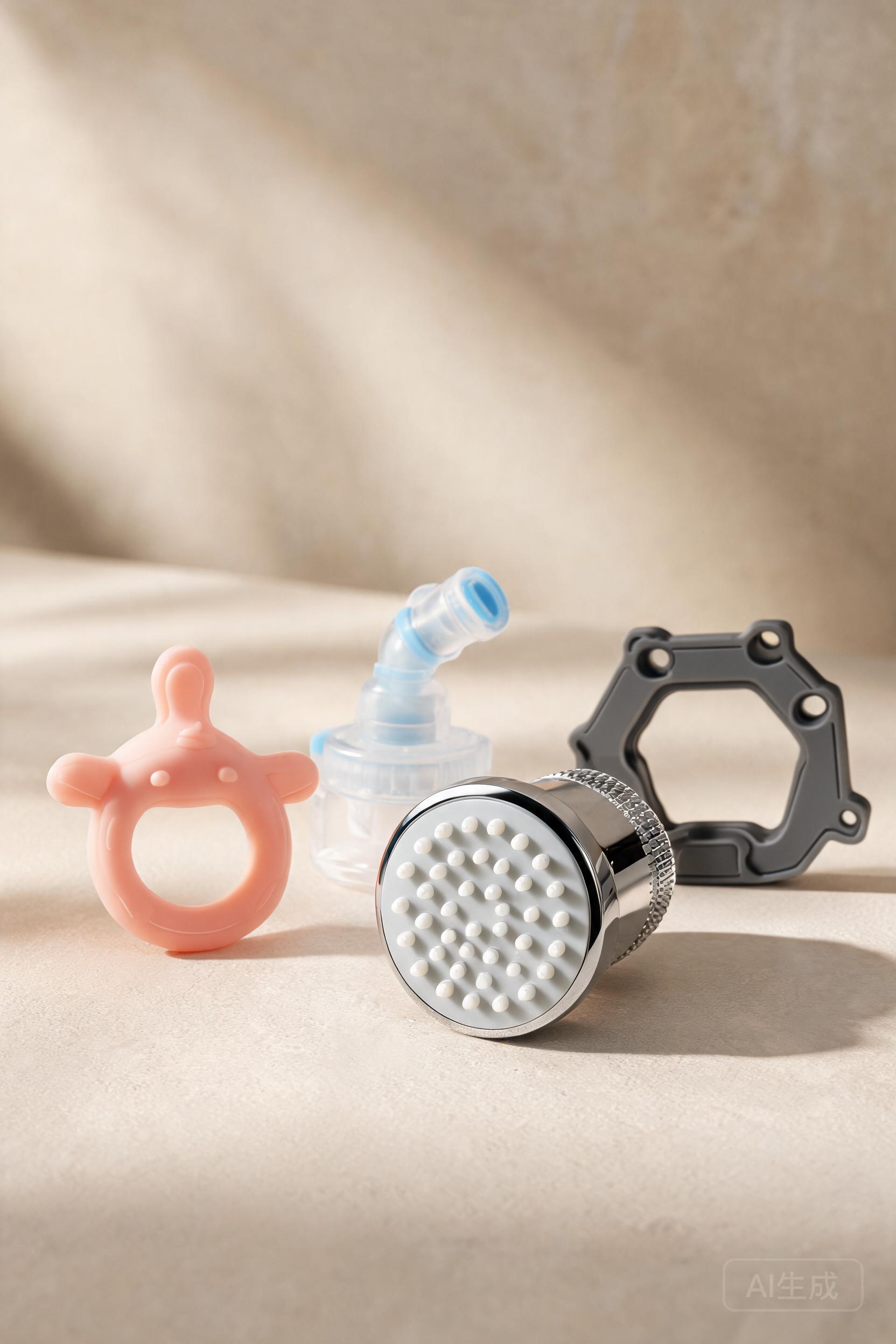
Local silicone factories in Hubei can supply shower parts to surrounding sanitary ware enterprises nearby, and provide high-precision liquid silicone rubber overmolding processing services. It not only reduces logistics costs and transportation losses, but also quickly responds to customized needs, ensuring the dimensional accuracy and bonding firmness of shower seals, handle overmolding and other components, meeting the quality requirements of middle and high-end sanitary products.
The global bathroom fixture manufacturing sector is undergoing a strategic shift toward regionalized supply chains, driven by rising logistics costs, supply chain volatility, and escalating demand for high-precision, skin-safe components in shower systems. Liquid Silicone Rubber (LSR) has emerged as the material of choice for critical shower parts including nozzles, handle grips, and seal gaskets, due to its exceptional temperature resistance, biocompatibility, and long-term durability against water exposure and mineral buildup. For Original Equipment Manufacturers (OEMs) operating in central China’s bathroom fixture cluster, partnering with local silicone manufacturing facilities eliminates the 7–15 day lead times and 12–18% cross-regional transportation costs associated with sourcing from coastal factories, while enabling real-time quality collaboration and iterative design adjustments for complex overmolded parts. This article analyzes the operational advantages of Hubei-based LSR factories, the technical specifications of their precision overmolding processes for shower components, and the measurable supply chain efficiencies they deliver to domestic and global bathroom OEMs.
Hubei’s strategic location at the intersection of China’s north-south and east-west logistics networks, combined with its deep integration into the central China bathroom manufacturing ecosystem, positions local silicone factories as uniquely positioned to serve shower OEMs. Unlike coastal LSR suppliers that primarily serve export markets and operate on minimum order quantities (MOQs) 2–3 times higher than regional demand requirements, Hubei’s silicone facilities are optimized for the specific needs of central China’s 300+ bathroom fixture manufacturers, with customized production capacity, localized material sourcing, and on-site technical support capabilities.
Hubei’s transportation infrastructure reduces supply chain friction for shower OEMs across central, southwest, and east China, with delivery lead times to major manufacturing hubs in Hunan, Henan, Jiangxi, and Chongqing averaging 48 hours or less, compared to 7–10 days for suppliers based in Guangdong or Jiangsu. This proximity translates to measurable cost savings across the supply chain, as outlined in Table 1:
Beyond cost and speed, local supply enables flexible inventory models for OEMs, including just-in-time (JIT) delivery with 24-hour turnaround for rush orders, and consignment inventory arrangements that reduce OEM warehousing costs by an average of 22%. For shower manufacturers launching new product lines, this proximity allows for same-day on-site testing of prototype overmolded parts, cutting product development cycles by 30–40% compared to working with remote suppliers.
Hubei’s silicone factories have tailored their production lines to the unique volume and specification requirements of the shower component market, with dedicated cells for high-volume nozzle production, low-volume custom handle grips, and small-batch prototype overmolding. Unlike general-purpose LSR facilities that allocate 30–40% of capacity to automotive or medical parts, 65% of production capacity at leading Hubei silicone factories is dedicated to bathroom fixture components, with deep expertise in the specific performance requirements of shower applications:
Production capacity at Hubei’s mid-to-large silicone facilities ranges from 2.5 million to 4 million shower nozzles per month, with MOQs as low as 5,000 units for custom overmolded parts, compared to 20,000–30,000 units required by coastal suppliers. This flexibility allows small and medium-sized shower OEMs to access the same high-precision overmolding technology as large multinational brands, without the burden of excess inventory.
LSR overmolding, the process of injecting liquid silicone onto a pre-formed rigid substrate (typically ABS, POM, or brass for shower components), requires extremely tight process control to ensure consistent adhesion, dimensional accuracy, and long-term performance in wet, high-temperature environments. Hubei’s silicone factories have invested in specialized equipment and process optimization for shower part production, with defect rates as low as 0.15% for high-volume nozzle runs, compared to the industry average of 0.8–1.2%.
The success of LSR overmolding for shower components depends on precise control of six core process parameters, which Hubei’s factories have standardized for common shower part applications, as outlined in Table 2:
To ensure consistent adherence to these parameters, Hubei’s leading silicone facilities implement a three-stage quality control (QC) framework specific to shower components:
Hubei’s silicone factories have developed specialized LSR formulations tailored to the unique stressors of shower environments, addressing common pain points for OEMs including limescale buildup, discoloration, and reduced flexibility over time:
All formulations are certified free of BPA, phthalates, and heavy metals, complying with global safety standards for products in contact with drinking water, including NSF/ANSI 61, WRAS, and ACS. For OEMs targeting the Chinese domestic market, materials also hold CCC certification for bathroom fixture components.
To illustrate the tangible benefits of partnering with Hubei local silicone factories, we analyze a 12-month collaboration between a top 10 domestic shower OEM based in Wuhan and a Hubei-based LSR manufacturer, covering the production of 8.2 million overmolded shower nozzles and 1.2 million overmolded handle grips.
Prior to the collaboration, the OEM sourced LSR components from a Guangdong-based supplier, facing three core pain points:
The project objectives were to reduce component lead times by 70%, cut defect rates to <0.3%, and reduce overall supply chain costs by 15% within 6 months of launch.
Over the 12-month collaboration period, the Hubei silicone factory delivered the following results, as outlined in Table 3:
The total annual cost savings for the OEM exceeded ¥7.8 million, including ¥4.2 million in reduced production downtime costs, ¥1.8 million in lower logistics and inventory costs, and ¥1.8 million in reduced warranty and return processing costs. The return on investment (ROI) for the supplier transition was 320% in the first year, with additional intangible benefits including improved customer satisfaction scores and faster time-to-market for new product lines.
Additional qualitative benefits included weekly on-site technical support from the Hubei factory’s engineering team, which collaborated with the OEM to optimize the nozzle design, reducing limescale buildup by an additional 22% and improving user experience for consumers in hard water regions.
For shower OEMs operating in central China and beyond, partnering with Hubei local silicone factories delivers a unique combination of supply chain resilience, technical expertise, and cost efficiency that cannot be matched by cross-regional suppliers. The region’s strategic logistics location, customized production capacity for shower components, and advanced precision LSR overmolding capabilities enable OEMs to reduce lead times by 70–80%, cut supply chain costs by 15–25%, and achieve defect rates as low as 0.13% for high-volume production runs. As global supply chains continue to shift toward regionalization, Hubei’s silicone manufacturing sector is positioned to become a core hub for high-quality LSR shower components, serving both the domestic Chinese market and export markets across Southeast Asia, Europe, and North America. For OEMs prioritizing speed, quality, and long-term supply chain stability, the business case for local sourcing from Hubei’s silicone factories is no longer just competitive—it is essential.