
橡楚编辑部 5/18/2026 44 min read
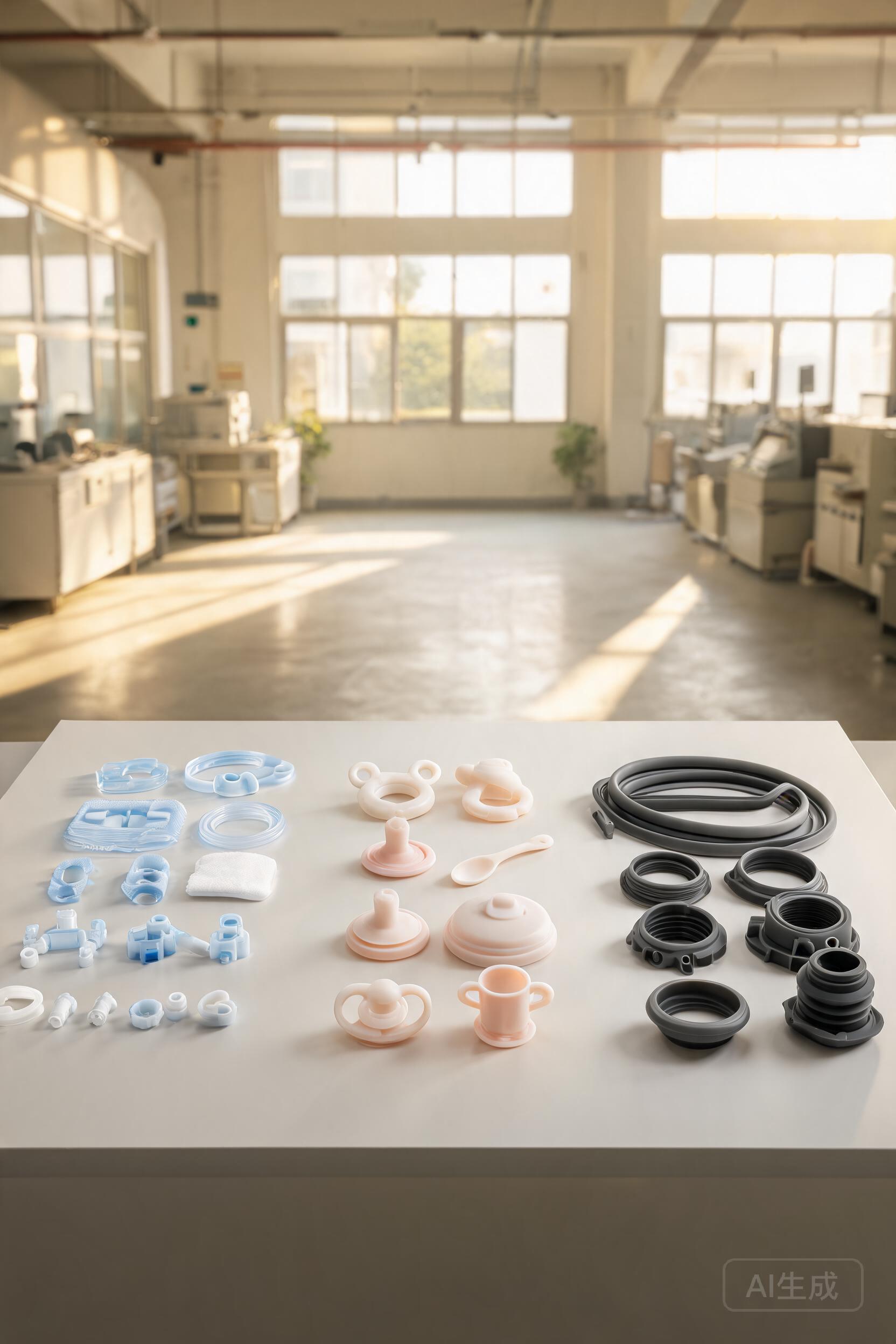
When manufacturing enterprises around Wuhan look for reliable silicone processing partners, they often face pain points such as incomplete qualifications, insufficient production capacity, and unstable quality. This article sorts out the core criteria for screening silicone processing factories, and analyzes the core advantages of Xiangchu Liquid Silicone Factory, including technical reserve, production capacity scale, quality control system, and customized services, to help enterprises quickly match processing resources that meet their needs, reduce cooperation risks, and improve product launch efficiency.
As a core industrial hub in Central China, Wuhan and its surrounding metropolitan area have seen explosive growth in demand for liquid silicone rubber (LSR) components across medical device, automotive, consumer electronics, and new energy sectors in recent years. Original equipment manufacturers (OEMs) and product developers in the region face a critical challenge: selecting a reliable silicone contract processing partner that can balance precision, cost efficiency, regulatory compliance, and supply chain stability.
Unlike thermoplastic processing, LSR manufacturing requires specialized injection molding equipment, strict cleanroom control, material formulation expertise, and robust quality management systems, making the vendor selection process far more complex than traditional plastic processing partnerships. For businesses operating in or around Wuhan, prioritizing local suppliers offers inherent advantages, including reduced logistics costs, faster communication cycles, and on-site troubleshooting support. However, not all local silicone processing enterprises meet the technical and operational standards required for high-value, regulated applications.
This guide outlines core evaluation criteria for selecting silicone processing enterprises around Wuhan, and provides a detailed analysis of Xiangchu LSR Factory, a leading local LSR manufacturing specialist, to illustrate how high-performing vendors address common industry pain points.
Before entering a partnership, OEMs must systematically assess potential suppliers across four non-negotiable dimensions, aligned with the unique operational and regulatory requirements of LSR component production.
The foundation of high-quality LSR processing lies in specialized equipment and engineering expertise, as LSR’s low viscosity, rapid curing, and temperature-sensitive properties demand hardware distinct from thermoplastic injection molding.
First, assess the supplier’s LSR-dedicated injection molding fleet: standard thermoplastic machines cannot achieve the precise metering, mixing ratio control, and low-shear injection required for LSR. Qualified suppliers should deploy servo-driven LSR injection presses with closed-loop control systems, paired with 1:1 or adjustable ratio metering units for A/B component silicone raw materials. For precision components such as medical seals or wearable sensor diaphragms, the machine must maintain a shot weight tolerance of ±0.5% and injection pressure stability of ±1 bar.
Second, evaluate mold manufacturing and maintenance capacity. LSR molds require tighter parting line tolerances (typically ≤0.005 mm) than thermoplastic molds to prevent flash, as well as polished surfaces and temperature-controlled heating systems to ensure uniform curing. Suppliers with in-house mold design and machining capabilities can reduce lead times for new product development by 30–40% compared to vendors that outsource mold production, and can conduct rapid mold repairs to minimize production downtime.
Third, assess secondary processing capabilities. Most LSR components require post-molding operations including deflashing, plasma treatment for bonding, printing, and assembly. Suppliers with automated deflashing equipment (cryogenic deflashing, robotic trimming) can ensure consistent part quality, while manual deflashing carries a higher risk of dimensional deviation and surface defects. Table 1 outlines the minimum equipment configuration required for mid-to-high volume LSR processing:
LSR components are often used in regulated industries, so a supplier’s compliance credentials directly determine whether products can enter target markets.
For medical device components, the supplier must hold ISO 13485 medical quality management system certification, and have processes in place to support FDA 21 CFR Part 177.2600 and EU REACH compliance for raw materials. For food-contact LSR products, compliance with China GB 4806.11, US FDA 21 CFR 177.2600, and EU EU 10/2011 standards is mandatory. Automotive LSR components require compliance with IATF 16949 and specific OEM material specifications (e.g. Volkswagen TL 52636, BMW GS 93016).
Beyond certification, assess the supplier’s quality control process: incoming raw material testing (hardness, tensile strength, elongation at break, curing time), in-process inspection (dimensional measurement, visual defect detection, functional testing), and outgoing batch testing. For high-precision components, suppliers should deploy coordinate measuring machines (CMM) with ±0.001 mm accuracy and optical profile projectors to ensure dimensional consistency. A reliable supplier will provide a full material traceability record for each production batch, including raw material lot numbers, processing parameters, and inspection reports.
Local suppliers around Wuhan offer unique advantages in supply chain responsiveness, but performance varies widely across enterprises.
First, evaluate raw material inventory capacity. Silicone raw materials have a 6–12 month shelf life, and global supply chain fluctuations can lead to lead times of 4–8 weeks for imported materials. Suppliers with 1–2 months of safety stock for common LSR grades (Shore A 30–70, medical/food grade) can reduce production lead times by 20–30% compared to suppliers that order materials on demand.
Second, assess production scheduling flexibility. Many OEMs require small-batch trial production (100–1000 units) for new product validation, followed by rapid scaling to mass production (100k+ units per month). Suppliers with a dedicated pilot production line can complete prototype production in 7–10 days, while vendors that only handle mass production may require 30+ days for trial runs.
Third, analyze cost structure. Local suppliers around Wuhan typically have 15–25% lower labor and overhead costs than coastal LSR factories in Guangdong or Jiangsu, but cost advantages are only meaningful if they do not come at the expense of quality. Avoid suppliers that quote prices 20% below the market average, as they may cut corners on raw material quality or skip critical quality control steps.
For OEMs developing new LSR products, a supplier’s R&D capacity directly reduces product development cycles and failure risks.
First, assess material formulation and application expertise. LSR can be modified with additives to achieve specific properties: UV resistance for outdoor applications, flame retardancy for new energy components, or conductivity for sensor parts. Suppliers with in-house material testing laboratories can help customers select or customize LSR formulations to meet performance requirements, rather than forcing customers to adjust product designs to fit off-the-shelf materials.
Second, evaluate design for manufacturing (DFM) support. LSR has unique design constraints: draft angles of 1–3 degrees for demolding, minimum wall thickness of 0.2 mm for small parts, and gating designs that avoid air entrapment. Suppliers that provide free DFM analysis during the product design phase can reduce mold modification rates by 50% and shorten time-to-market by 2–4 weeks.
Third, assess after-sales technical support. Local suppliers around Wuhan should be able to deploy technical engineers to customer sites within 24 hours to address quality issues or assembly compatibility problems, a timeline that is impossible for coastal or overseas suppliers to meet.
As a specialized LSR manufacturer located in the Wuhan East Lake High-Tech Development Zone, 45 minutes from Wuhan Tianhe International Airport and 30 minutes from the Wuhan Freight Railway Hub, Xiangchu LSR Factory has become a preferred partner for medical, automotive, and consumer electronics OEMs across Central China. Its core advantages align directly with the evaluation criteria outlined above, addressing common pain points for local and regional customers.
Xiangchu has invested over RMB 80 million in LSR-specific production and testing equipment, with a production capacity of 120 million LSR components per year, making it one of the largest specialized LSR factories in Central China.
Its injection molding fleet includes 16 servo-driven LSR injection presses ranging from 50 to 300 tons, all equipped with German-made 2KM metering units that maintain a 1:1 A/B material mixing ratio tolerance of ±0.1%, far exceeding the industry average of ±0.5%. The factory operates a 1,200 sq.m ISO Class 8 cleanroom production area, with a separate ISO Class 7 zone for medical implantable component processing, equipped with air filtration systems that maintain a particulate count of <352,000 particles ≥0.5 μm per cubic meter, in full compliance with medical device production requirements.
Xiangchu’s in-house mold center is equipped with 3 5-axis CNC machining centers, 2 EDM machines, and a mold polishing workshop, enabling it to design and manufacture precision LSR molds with parting line tolerances of ≤0.003 mm and surface roughness of ≤Ra 0.02 μm. The team specializes in insert molding molds for LSR and thermoplastic/metal components, with a success rate of 98% for first mold trials, compared to the industry average of 75%.
For secondary processing, Xiangchu deploys 2 cryogenic deflashing lines and 4 robotic trimming stations, which reduce deflashing defect rates to <0.1%, compared to 2–3% for manual deflashing. The factory also offers in-house plasma treatment, pad printing, and ultrasonic welding services, eliminating the need for customers to coordinate with multiple third-party processors.
Xiangchu holds a full set of industry-specific certifications, including ISO 9001:2015, ISO 13485:2016, IATF 16949:2016, and food contact safety certifications for China GB 4806.11, US FDA, and EU EU 10/2011, enabling it to support customers selling products in global markets.
The factory’s quality management system operates on a “zero-defect” framework, with 3 layers of quality control:
Xiangchu’s 3-year average customer return rate is 0.08%, far below the industry average of 0.5%, with zero regulatory non-compliance incidents since its establishment in 2018.
Located in the Wuhan metropolitan area, Xiangchu offers unique supply chain and cost advantages for customers in Central China, as well as national and international clients.
First, its raw material inventory system maintains 2 months of safety stock for 12 common LSR grades, including medical grade, food grade, flame retardant, and high-temperature resistant formulations, enabling it to start mass production within 3 days of order confirmation, compared to the industry average of 7–10 days. For emergency orders, Xiangchu has a dedicated rapid response production line that can deliver 10,000+ units within 48 hours, supporting customers facing unexpected supply chain disruptions.
Second, Xiangchu offers flexible production scheduling to accommodate customer needs: its dedicated pilot production line can deliver 100–5000 prototype units within 7 days, with DFM support included free of charge. For mass production, the factory’s maximum monthly capacity is 15 million units, enabling it to scale with customer demand as products move from launch to full mass production.
Third, Xiangchu’s localized cost structure enables it to offer pricing that is 18–22% lower than coastal LSR factories, with no compromise on quality or compliance. The factory works with customers to optimize costs through multiple channels: material substitution (identifying cost-effective domestic LSR grades that meet performance requirements), process optimization (reducing cycle times through improved mold temperature control), and high-volume order discounts. For a medical device customer producing 2 million LSR seals annually, Xiangchu’s cost optimization efforts reduced the customer’s total production cost by 24% in the first year of partnership, with no impact on product performance or regulatory compliance.
Unlike many silicone processing enterprises that only provide manufacturing services, Xiangchu offers end-to-end R&D support from product design to mass production, reducing customer development cycles by 30% on average.
Its in-house R&D center employs 12 material scientists and LSR process engineers, with 5+ years of average industry experience, who can customize LSR formulations to meet specific customer requirements: for example, the team developed a UV-stabilized LSR grade for a new energy customer that maintains 90% of its tensile strength after 1000 hours of UV exposure, meeting the customer’s outdoor application requirements. For a wearable device customer, the team developed a skin-safe LSR formulation with a low coefficient of friction, reducing skin irritation during long-term wear.
Xiangchu provides free DFM analysis for all new product inquiries, identifying potential design flaws that could lead to mold defects or production issues before mold manufacturing begins. For a consumer electronics customer developing a waterproof LSR speaker seal, the DFM team recommended adjusting the part’s draft angle from 0.5 degrees to 2 degrees and modifying the gating design to avoid air entrapment, reducing mold modification costs by RMB 28,000 and shortening the development cycle by 3 weeks.
For after-sales support, Xiangchu’s technical team provides 24/7 response, with on-site support available within 24 hours for customers in Wuhan and the surrounding Hubei province, and within 48 hours for customers in other parts of China. The team also provides assembly support, helping customers optimize their assembly processes to reduce LSR component damage during installation, which reduced one automotive customer’s assembly scrap rate from 1.2% to 0.2% in 6 months.
Selecting a reliable silicone processing enterprise around Wuhan requires a systematic evaluation of technical capacity, regulatory compliance, supply chain flexibility, and R&D support, rather than focusing solely on price. For OEMs operating in regulated industries such as medical devices, automotive, and consumer electronics, partnering with a specialized LSR manufacturer that meets these criteria can reduce product development cycles, lower supply chain risks, and improve long-term cost efficiency.
Xiangchu LSR Factory exemplifies the advantages of a high-performing local LSR supplier: its industry-leading equipment configuration, full regulatory compliance, localized supply chain responsiveness, and end-to-end R&D support address the core pain points of OEMs in Central China and beyond. For businesses looking for a silicone processing partner around Wuhan, Xiangchu’s track record of zero quality incidents, flexible production scheduling, and cost optimization capabilities make it a benchmark choice for both prototype development and large-scale mass production.
As the LSR industry continues to grow in Central China, the gap between specialized LSR manufacturers and general silicone processing enterprises will widen, making targeted evaluation of supplier core capabilities even more critical for long-term partnership success.