
橡楚编辑部 6/18/2026 49 min read
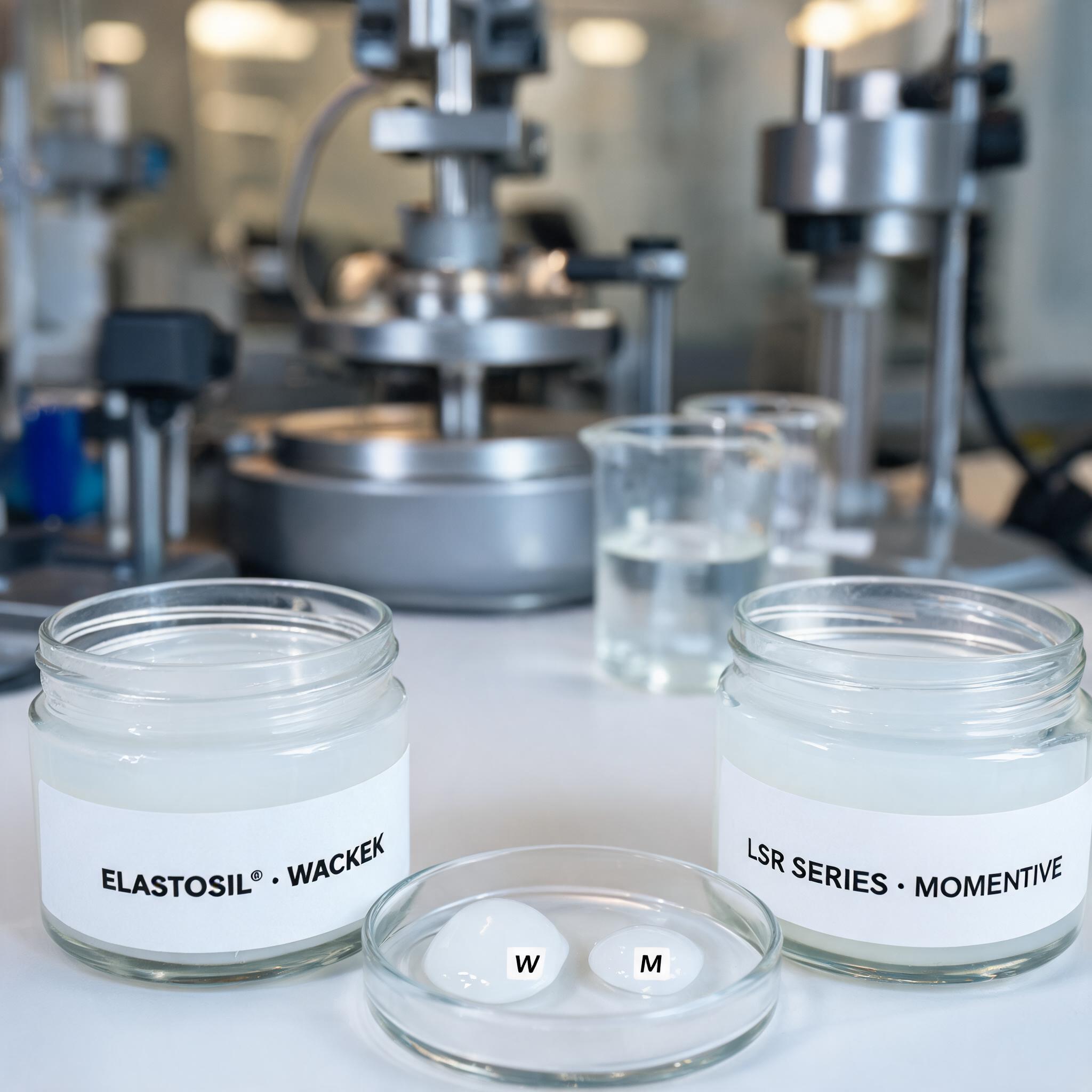
Choosing the right LSR liquid silicone rubber raw material can be tricky. From Wacker ELASTOSIL® to Momentive LSR series, engineers from Xiangchu (Hubei) Rubber will share professional material evaluation logic to help you clarify selection directions and meet production requirements of different liquid silicone products. We hold ISO 9001 certification and focus on LSR product manufacturing.
Liquid Silicone Rubber (LSR) has become an irreplaceable material in modern manufacturing, with applications spanning medical devices, baby products, automotive components, consumer electronics, and industrial seals. Its unique combination of biocompatibility, thermal stability, chemical resistance, and design flexibility makes it a preferred choice for high-performance end products. However, selecting the right LSR raw material for a specific application is far from a one-size-fits-all process. The wide range of commercially available LSR grades – from Wacker Chemie’s ELASTOSIL® series to Momentive’s LSR product lines – brings both options and confusion for product designers and manufacturers.
At 橡楚(湖北)橡胶有限公司, our engineering team has decades of combined experience in LSR product development and injection molding, working with a full spectrum of commercial LSR raw materials from leading global suppliers. We are based at 湖北省鄂州市鄂城区经济开发区凡口街道内河巷54号, and operate under an ISO 9001 certified quality management system to ensure consistent material evaluation and finished product performance. In this article, we will break down our systematic material review logic, walking through the core criteria that guide our selection process from leading brand LSR series to custom formulations. Whether you are developing a new medical device or optimizing an existing consumer product, this framework will help you avoid costly material selection mistakes and end-product failures.
All LSR material selection starts with a clear definition of end-use requirements. No single LSR grade can meet every performance need, so aligning material properties with application demands is the first step in our review process. We break this down into two core categories of requirements: regulatory compliance and mechanical performance.
Regulatory compliance is non-negotiable for most LSR applications, and failing to meet the required standards can lead to product recalls, legal penalties, and reputational damage. Different regions and industries have distinct compliance requirements, so we first map the target market and application to narrow down eligible LSR grades.
Common compliance frameworks we evaluate against include:
Both Wacker ELASTOSIL® and Momentive LSR series offer a wide range of pre-complied grades that meet most global regulatory requirements. For example, Wacker’s ELASTOSIL® LR 5040 series is fully certified for food contact and medical applications, while Momentive’s LSR 3xxx series is designed for high-compliance baby and consumer products. Our engineering team always cross-checks the latest compliance certificates from the raw material supplier before including a grade in our review, and we only source raw materials from authorized distributors to avoid counterfeit or non-compliant material.
After confirming regulatory compliance, we evaluate mechanical and physical properties against the end-use application. Key parameters we assess include:
Hardness also affects compression set – softer LSR typically has higher compression set, which is a critical consideration for long-term sealing applications.
Table 1 below compares the typical mechanical properties of common LSR grades from Wacker ELASTOSIL® and Momentive LSR series:
Even if an LSR grade meets all performance requirements, it can still lead to production delays, high scrap rates, and poor part quality if it is not compatible with your existing molding equipment and process. Our engineering team always evaluates processing compatibility early in the selection process to avoid downstream issues. We focus on two core processing factors: injection molding behavior and curing system compatibility.
Liquid silicone rubber is processed via liquid injection molding (LIM), which relies on consistent flow behavior to fill complex mold cavities completely without defects. The key parameter that determines flow behavior is the viscosity of the uncured A and B components. LSR viscosity typically ranges from 100,000 mPa·s to 1,000,000 mPa·s, measured at room temperature before mixing.
Our team matches viscosity to part design and mold design as follows:
Another flow-related property we evaluate is the mold release behavior. Some LSR grades are formulated with internal mold release agents, which reduce the need for external mold spraying and shorten cycle time. For high-volume production, this is a major advantage. However, for applications that require secondary bonding (such as LSR-over-molding onto plastic or metal), internally released LSR can reduce bond strength, so we select non-internally released grades for over-molding applications. Both Wacker and Momentive offer LSR grades with and without internal mold release, so we can match the formulation to the production process.
All commercial LSR raw materials are two-part platinum-catalyzed systems, consisting of a base component (Part A) and a crosslinker/catalyst component (Part B), mixed at a standard 1:1 ratio by weight. However, different formulations have different curing kinetics, which affects production cycle time and requires different molding temperature settings.
We evaluate two key curing parameters: pot life after mixing and cure time at molding temperature.
A critical factor we always test for is cure inhibition. Platinum-catalyzed LSR can be inhibited by certain contaminants, including nitrogen, sulfur, tin, and amine additives that are common in some rubber compounds and plastics. If you are over-molding LSR onto a plastic substrate that contains these inhibitors, the LSR will not cure properly at the interface, leading to poor bond strength and sticky surfaces. When selecting LSR for over-molding applications, we work with suppliers to select inhibition-resistant LSR grades, and we always run small-scale bonding tests before full production. Wacker and Momentive both offer specialized inhibition-resistant LSR grades for over-molding applications, which are our go-to options for multi-material parts.
The performance of LSR can change significantly over time when exposed to different operating environments. Our material review process always includes an evaluation of long-term environmental endurance, based on the expected operating conditions of the end product. We focus on two core areas: thermal stability and chemical resistance.
LSR is known for excellent thermal stability compared to organic rubbers, but different LSR grades have different maximum and minimum continuous operating temperatures. We match thermal stability to the application as follows:
Table 2 below summarizes the typical aging performance of different LSR grades after 1000 hours of heat exposure:
Chemical resistance is a critical requirement for LSR parts that come into contact with oils, fuels, cleaning agents, or other chemicals during use. LSR has excellent resistance to water, polar solvents, and common cleaning agents, but it has poor resistance to non-polar hydrocarbons such as gasoline and mineral oil, unless specially formulated.
Our evaluation of chemical resistance is tailored to the media the part will contact:
After covering the individual evaluation criteria, we want to share the full systematic review framework our engineering team uses for every new project, when selecting between Wacker ELASTOSIL® and Momentive LSR series (or other brand LSR grades). This process eliminates subjective selection and ensures we find the optimal balance of performance, compliance, processing, and cost.
We start by collecting all requirements from the customer, including:
Using this information, we screen out any LSR grades that do not meet non-negotiable requirements (such as regulatory compliance) to create a shortlist of 2–3 candidate grades. For example, if the project is for a medical implant that requires USP Class VI compliance, we automatically narrow the shortlist to Wacker ELASTOSIL® LR 5000 series medical-grade LSR and Momentive LSR 3000-50 series medical LSR, eliminating all general-purpose grades.
For the shortlisted candidates, we conduct small-scale testing in our in-house laboratory to verify material properties and processing behavior. Our testing includes:
After testing, we conduct a cost-benefit analysis of the candidate materials to select the final grade. We do not automatically select the highest performance (or lowest cost) material – we select the material that meets all requirements at the lowest total cost. For example:
At 橡楚(湖北)橡胶有限公司, we maintain long-term partnerships with authorized distributors of both Wacker and Momentive LSR raw materials, so we can access competitive pricing for all grades, and we pass these cost savings on to our customers