
橡楚编辑部 8/5/2026 44 min read
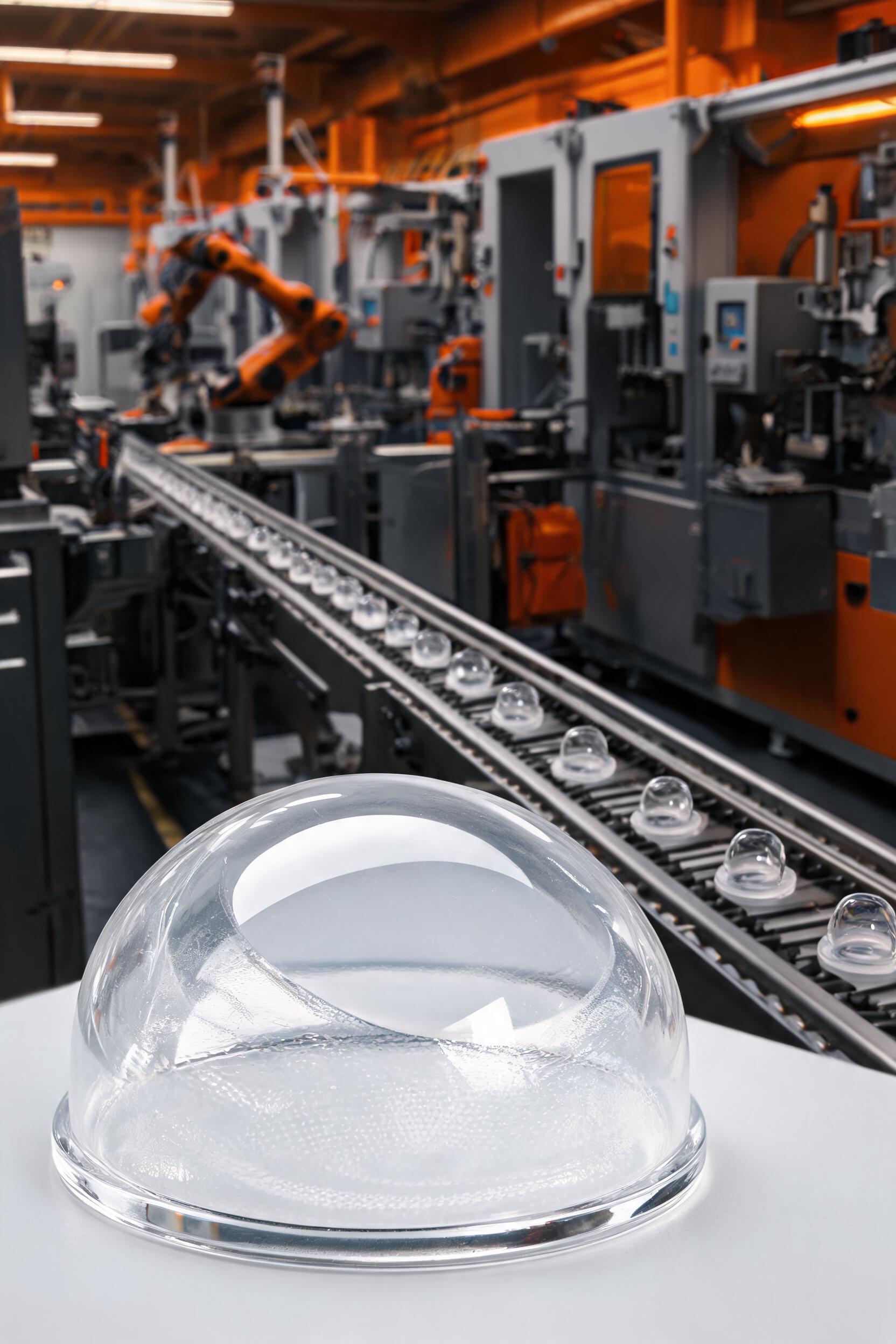
High transparency optical liquid silicone rubber (LSR) lenses, with excellent properties such as high light transmittance, yellowing resistance and impact resistance, have gradually replaced traditional glass and PC lenses, and are widely used in automotive lights, AR/VR devices, medical optical instruments and other fields. This article explains the core technical requirements and application advantages of high transparency optical LSR lenses from the dimensions of material properties, molding process and quality control points, providing technical references for relevant manufacturing enterprises.
High transparency optical liquid silicone rubber (LSR) lenses have emerged as a critical alternative to traditional glass and thermoplastic optical components in consumer electronics, automotive lighting, medical devices, and AR/VR systems. Unlike polycarbonate (PC) and polymethyl methacrylate (PMMA), optical LSR exhibits unique properties including 92%+ visible light transmittance, -40°C to 200°C operating temperature stability, inherent UV resistance, and low birefringence, making it ideal for high-performance optical applications requiring long-term reliability in harsh environments.
The global market for optical LSR lenses is projected to grow at a CAGR of 12.7% from 2024 to 2030, driven by rising demand for miniaturized, lightweight optical modules in smart wearables and adaptive automotive lighting. However, the preparation of high-transparency LSR lenses requires strict control over raw material formulation, molding process parameters, and post-treatment to avoid defects such as bubbles, haze, and refractive index inhomogeneity. This article systematically analyzes the material formulation system, precision injection molding process, post-treatment and quality control methods of high-transparency optical LSR lenses, and quantifies their performance advantages compared to traditional optical materials, providing technical reference for mass production and application expansion of LSR optical components.
The transparency and optical uniformity of LSR lenses are fundamentally determined by the raw material formulation, which requires precise control of polymer matrix composition, crosslinking systems, and additive content to minimize light scattering and absorption.
The core component of high-transparency optical LSR is vinyl-terminated polydimethylsiloxane (V-PDMS), whose molecular weight distribution and vinyl content directly affect crosslinking density, mechanical properties, and optical performance. To achieve high transparency, the base polymer must have a narrow molecular weight distribution (polydispersity index < 1.2) to avoid microphase separation between polymer chains of different lengths, which would cause light scattering and increase haze.
Table 1 shows the performance comparison of V-PDMS with different vinyl contents for optical LSR applications:
As shown in Table 1, 0.15 mmol/g vinyl content offers the optimal balance: crosslinking density is sufficient to ensure structural stability of the lens, while the refractive index uniformity is high, achieving peak transmittance of 92.1%. For applications requiring higher refractive index (1.43~1.45), phenyl-modified V-PDMS is used, where the introduction of phenyl groups increases the polarizability of the polymer chain, raising the refractive index without significantly reducing transmittance. However, phenyl content must be controlled below 15 mol% to avoid excessive chain rigidity that increases residual stress during molding.
The crosslinking system of optical LSR adopts a platinum-catalyzed hydrosilylation reaction between hydrogen-containing PDMS (H-PDMS) and vinyl groups on the base polymer, which avoids the byproducts generated by peroxide curing systems, thus eliminating internal voids and haze caused by volatile small molecules. The molar ratio of Si-H groups in H-PDMS to Si-Vi groups in V-PDMS (H/Vi ratio) is a key parameter: when the ratio is 1.1~1.3:1, crosslinking is complete, residual Si-H or Si-Vi groups are minimized, and the risk of post-curing yellowing is reduced.
For additives, optical LSR formulations require strict restriction of non-reactive components to avoid light scattering:
Importantly, no reinforcing fillers such as fumed silica are added to high-transparency optical LSR formulations, as the refractive index difference between silica (1.46) and PDMS (1.41) will cause significant light scattering, increasing haze to above 5% even with nanoscale silica. Instead, crosslinking density is adjusted to meet the hardness and modulus requirements of the lens, ensuring optical performance is prioritized.
LSR injection molding is a thermoset processing method, which is fundamentally different from thermoplastic lens molding, requiring precise control of material metering, mold temperature, injection speed, and curing time to ensure optical uniformity and surface accuracy of the lens.
Specialized LSR injection molding machines are required for optical lens production, equipped with a closed-loop proportional control metering system to ensure the mixing ratio of the two-component LSR (A component: V-PDMS + platinum catalyst; B component: V-PDMS + H-PDMS + inhibitor) is accurate to ±0.1%, as mixing ratio errors exceeding 0.5% will lead to incomplete curing and refractive index deviations of up to 0.002, resulting in focal length offset and imaging distortion.
The mold for optical LSR lenses has the following core design points:
The key process parameters for high-transparency LSR lens molding include injection speed, holding pressure, curing time, and demolding temperature, and their optimization is shown in Table 2 for a 2 mm thick, 10 mm diameter plano-convex LSR lens:
Common optical defects in LSR lens molding and their control methods are as follows:
For high-precision lenses used in AR/VR systems, the birefringence value must be controlled below 10 nm/cm, which can be achieved by adding a 2-second delay between the end of injection and the start of curing, allowing oriented molecular chains to fully relax before crosslinking is completed.
Even with optimized molding processes, cured LSR lenses usually have a small amount of residual stress and unreacted small molecules, requiring post-treatment to further improve optical stability, followed by strict performance testing to meet application requirements.
The main post-treatment processes for high-transparency optical LSR lenses include post-curing, surface modification, and edge trimming:
The performance of high-transparency optical LSR lenses must be tested against strict standards, with key testing items and acceptance criteria shown in Table 3:
In mass production, an automatic optical inspection (AOI) system is used for 100% inspection of lenses, which can detect surface defects such as scratches, bubbles, and impurities with a minimum size of 1 μm, ensuring the product yield is above 95%. For high-end AR/VR lenses, additional focal length and modulation transfer function (MTF) testing is performed, requiring the MTF value at 50 lp/mm to be ≥0.8, meeting the requirements of high-resolution imaging.
Compared with traditional optical materials (glass, PC, PMMA), high-transparency LSR lenses have unique comprehensive performance advantages, enabling their rapid penetration in multiple high-growth application fields.
Table 4 quantifies the performance comparison between optical LSR and traditional optical materials:
As shown in Table 4, LSR has obvious advantages in temperature stability, UV resistance, and density: its operating temperature range is 80°C higher than PC and 120°C higher than PMMA, making it suitable for high-temperature environments such as automotive headlights and outdoor lighting; its 85%+ UV transmittance makes it ideal for UV disinfection equipment optical components, where PC and PMMA are completely opaque and have poor UV aging resistance; and its density is 20% lower than PC and 18% lower than PMMA, which helps reduce the weight of wearable devices such as AR glasses.
Compared with glass, LSR has obvious advantages in mass production efficiency and impact resistance: the molding cycle of LSR is only 1/10 of that of glass grinding, and the material cost is 30~50% lower for complex aspherical lenses; LSR lenses will not break when impacted, which improves the safety of automotive lighting and medical device applications. The only disadvantage of LSR compared to glass is the relatively narrow refractive index range, but the development of high-refractive index LSR (up to 1