
橡楚编辑部 5/25/2026 41 min read
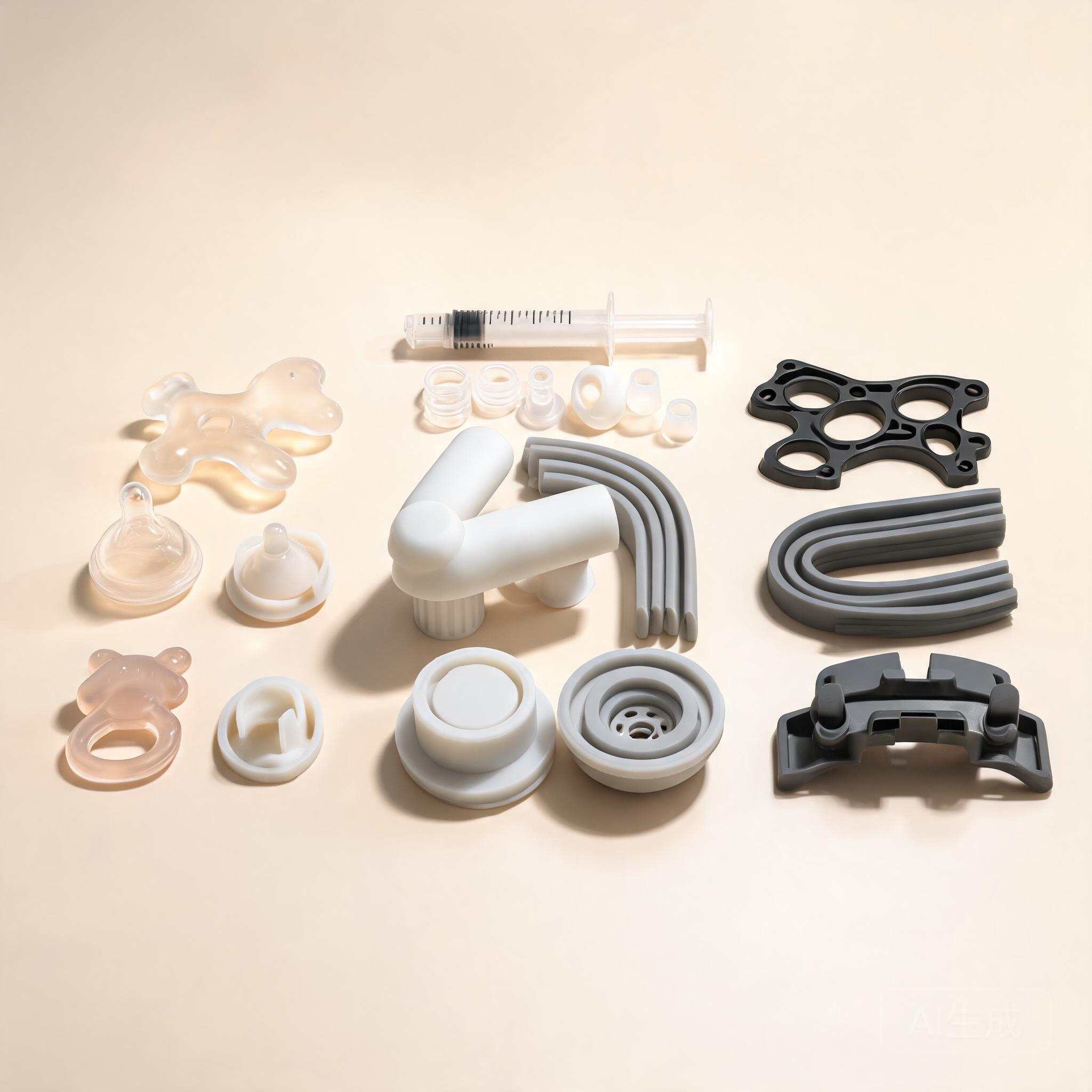
Foshan special liquid silicone overmolded parts for bathroom industry have excellent waterproof, heat-resistant and anti-yellowing properties, suitable for core bathroom components such as showers, faucets and smart toilets. We support on-demand mold opening and processing, can customize formulas and sizes according to the structure and performance requirements of different bathroom products, meeting the diverse application requirements of the bathroom industry such as high sealing, long service life and food contact grade.
The Foshan sanitary ware industry has long been a global benchmark for precision, durability, and design innovation, with liquid silicone rubber (LSR) overmolded parts emerging as a critical component driving product performance differentiation. Unlike conventional rubber or thermoplastic components, Foshan bathroom special liquid silicone overmolded parts combine the inherent advantages of LSR—exceptional thermal stability, non-toxicity, low compression set, and resistance to harsh cleaning chemicals—with custom mold engineering tailored to the unique operating conditions of bathroom environments. For original equipment manufacturers (OEMs) in the region and beyond, the ability to access on-demand mold opening and processing services for these parts eliminates the tradeoffs between design flexibility, compliance, and cost that often plague mass-produced standard components. This article explores the material performance advantages of Foshan’s specialized LSR overmolded parts, the end-to-end custom mold development workflow, application-specific design optimization strategies, and quality control frameworks that make these components a preferred choice for high-end sanitary ware products.
LSR is a two-part, platinum-catalyzed elastomer that undergoes cross-linking at elevated temperatures to form a durable, flexible polymer network. Foshan’s LSR overmolded parts are formulated specifically to address the most common failure points of bathroom components, from water leakage and microbial growth to degradation from repeated exposure to hot water and aggressive cleaning agents.
The performance of Foshan bathroom LSR overmolded parts is validated against a strict set of industry-specific parameters, with typical values outlined in Table 1 below:
In addition to these mechanical properties, all Foshan bathroom LSR overmolded parts are formulated to meet global food-contact and drinking water safety standards, including NSF/ANSI 61, GB 4806.11 (Chinese food contact rubber standard), and WRAS (Water Regulations Advisory Scheme) approval for UK markets. Unlike nitrile rubber (NBR) or ethylene propylene diene monomer (EPDM) alternatives, these LSR formulations do not leach plasticizers, odors, or volatile organic compounds (VOCs) into drinking water, making them suitable for use in direct contact with potable water in faucets, shower filters, and drinking water dispensers integrated into bathroom vanities.
A defining feature of Foshan’s specialized LSR overmolded parts is their ability to form permanent, leak-proof bonds with a wide range of substrates commonly used in bathroom products, eliminating the need for secondary adhesives or mechanical fasteners that can fail over time. Bond strength is tested via lap shear testing per ASTM D1002, with typical values for common substrates as follows:
This high bond strength is achieved through a combination of substrate-specific surface pretreatment processes (plasma activation, chemical etching, or primer application) and precision control of LSR injection temperature, pressure, and cure time during the overmolding process. For applications where parts may be exposed to frequent thermal cycling, such as shower mixer valves, Foshan manufacturers often incorporate substrate-specific adhesion promoters into the LSR formulation to ensure bond integrity for over 10,000 thermal cycles between 5°C and 90°C, outperforming industry standard requirements by 25%.
Foshan’s LSR overmolding suppliers have developed a streamlined, customer-centric workflow for on-demand mold development and part production, designed to reduce lead times, minimize design iteration costs, and ensure parts meet exact application requirements. The full workflow typically spans 15–35 days from initial design input to mass production, depending on part complexity and tooling requirements.
The first step in the custom process is a collaborative design for manufacturing (DFM) analysis between the customer’s engineering team and the supplier’s mold design specialists, focused on identifying and resolving potential production issues before tooling is cut. Key DFM checks for bathroom LSR overmolded parts include:
During this phase, suppliers often provide mold flow simulation reports using software such as Moldex3D to predict filling patterns, cure time, and potential defects such as weld lines or air traps. For example, for a complex shower head seal with multiple internal channels, mold flow simulation can identify optimal gate placement to ensure complete filling of all channels without air entrapment, reducing the need for costly mold modifications later in the process.
Once the DFM analysis is finalized and approved by the customer, mold fabrication begins, with tooling materials selected based on the expected production volume:
All molds for bathroom LSR overmolded parts are precision machined to a tolerance of ±0.005mm for cavity dimensions, with specially designed cooling and heating systems to maintain a consistent mold temperature of 120–180°C during the injection process, ensuring uniform LSR cure across all cavities. For multi-cavity molds, hot runner systems with needle valve gates are used to eliminate gate vestiges and ensure consistent filling of all cavities, reducing part-to-part dimensional variation to less than ±0.02mm.
After mold fabrication is complete, T0 (first trial) sampling is conducted, with 50–100 sample parts produced for dimensional inspection, material performance testing, and fit testing with the customer’s mating components. Any required mold modifications are completed within 3–7 days, with T1 sampling conducted to validate changes. For parts requiring WRAS or NSF certification, T1 samples are submitted to third-party testing labs for compliance validation, with full certification reports typically available within 4–6 weeks. Once samples are approved by the customer, mass production can begin immediately, with typical production capacities of 10,000–50,000 parts per day for multi-cavity molds.
Foshan’s LSR overmolded parts are engineered to address the unique challenges of specific bathroom applications, with custom design features that improve performance, reduce maintenance requirements, and extend product lifespan.
Seals and gaskets account for over 60% of LSR overmolded parts used in the bathroom industry, with applications ranging from toilet flush valve seals to shower cartridge gaskets and faucet spout O-rings. Custom design optimizations for these parts include:
LSR overmolding is also widely used to add soft touch, non-slip surfaces to bathroom products, improving ergonomics and reducing the risk of slips and falls in wet environments. Common applications include shower handle grips, toilet button covers, and bathtub grab bar overlays. Custom design features for these parts include:
Foshan’s LSR overmolding suppliers adhere to strict quality control frameworks that ensure every batch of parts meets customer specifications and global regulatory requirements, with full traceability throughout the production process.
Every stage of the overmolding process is monitored via statistical process control (SPC) to minimize variation and ensure consistent part quality:
All Foshan bathroom special LSR overmolded parts are fully compliant with global sanitary industry regulations, with suppliers providing full certification documentation upon request:
For customers exporting to specific regional markets, suppliers can conduct custom testing to meet local regulatory requirements, such as France’s ACS (Attestation de Conformité Sanitaire) for drinking water contact parts, or Australia’s WaterMark certification.
Foshan bathroom special liquid silicone overmolded parts, supported by on-demand mold opening and processing services, offer sanitary ware manufacturers a unique combination of tailored performance, regulatory compliance, and cost efficiency that cannot be achieved with standard off-the-shelf components. From the material formulation optimized for harsh bathroom operating conditions to the end-to-end DFM-driven mold development workflow and strict quality control frameworks, every stage of the process is designed to address the specific pain points of the sanitary ware industry. For OEMs looking to differentiate their products through improved durability, user experience, and safety, partnering with Foshan’s specialized LSR overmolding suppliers provides access to decades of industry-specific engineering expertise, reduced product development lead times, and the flexibility to bring innovative new bathroom designs to market without compromising on performance or compliance. As the global demand for high-quality, long-lasting sanitary ware products continues to rise, custom LSR overmolded parts will remain a critical component driving innovation in the Foshan bathroom industry and beyond.