
橡楚编辑部 5/18/2026 37 min read
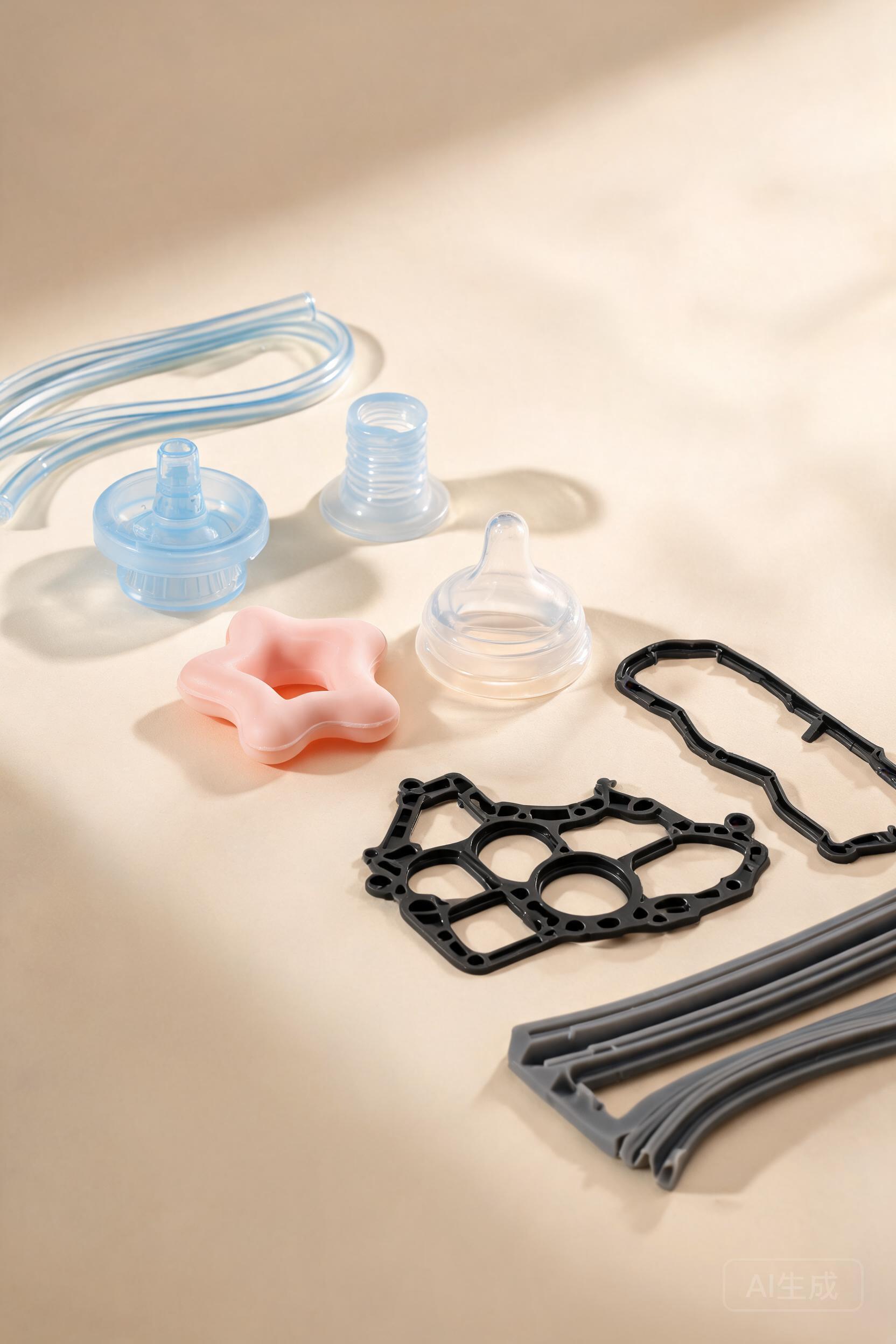
This article introduces the core service advantages of Xiangchu, a professional silicone processing manufacturer in Ezhou. With years of experience in liquid silicone rubber (LSR) precision manufacturing, it provides full-chain customized services from mold development, process optimization to mass production, covering the needs of medical, automotive, consumer electronics and other industries, with the characteristics of high precision, high yield and fast delivery, making it a reliable partner for LSR product customization.
Liquid silicone rubber (LSR) has emerged as a critical material across medical, automotive, consumer electronics, and food contact industries due to its exceptional biocompatibility, thermal stability (-60°C to 220°C long-term operation), low compression set (<10% for 22h at 175°C per ISO 815), and resistance to UV radiation and chemical exposure. However, LSR precision manufacturing requires rigorous control of material metering, mold temperature uniformity, and post-curing parameters, making it a high-barrier process that few domestic manufacturers in central China have historically been able to execute at scale. Ezhou-based Xiangchu Technology, a specialized silicone contract manufacturing provider, has filled this gap by building a 12,000㎡ production facility dedicated exclusively to LSR processing, with a 12-person R&D team focused on resolving common industry pain points including flash defects, micro-feature replication failure, and inconsistent cross-linking density in complex geometries. This article provides a technical deep dive into Xiangchu’s core service capabilities, quality control systems, and industry-specific application solutions for global original equipment manufacturers (OEMs) seeking reliable LSR precision manufacturing partners.
Xiangchu’s manufacturing ecosystem is designed to support full-cycle LSR production, from initial material formulation optimization to high-volume mass production, with equipment calibrated to meet the strictest dimensional tolerance requirements for micro and complex parts.
Xiangchu operates 26 servo-driven LSR injection molding machines ranging from 55kN to 650kN clamping force, all equipped with closed-loop metering systems that maintain a ±0.1% mixing ratio accuracy for LSR A/B component dosing, a critical parameter for ensuring consistent part hardness and mechanical properties. The facility’s mold temperature control systems use water-oil dual-circulation units to achieve ±0.5°C temperature uniformity across cavity surfaces, eliminating the non-uniform curing that leads to part warpage or incomplete micro-feature formation.
Table 1: Xiangchu LSR Injection Molding Equipment Parameter Matrix
For micro-molding applications, Xiangchu has developed a proprietary low-shear screw design that reduces material degradation during injection, enabling the replication of micro-features as small as 2μm, such as the micro-fluidic channels in point-of-care diagnostic devices and the anti-slip micro-protrusions on wearable medical electrodes. This capability is particularly rare among mid-sized LSR manufacturers in central China, as it requires both custom equipment modifications and specialized process parameter tuning.
Beyond standard off-the-shelf LSR grades, Xiangchu offers custom material formulation services to meet application-specific performance requirements, working with raw material suppliers including Dow, Wacker, and Momentive to adjust hardness, color, conductivity, and chemical resistance. For example, the company has developed a high-durability LSR grade for automotive charging port seals that achieves 96A hardness, <8% compression set after 1000h at 120°C, and resistance to EV charging fluid corrosion, exceeding the IEC 62196 standard for electric vehicle components.
Xiangchu also specializes in multi-material co-molding of LSR with engineering thermoplastics (polycarbonate, ABS, PBT) and metal inserts, with a 99.2% bonding success rate for overmolded parts. The process involves pre-treatment of insert surfaces via plasma cleaning to increase surface energy, followed by optimized injection timing and temperature control to ensure chemical bonding between LSR and the substrate, rather than just mechanical interlocking. This eliminates the risk of delamination even after 1000 thermal shock cycles (-40°C to 125°C), a key requirement for automotive and outdoor electronics applications.
To support medical and food contact part manufacturing, Xiangchu maintains a 4,200㎡ ISO Class 8 (100,000 level) cleanroom production area, with a separate ISO Class 7 (10,000 level) zone for sterile medical component processing. The cleanroom is equipped with HEPA filtration systems that achieve 99.97% particle removal efficiency for 0.3μm particles, with hourly air exchange rates of 30x for ISO Class 8 and 60x for ISO Class 7 zones.
All production staff complete a 40-hour GMP training program before entering cleanroom areas, and material transfer processes use sealed autoclavable containers to prevent cross-contamination. This environment enables Xiangchu to produce LSR parts that meet USP Class VI biocompatibility requirements for medical devices, as well as EU 1935/2004 and FDA 21 CFR Part 177.2600 standards for food contact applications.
Xiangchu has implemented a closed-loop quality control system that covers every stage of the manufacturing process, from incoming material inspection to final part validation, to ensure consistent compliance with customer specifications and global regulatory standards.
Xiangchu’s IPQC process integrates real-time sensor monitoring and manual sampling to catch defects early in production, reducing scrap rates to <1.2% for high-volume runs, well below the industry average of 3-5% for LSR molding. Every injection molding machine is equipped with sensors that track 12 critical process parameters in real time:
If any parameter deviates from the pre-defined tolerance range, the machine automatically pauses production and triggers an alert to the process engineering team, preventing non-conforming parts from being produced. For high-precision parts, operators perform dimensional checks every 30 minutes using a coordinate measuring machine (CMM) with 0.001mm accuracy, and hardness checks every 60 minutes using a Shore durometer calibrated to ISO 7619 standards.
Xiangchu operates an in-house testing laboratory equipped to validate all key performance properties of LSR parts, eliminating the need for third-party testing for most standard requirements and reducing lead times by 3-5 days for prototype and low-volume runs. Core testing capabilities include:
For medical device customers, Xiangchu provides full batch traceability records, including material lot numbers, process parameter logs for every part produced, and testing reports, which are stored for 15 years in compliance with FDA 21 CFR Part 820 medical device quality system requirements. The company also holds ISO 13485:2016 medical device quality management system certification, IATF 16949:2016 automotive quality system certification, and ISO 9001:2015 general quality system certification, covering all major industry regulatory frameworks.
For critical applications such as implantable medical components and automotive safety-related seals, Xiangchu offers non-destructive testing services to identify internal defects that are not visible to the naked eye, including voids, incomplete curing, and delamination in co-molded parts. The company uses high-resolution industrial CT scanning with 5μm resolution to detect internal voids as small as 10μm, and ultrasonic testing for thickness measurement of thin-walled LSR parts down to 0.1mm thickness.
Xiangchu has also developed a custom automated optical inspection (AOI) system for high-volume production runs, which uses machine vision to detect surface defects, flash, and dimensional deviations at a rate of 120 parts per minute, with a 99.8% defect detection accuracy. This eliminates the risk of human error in manual inspection, which is particularly critical for small parts such as micro-seals that are difficult to inspect visually.
Xiangchu’s R&D team has developed tailored LSR manufacturing solutions for three high-growth industries, addressing the unique performance and regulatory requirements of each sector.
Xiangchu’s medical device LSR solutions cover three core application areas: implantable components, minimally invasive surgical accessories, and wearable medical device parts. The company has produced over 32 million LSR parts for medical device customers globally, with a 0% field failure rate reported over the past 5 years.
For example, Xiangchu developed a custom LSR gasket for a portable insulin pump, which required ±0.008mm dimensional tolerance to prevent insulin leakage, 70A Shore hardness, and biocompatibility per ISO 10993-5 for cytotoxicity. The manufacturing process involved micro-injection molding with a 4-cavity precision mold, followed by plasma surface modification to reduce protein adsorption by 42% compared to standard LSR, extending the gasket’s service life from 30 days to 90 days. The company also produces LSR balloon catheters with 0.05mm wall thickness and ±0.01mm uniformity, which are used in cardiac ablation procedures, with batch validation of burst pressure up to 12 atm to meet clinical safety requirements.
As the electric vehicle (EV) industry expands, demand for high-durability LSR sealing and insulation components has grown rapidly, and Xiangchu has developed a full range of solutions for EV and traditional automotive applications. The company’s automotive LSR parts are validated to meet IATF 16949 quality requirements and perform reliably under the harsh operating conditions of vehicle environments.
Key automotive offerings include:
For a leading domestic EV manufacturer, Xiangchu developed a custom LSR battery pack sealing gasket that reduced assembly time by 30% compared to traditional rubber gaskets, with a 12-year service life guarantee, exceeding the customer’s 8-year warranty requirement for vehicle powertrain components.
Xiangchu also serves consumer electronics and food contact product OEMs, combining precision manufacturing with cost-effective high-volume production capabilities. For consumer electronics applications, the company produces LSR waterproof seals for smart watches, earphone tips, and keyboard protective films, with surface roughness as low as Ra 0.2μm to improve user comfort.
For food contact applications, Xiangchu produces LSR baking molds, baby bottle nipples, and coffee machine gaskets that meet FDA and EU food contact standards, with no BPA, phthalates, or volatile organic compounds (VOCs) detected in extractable testing. The company has also developed a proprietary anti-stick LSR formulation for baking molds that eliminates the need for surface coating, reducing production costs by 15% for customers while ensuring food safety compliance. For a global baby product brand, Xiangchu produced 12 million LSR pacifiers per year, with 100% of batches passing EU 1935/2004 testing for nitrosamine release, a key safety requirement for baby products.
As demand for high-precision LSR components continues to grow across regulated industries, Xiangchu Technology has established itself as a leading LSR contract manufacturing provider in central China, with a unique combination of custom material formulation expertise, precision injection molding capabilities, and industry-specific regulatory compliance knowledge. The company’s 12,000㎡ Ezhou facility is equipped to support production runs from 100-piece prototype orders to 10 million-piece mass production orders, with lead times as short as 7 days for prototype tooling and 15 days for mass production tooling, which is 20-30% faster than the industry average.
Looking forward, Xiangchu is investing RMB 28 million in a second-phase production facility scheduled to open in 2025, which will add 18,000㎡ of cleanroom production area and 32 additional high-precision LSR injection molding machines, increasing annual production capacity to 220 million parts. The company is also expanding its R&D focus on LSR 3D printing for low-volume custom applications and biodegradable LSR formulations for sustainable consumer products, to meet the evolving needs of global OEMs. For manufacturers seeking a reliable, technically capable LSR processing partner, Xiangchu’s end-to-end service model, rigorous quality control system, and deep industry expertise make it a competitive choice for both domestic and international projects.