
橡楚编辑部 7/23/2026 49 min read
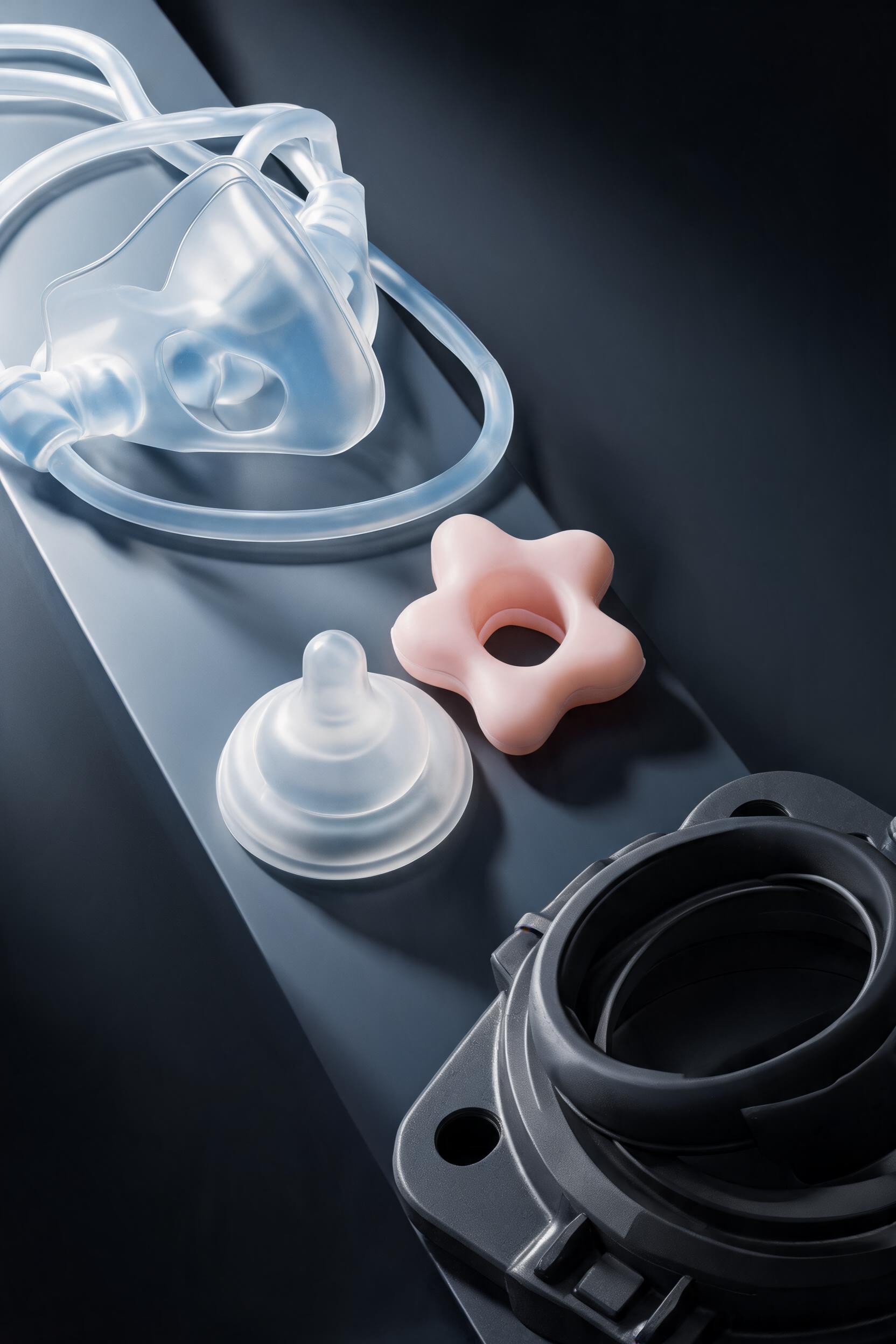
Custom processing of industrial non-standard silicone rubber parts can meet the needs of different special working conditions. This article sorts out the core precautions of the whole custom processing process from the dimensions of material selection matching, structure optimization, and molding process management, helping demanders clearly control the custom cycle and quality standards, reduce communication costs and trial-and-error losses, and obtain more adaptable silicone rubber accessory solutions.
Industrial non-standard silicone rubber parts are custom-manufactured components designed to meet unique performance, dimensional, and environmental resistance requirements that off-the-shelf standard parts cannot satisfy. Unlike mass-produced O-rings, gaskets, or tubing with fixed specifications, these custom parts are engineered for niche applications across aerospace, medical devices, automotive electrification, and industrial automation, where operating conditions often exceed the limits of commodity elastomers. Liquid Silicone Rubber (LSR) is the dominant material for these applications due to its exceptional thermal stability (-60°C to 220°C continuous operating temperature, with specialty grades extending to 300°C), biocompatibility (ISO 10993 and USP Class VI certified options), electrical insulation strength (15–22 kV/mm dielectric breakdown), and resistance to UV radiation, ozone, and most chemical solvents.
The custom processing workflow for non-standard silicone rubber parts differs significantly from standard manufacturing, as it requires iterative collaboration between part designers, material scientists, and processing engineers to resolve trade-offs between performance, dimensional tolerance, and production cost. A 2023 industry survey by the International Elastomer Association found that 68% of industrial equipment manufacturers report production downtime related to failed standard elastomer parts, with 72% of these failures attributable to mismatched material properties or dimensional inaccuracies in off-the-shelf components. This statistic underscores the critical value of tailored custom processing for non-standard silicone rubber parts, as well as the need for standardized engineering frameworks to minimize development cycles and reduce defect rates. This article systematically analyzes the core stages of custom processing, including design for manufacturing (DFM) optimization, material formulation customization, precision processing technologies, and quality control protocols, with quantitative performance data and case studies to illustrate industry best practices.
DFM is the foundational stage of custom processing, as it aligns part functional requirements with the inherent limitations of LSR processing technologies to reduce production costs, shorten lead times, and minimize defect risks. Unlike rigid materials such as metal or thermoplastics, LSR exhibits unique rheological and shrinkage behaviors during curing, which require targeted design adjustments to avoid common failures such as flash, dimensional deviation, and incomplete filling.
The first step in DFM is to define achievable dimensional tolerances based on part size, geometric complexity, and selected processing method. While LSR has higher molding precision than most thermoset rubbers, tolerance limits are constrained by material shrinkage, mold precision, and demolding mechanics. Table 1 outlines standard achievable tolerances for LSR custom parts across different size ranges, per ISO 3302-1 Class M1 (tightest tolerance class for rubber products):
For geometric features, engineers must avoid sharp internal corners (minimum recommended radius: 0.2 mm) to reduce stress concentration and prevent mold wear. Undercut features require special demolding mechanisms (e.g., collapsible cores, side actions) which increase mold cost by 30–50% and extend lead times by 5–7 days, so designers are advised to modify part geometry to eliminate undercuts where functional requirements allow. Draft angles are another critical design parameter: for vertical walls, a minimum draft angle of 1° per side is recommended for parts with smooth surfaces, while 2–3° per side is required for textured surfaces to prevent tearing during demolding. For thin-wall parts (wall thickness < 0.5 mm), flow path length-to-thickness ratio should not exceed 150:1 to ensure complete cavity filling, as LSR’s low viscosity (10,000–1,000,000 cP before curing) can cause jetting or incomplete filling if flow paths are excessively long relative to wall thickness.
LSR undergoes volumetric shrinkage during curing, primarily due to cross-linking density increases and thermal contraction during cooling from curing temperature (typically 120–180°C) to ambient temperature. Volumetric shrinkage ranges from 2.0% to 4.0% for standard LSR grades, with specialty high-hardness or filled grades exhibiting shrinkage up to 5.5%. Shrinkage is not isotropic: flow-direction shrinkage is typically 0.2–0.5% higher than cross-flow direction shrinkage, due to molecular alignment during cavity filling.
To mitigate shrinkage-related dimensional deviation, processing engineers conduct mold flow simulation prior to mold manufacturing to predict shrinkage distribution across the part. For example, for a custom LSR diaphragm for a pneumatic valve with a nominal diameter of 80 mm and wall thickness of 0.8 mm, mold flow analysis can predict that the outer edge will shrink by 2.8% while the central sealing bead will shrink by 3.2% due to higher cross-linking density in thicker sections. The mold cavity is then scaled by these predicted values to ensure the final part meets dimensional requirements. Warpage, another common defect, occurs when shrinkage is uneven across different part sections, typically in parts with variable wall thickness. Design rules to reduce warpage include:
For complex parts with stringent dimensional requirements, iterative prototype testing is often required to adjust shrinkage compensation factors: a 2022 study by the American Society of Mechanical Engineers found that prototype testing reduces final part dimensional deviation by 47% compared to relying solely on simulation data.
One of the core advantages of custom non-standard silicone rubber parts is the ability to modify LSR base formulations to meet unique operating environment requirements, rather than compromising on off-the-shelf material properties. Formulation customization involves adjusting base polymer molecular weight, adding functional fillers, and incorporating curing agents to tailor mechanical, thermal, chemical, and electrical properties.
Base LSR formulations consist of vinyl-terminated polydimethylsiloxane (PDMS), hydride cross-linkers, platinum catalysts, and optional fillers. The most common mechanical property adjusted during customization is shore hardness, which ranges from 10 Shore A (ultra-soft, gel-like) to 90 Shore A (semi-rigid) for standard LSR, with specialty grades reaching 40 Shore D for high-stiffness applications. Hardness is adjusted by varying the ratio of reinforcing fumed silica filler to base PDMS: each 5 parts per hundred (phr) increase in fumed silica content typically increases shore hardness by 3–5 Shore A. Table 2 outlines common formulation modifications for different performance requirements:
Formulation customization requires rigorous compatibility testing to avoid adverse interactions between additives: for example, amine-based curing agents or sulfur-containing compounds can poison platinum catalysts, leading to incomplete curing (often referred to as “uncured” or “sticky” parts). For food-contact and medical applications, all additives must comply with regulatory requirements such as FDA 21 CFR Part 177.2600, USP Class VI, or ISO 10993-5, which restricts the use of certain heavy metal stabilizers and low-molecular-weight additives that may leach into contact media.
For parts used in highly regulated sectors, material formulation must be validated to meet industry-specific standards before full-scale production. For medical device parts, for example, biocompatibility testing is mandatory, including:
For automotive parts, compliance with RoHS 2.0 and REACH regulations is required, restricting the content of lead, cadmium, mercury, and phthalates to < 0.1% by weight. For aerospace applications, materials must meet ASTM D2000 standard specifications for rubber products, with additional testing for ozone resistance (no cracking after 70 hours of exposure to 50 pphm ozone at 40°C under 20% elongation) and flammability (UL 94 V-0 rating for enclosed cabin components).
To reduce regulatory validation lead times, many custom processors maintain pre-certified material libraries: for example, a medical-grade LSR formulation pre-validated to USP Class VI can reduce material qualification time for a custom surgical instrument component from 12 weeks to 2 weeks, as only application-specific testing (e.g., sterilization resistance to autoclaving or gamma radiation) is required.
The choice of processing technology directly impacts part quality, production volume, and cost, so it is selected based on part complexity, required tolerance, order quantity, and material formulation. The three most common processing methods for custom non-standard LSR parts are compression molding, liquid injection molding (LIM), and additive manufacturing (3D printing), each with distinct advantages and limitations.
Compression molding is the most cost-effective method for low-to-medium volume production (10–10,000 parts per order) of larger non-standard parts with relatively simple geometries. The process involves placing pre-cut LSR preforms into a heated mold cavity, closing the mold, and applying pressure (10–20 MPa) and heat (140–180°C) to cure the material for 2–10 minutes, depending on part thickness. Compression molding has lower tooling costs (30–50% lower than LIM) and shorter mold lead times (7–10 days vs. 15–20 days for LIM), making it ideal for prototype runs and low-volume custom parts. However, it has higher labor costs, higher flash generation (requiring post-processing deflashing), and lower dimensional precision than LIM, making it unsuitable for high-precision micro parts.
LIM is the preferred technology for medium-to-high volume production (10,000–1,000,000 parts per order) of complex, high-tolerance non-standard parts. The process uses a metering system to mix two-part LSR components (Part A: base polymer + catalyst, Part B: cross-linker + additives) in a 1:1 ratio, injects the mixture into a heated closed mold under low pressure (5–10 MPa), and cures it at 120–160°C for 30 seconds to 3 minutes. LIM offers several key advantages for custom parts:
For micro non-standard parts with feature sizes < 0.1 mm, LIM is often combined with micro-mold machining using precision CNC milling or electrical discharge machining (EDM) with ±0.005 mm mold tolerance, to replicate micro-features such as microfluidic channels and micro-sealing beads.
LSR additive manufacturing (3D printing) is a rapidly growing technology for prototype fabrication and ultra-low-volume custom part production (1–100 parts per order), eliminating the need for expensive mold tooling and reducing lead times from 1–2 weeks to 24–72 hours. Two commercial LSR 3D printing technologies are currently in widespread use:
While LSR 3D printing offers unmatched speed for prototyping, it has limitations that restrict its use for mass production:
For custom part development, a hybrid workflow is increasingly common: 3D printing is used to produce 1–5 prototype parts for form, fit, and functional testing, followed by compression molding for 10–100 pre-production parts for field validation, and LIM for full-scale mass production once the design is finalized. This approach reduces total development time by 30–40% compared to using molding for all prototype stages.
Quality control for custom non-standard silicone rubber parts differs from standard parts, as there is no universal specification to reference: all inspection criteria are defined based on the custom part’s unique technical requirements, requiring tailored inspection plans and defect prevention protocols.
In-process quality control is implemented at every stage of production to identify defects early, reducing scrap rates and avoiding costly rework. Key IPQC steps include:
For critical custom parts such as aerospace seals and medical device components, statistical process control (SPC) is implemented, with process capability index