
橡楚编辑部 8/6/2026 46 min read
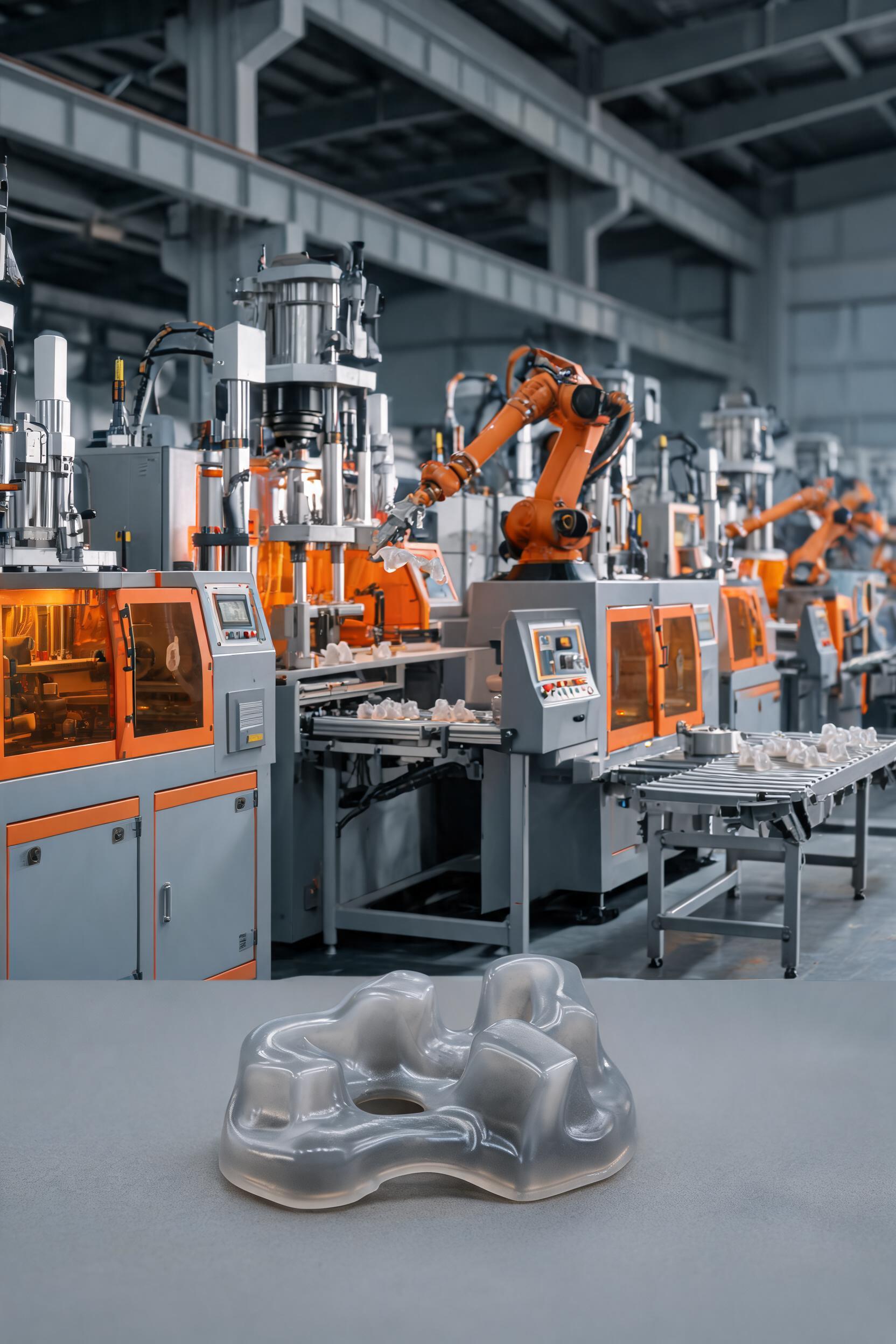
Custom processing of industrial non-standard silicone rubber parts is a core process adapted to special working condition requirements. It can customize silicone rubber products with non-standard sizes, properties and structures according to special requirements of different industries such as high temperature resistance, corrosion resistance, sealing and shock absorption. This article sorts out the whole process of custom processing, covering key links such as demand evaluation, material selection, mold development, molding process and quality testing, helping customers clarify custom key points, avoid common errors and obtain more adaptable non-standard silicone rubber products.
Industrial non-standard silicone rubber parts are critical customized components designed to address unique operating requirements that off-the-shelf standard parts cannot meet, including extreme temperature resistance, chemical compatibility, complex geometric constraints, and specialized mechanical performance. Unlike mass-produced standard O-rings, gaskets, and seals, these custom parts are tailored for niche applications across aerospace, medical devices, automotive electrification, food processing, and industrial automation, where failure can lead to costly downtime, safety hazards, or regulatory non-compliance.
The global market for custom liquid silicone rubber (LSR) and high-consistency rubber (HCR) non-standard components is projected to grow at a 6.8% CAGR through 2030, driven by rising demand for miniaturized electronics, electric vehicle (EV) battery seals, and implantable medical components. However, 42% of custom non-standard silicone part projects experience delays or performance failures due to incomplete design input, improper material selection, or suboptimal manufacturing process validation, according to a 2024 survey by the International Liquid Silicone Rubber Association (ILSRA). This article provides a structured, end-to-end overview of the custom processing workflow, key technical considerations, and quality control frameworks to mitigate these risks, with actionable data for design engineers, procurement teams, and manufacturing stakeholders.
The success of custom non-standard silicone rubber parts is 70% determined by the accuracy of pre-production requirement capture and feasibility validation, as unaddressed constraints at this stage lead to 80% of total post-production rework costs. This phase focuses on aligning stakeholder expectations with material and manufacturing capabilities to avoid costly iterative revisions later.
The first step is to formalize all performance, environmental, and regulatory requirements into a structured technical data package (TDP), which serves as the single source of truth for all subsequent processes. Critical parameters to document include:
In addition to quantitative parameters, the TDP must include application context: for example, a seal for an EV battery pack may require not only flame retardancy but also resistance to thermal runaway off-gases, a detail that is often overlooked if only basic performance metrics are collected. Stakeholders should also specify volume requirements (prototyping, low-volume production, high-volume mass production) and lead time constraints, as these directly influence manufacturing process selection.
Once requirements are documented, material scientists and process engineers conduct a feasibility analysis to match performance needs to available silicone formulations and manufacturing methods, while identifying potential design conflicts.
For material selection, silicone formulations are tailored to meet specific performance demands, and common custom formulations include:
Process feasibility assessment evaluates whether the part design is compatible with the intended manufacturing method. For example, micro-parts with features smaller than 0.1mm require injection molding with precision micro-tool steels, while large-format gaskets over 1m in diameter are more cost-effectively produced via compression molding. Engineers also identify design for manufacturing (DFM) issues at this stage: common conflicts include undercuts that require complex side actions, insufficient draft angles (minimum 1.5° per side is recommended for LSR parts), and wall thickness variations exceeding 2:1 that can lead to curing inconsistencies. If feasibility risks are identified, the engineering team will propose design modifications (e.g., adjusting wall thickness, adding draft, simplifying undercuts) with a trade-off analysis of performance impact vs. manufacturing cost and yield.
Tooling is the highest-cost single component of custom non-standard silicone part projects, accounting for 20–40% of total project expenditure for low-volume runs, and its design directly impacts part quality, production efficiency, and tool lifespan. This phase translates the finalized TDP into production-ready tooling and validates performance via small-batch prototyping.
Silicone rubber tooling differs significantly from thermoplastic tooling due to LSR’s low viscosity during injection, high thermal expansion during curing, and tendency to flash at parting lines. Key design considerations include:
Additional tool design features tailored for silicone processing include:
Once tooling is manufactured, small-batch prototyping (5–500 parts) is conducted to validate dimensional accuracy, material performance, and functional fit before full production. This phase includes three layers of verification:
Once prototyping is fully validated, the project moves to mass production, where consistent process control is critical to maintain part quality across thousands or millions of units. Non-standard silicone parts are particularly vulnerable to batch-to-batch variation due to minor changes in curing parameters, material mixing ratios, or tool wear, so a structured quality control framework is required throughout production.
Silicone rubber processing relies on precise control of curing, mixing, and molding parameters to ensure consistent cross-linking density and mechanical performance. For the three most common non-standard silicone processing methods, key controlled parameters include:
In addition to parameter control, material handling protocols are standardized to prevent contamination: LSR materials are stored at 5–15°C to extend shelf life, and all material transfer equipment is cleaned between formulation changes to avoid cross-contamination between medical-grade, industrial-grade, and flame-retardant materials. For regulated applications (medical, food, aerospace), all material batches are traceable via lot numbers, with full chain of custody documentation from raw material supplier to finished part.
A multi-layer quality control (QC) system is implemented to catch defects at the earliest possible stage, reducing scrap rates and preventing non-conforming parts from reaching customers:
Even with a structured process, custom non-standard silicone part projects face unique risks due to their one-off nature. The following are the most common failure points and mitigation strategies based on industry data:
The most common design-related failure is under-specification of edge case operating conditions, such as transient high-temperature exposure or occasional contact with unexpected chemicals. To mitigate this, design teams should conduct a failure modes and effects analysis (FMEA) at the pre-production stage, ranking potential failure risks by severity and occurrence, and specifying test protocols to validate performance against edge cases. For example, an EV battery seal should be tested for resistance to thermal runaway gases even if such an event is extremely rare, as failure would lead to catastrophic safety risks.
Another common design error is over-specification of tolerances beyond manufacturing capabilities, which increases tooling cost by 30–50% and reduces production yield by up to 40%. Teams should work with manufacturing partners to conduct a tolerance analysis, identifying which dimensions are truly critical to function and which can be relaxed to improve manufacturability. For example, a non-critical cosmetic feature on a silicone housing may have a tolerance of ±0.5mm instead of ±0.1mm, with no impact on performance but significant cost savings.
Custom silicone part projects often experience delays due to long tooling lead times (typically 2–4 weeks for standard tooling, 6–8 weeks for high-precision micro-tooling) or raw material shortages for specialized formulations. To mitigate this, procurement teams should:
Custom industrial non-standard silicone rubber part processing is a highly iterative, cross-functional process that relies on close alignment between design, material science, manufacturing, and quality teams to deliver parts that meet unique performance requirements. By following a structured workflow of pre-production requirement capture, tooling design optimization, prototyping validation, and mass production process control, teams can reduce project delays by 60% and post-production failure rates by 80% compared to unstructured custom manufacturing approaches.
Key success factors include prioritizing DFM analysis early in the design phase, selecting material formulations tailored to the specific end-use environment rather than relying on generic silicone grades, and implementing a multi-layer quality control system that validates both dimensional accuracy and functional performance across all production batches. As industrial applications continue to demand higher performance, smaller form factors, and stricter regulatory compliance, the custom non-standard silicone processing workflow will continue to evolve, with advances in in-situ process monitoring, 3D printed soft tooling, and AI-driven formulation optimization further reducing lead times and improving part quality for niche industrial use cases.