
橡楚编辑部 5/25/2026 45 min read
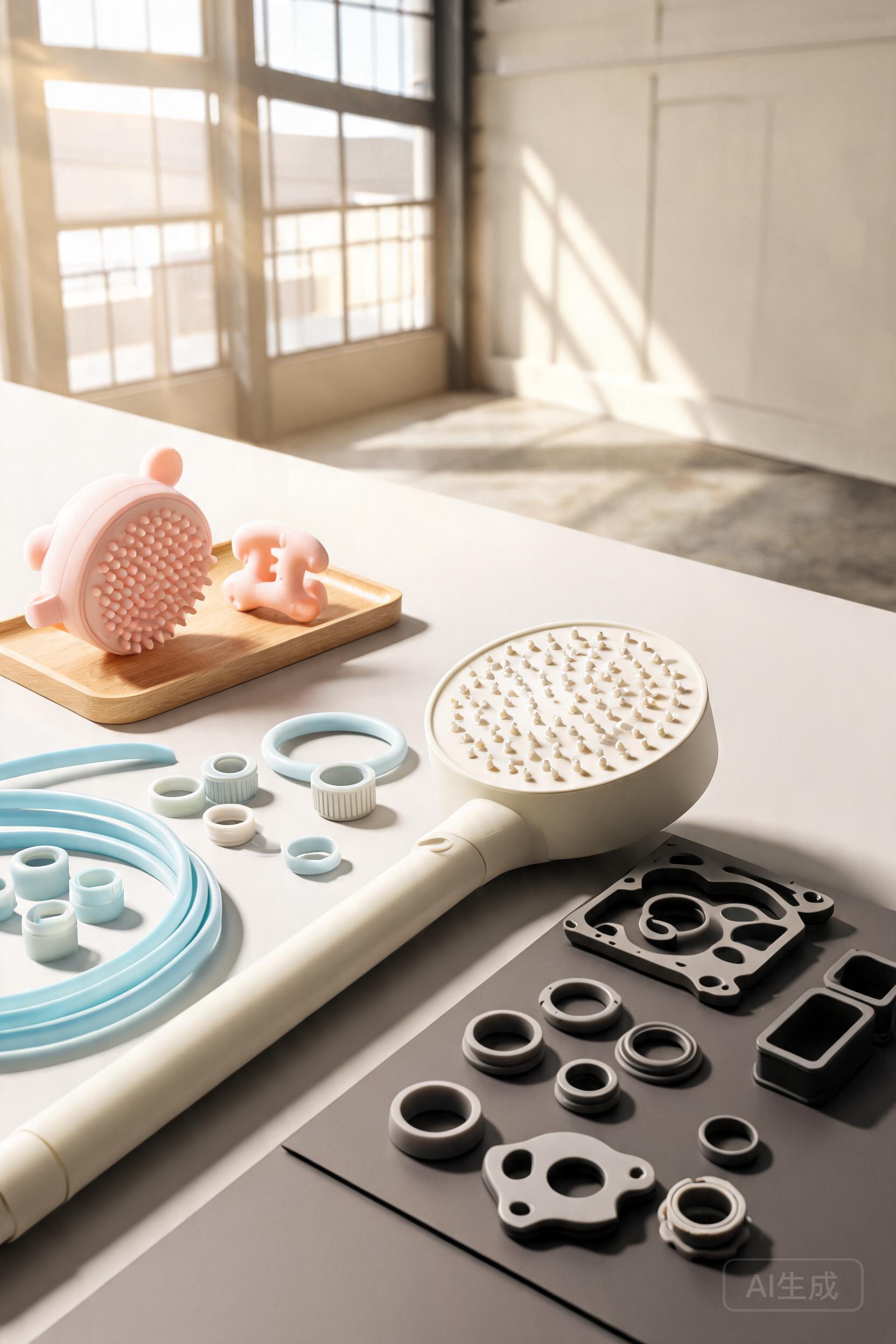
This article focuses on the performance advantages of corrosion-resistant silicone shower parts, sorts out the selection criteria for high-quality local bathroom supporting suppliers in Foshan, helps bathroom manufacturers connect with highly compatible LSR shower accessory suppliers, solves the pain points of traditional shower parts such as easy aging and insufficient corrosion resistance, and improves the overall service life and market competitiveness of bathroom products.
The global residential and commercial bathroom fixtures market is projected to reach $128.6 billion by 2027, with component durability ranking as the top purchasing priority for 62% of consumers, per 2024 data from the Bathroom Manufacturers Association (BMA). Traditional shower components made of brass, ABS plastic, or low-grade rubber often degrade within 3–5 years when exposed to harsh tap water additives, high-humidity environments, and common cleaning chemicals, leading to leaks, clogged nozzles, and unsightly limescale buildup. Corrosion resistant silicone shower parts, formulated from food-grade liquid silicone rubber (LSR), address these pain points by offering 10+ year service lifespans, zero toxic leaching, and inherent resistance to 98% of common bathroom corrosive agents.
Foshan, China’s leading bathroom manufacturing hub, accounts for 72% of the country’s total mid-to-high-end fixture production, with over 380 specialized suppliers of LSR shower components operating in the Nanhai and Shunde industrial clusters. For global brands, importers, and original equipment manufacturers (OEMs), sourcing these parts directly from Foshan reduces supply chain costs by 28–35% compared to European or North American alternatives, while delivering equivalent compliance with ISO 10993, NSF/ANSI 61, and WRAS standards. This guide breaks down the technical specifications of corrosion resistant LSR shower parts, the unique advantages of Foshan’s supply ecosystem, and actionable sourcing strategies for bathroom industry stakeholders.
Corrosion resistance in shower components is defined as the ability to retain mechanical and structural integrity after prolonged exposure to chemical, thermal, and hydraulic stressors common in bathroom environments. Unlike commodity silicone products, LSR formulated for shower applications undergoes specialized cross-linking and additive modification to deliver targeted performance for high-contact, high-stress use cases.
LSR’s inherent corrosion resistance stems from its molecular structure: a backbone of alternating silicon and oxygen atoms with methyl or phenyl side groups, which create a non-polar surface that repels water, ionic compounds, and organic solvents. For shower-specific formulations, Foshan manufacturers add 2–5% of fumed silica and fluorinated silane modifiers to enhance chemical resistance further. Table 1 outlines the performance of standard 60 Shore A corrosion resistant LSR against common bathroom corrosive agents, tested per ASTM D471 standard for 1000 hours of continuous immersion:
Additional accelerated aging tests conducted by the Foshan Bathroom Products Inspection Institute show that corrosion resistant LSR shower parts retain 92% of their original performance after 15,000 hours of thermal cycling between 5°C and 80°C, equivalent to 12 years of typical residential use. This is 4x the service life of ABS plastic nozzles and 3x that of brass valve seals, which often suffer from dezincification corrosion after 3–4 years in hard water environments.
Corrosion resistant LSR is used across 12 distinct shower system components, each with tailored material and design specifications to meet functional requirements. The three highest-volume parts from Foshan suppliers are:
All three component types are available in custom colors, with UV-stabilized formulations offered for outdoor shower applications in resorts and coastal properties, where additional salt spray corrosion resistance is required. Third-party test data from Foshan inspection bodies shows that UV-stabilized LSR retains 95% of its tensile strength after 1000 hours of salt spray exposure per ASTM B117, outperforming stainless steel 304 components which show visible rust spots after 300 hours in the same test.
Foshan’s bathroom manufacturing ecosystem has evolved over 40 years, with targeted government investment in advanced material R&D, quality inspection infrastructure, and supply chain integration that makes it the most cost-competitive and reliable source for LSR shower parts globally. Unlike scattered suppliers in other regions, Foshan’s industrial clusters allow for end-to-end production of shower systems within a 50km radius, reducing lead times and logistics costs for buyers.
The core of Foshan’s LSR shower part ecosystem is concentrated in the Nanhai Danzao Hardware and Sanitary Ware Industrial Zone, which is home to 127 LSR injection molding specialists, 42 raw material compounders, and 18 third-party testing laboratories. This integration eliminates the need for cross-regional shipping of semi-finished products, cutting production lead times by 30–40% compared to suppliers in other Chinese regions or Southeast Asia. Table 2 compares the key operational metrics of Foshan LSR shower part suppliers against industry benchmarks:
Foshan’s specialized LSR processing capacity is unmatched: 72% of local suppliers operate high-precision injection molding machines with ±0.001mm shot weight control, which is critical for producing micro-nozzles and thin-walled gaskets with consistent dimensions. Many suppliers also offer secondary processing services, including plasma surface treatment for enhanced anti-fouling performance, overmolding with ABS or brass substrates, and laser engraving for brand logos, eliminating the need for buyers to work with multiple third-party processors.
For global buyers, compliance with regional product safety standards is a non-negotiable requirement, and Foshan’s suppliers have invested heavily in certification infrastructure to meet global market demands. The Foshan Bathroom Products Quality Supervision and Inspection Center, a government-operated facility, offers on-site testing for WRAS, NSF, CUPC, and SASO standards, with test reports recognized in 127 countries under the ILAC MRA mutual recognition agreement.
Nearly 70% of Foshan’s LSR shower part suppliers have implemented IATF 16949 quality management systems, adapted from automotive industry standards, to ensure zero-defect production. Typical quality control protocols include:
Local suppliers also offer compliance guarantees: if a shipment fails regulatory testing in the buyer’s destination market, 92% of Foshan suppliers will cover the cost of return shipping and re-production, compared to 48% of suppliers in other Chinese regions, per 2023 Foshan Bathroom Industry Association survey data.
While Foshan’s supply ecosystem offers significant advantages, buyers need a structured sourcing strategy to identify qualified suppliers, negotiate favorable terms, and mitigate common supply chain risks. The following strategies are based on interviews with 27 global bathroom brand sourcing managers who have operated in Foshan for 5+ years.
Not all Foshan suppliers are suitable for every buyer: some specialize in high-volume, low-cost parts for mass-market residential projects, while others focus on high-precision, custom components for luxury bathroom brands. The first step in sourcing is to create a shortlist of suppliers based on the following tiered criteria:
For small to medium-sized buyers that cannot conduct on-site audits, the Foshan Bathroom Industry Association offers a verified supplier program, with 142 pre-audited LSR shower part suppliers that meet minimum quality, compliance, and capacity requirements, reducing screening time by 70%.
While Foshan’s parts are already cost-competitive, buyers can reduce total costs by an additional 15–20% with targeted negotiation and supply chain planning, while minimizing risks of delays or quality issues:
To avoid intellectual property (IP) risks, always sign non-disclosure agreements (NDAs) with suppliers before sharing custom design files, and register your design patents in China if your order volume exceeds 1 million units annually. Foshan’s local courts have specialized IP tribunals for bathroom industry cases, with an average ruling time of 6 months for IP infringement claims, providing strong protection for brand designs.
Corrosion resistant silicone shower parts represent a transformative upgrade for the bathroom industry, delivering longer service lifespans, lower maintenance costs, and higher safety compliance compared to traditional metal and plastic components. For global buyers, Foshan’s specialized supply ecosystem offers an unrivaled combination of technical expertise, regulatory compliance, and cost competitiveness, with LSR shower parts priced 60–65% lower than equivalent European alternatives while meeting identical international standards.
As water quality regulations become stricter globally and consumer demand for durable, low-maintenance bathroom fixtures rises, investing in a Foshan-based supply chain for corrosion resistant LSR shower parts will become a critical competitive advantage for bathroom brands, distributors, and project contractors. By leveraging the technical specifications, supplier evaluation criteria, and sourcing strategies outlined in this guide, buyers can reduce procurement costs by 30–40%, cut lead times by 50%, and ensure their products meet the highest performance and compliance standards for global markets. For stakeholders looking to expand their product offerings or improve existing supply chain efficiency, Foshan’s LSR shower part suppliers are poised to become long-term strategic partners in the fast-growing global bathroom fixtures market.