
橡楚编辑部 6/18/2026 44 min read
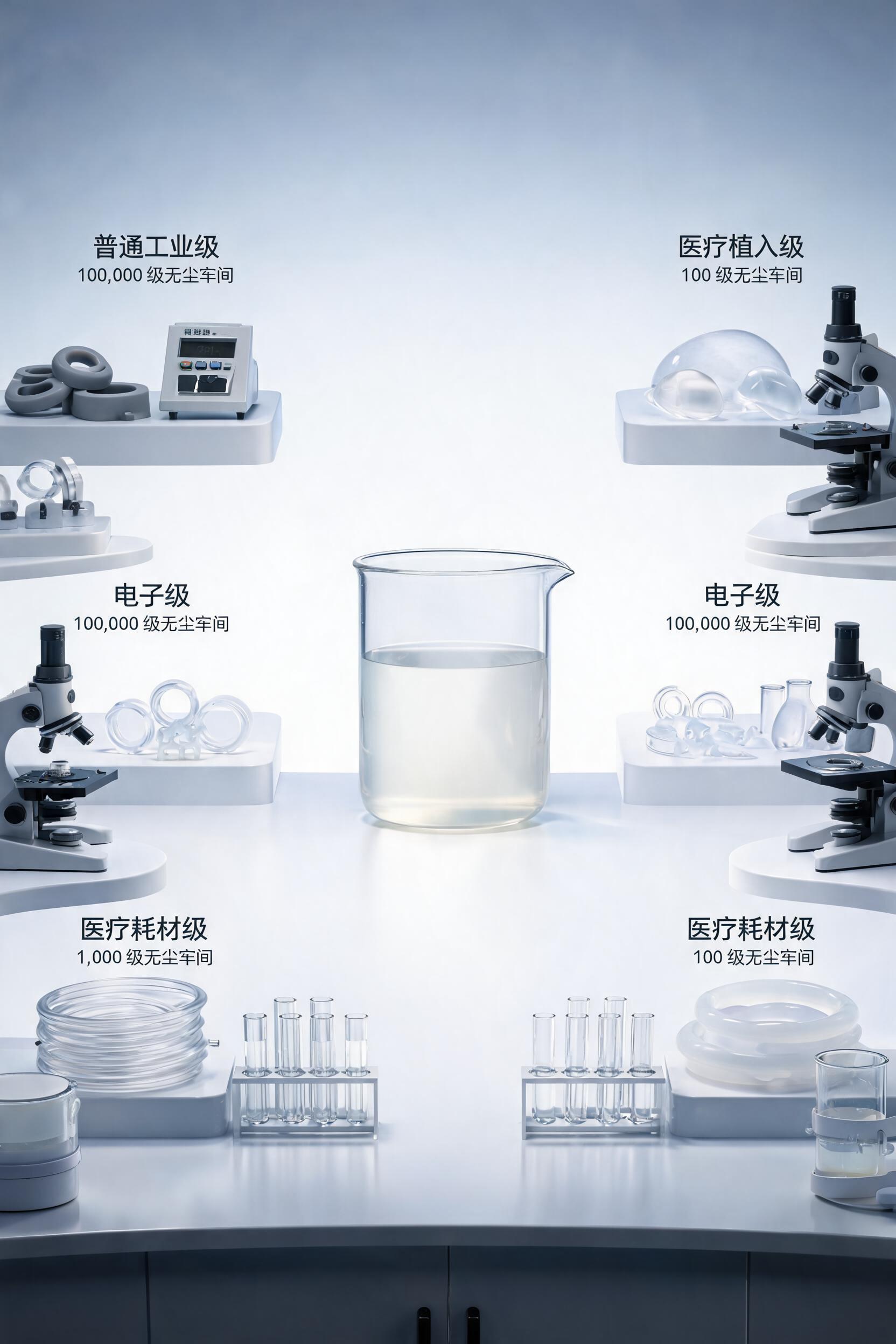
Different application scenarios of liquid silicone rubber (LSR) products have different requirements for production workshop cleanliness. This article sorts out the cleanroom matching requirements for LSR products of different grades from general industrial parts to medical implant grade, helping you reasonably select production environment and control product quality. Xiangchu (Hubei) Rubber Co., Ltd. is located in Ezhou, Hubei, with ISO 9001 certification, focusing on LSR products manufacturing.
Liquid Silicone Rubber (LSR) has become one of the most versatile materials across industries from general industrial manufacturing to healthcare, thanks to its inherent biocompatibility, chemical resistance, thermal stability, and low toxicity. A critical factor that determines whether an LSR product meets industry specifications and regulatory requirements is the cleanroom manufacturing environment. Contamination from dust, particulates, microbes, or volatile organic compounds can compromise product performance, safety, and compliance—especially for applications that demand high purity.
At橡楚(湖北)橡胶有限公司, we specialize in custom LSR product manufacturing, and we work with clients across multiple sectors to align production cleanroom standards with specific application requirements. Many new product developers and sourcing teams often ask the same question: what cleanroom class is required for my silicone product? Too low a cleanroom rating leads to non-compliance and failed quality inspections; too high a rating unnecessarily increases production costs without adding value. This guide breaks down cleanroom classification standards, matches cleanroom levels to common LSR application categories, and provides practical guidance for selection, to help you make informed sourcing decisions.
Before discussing matching for specific LSR products, it is necessary to clarify the two most widely used cleanroom classification systems in global manufacturing, as different regions and industries adopt different standards, which often causes confusion in specification communication.
The ISO 14644-1 standard, published by the International Organization for Standardization, is the most widely accepted classification system globally. It defines cleanroom classes based on the maximum allowable concentration of particulate matter per cubic meter of air, sorted by particle size. The classification number (ISO Class N) corresponds to the log10 of the maximum allowable concentration of particles ≥0.1μm per cubic meter. A lower class number indicates a cleaner environment.
The table below summarizes the key parameters of common ISO 14644-1 cleanroom classes used in LSR manufacturing:
For context, typical indoor ambient air in an uncontrolled manufacturing facility is roughly equivalent to ISO 9, with over 100,000,000 particles ≥0.5μm per cubic meter.
While the ISO 14644-1 standard has replaced the older US FED-STD-209E in most regions, many manufacturers and clients still reference the class naming convention from this older system (e.g., Class 100, Class 10,000, Class 100,000). The naming comes from the maximum allowable number of particles ≥0.5μm per cubic foot of air.
The common equivalence between FED-STD-209E and ISO 14644-1 is as follows:
In this guide, we use the ISO 14644-1 classification system for all descriptions, with corresponding FED-STD-209E references for context.
Different LSR applications have vastly different requirements for surface cleanliness, biological contamination, and residual particulate. Below we break down matching recommendations by common application categories, from lowest to highest cleanroom requirement.
General industrial LSR products include automotive sealing gaskets, industrial O-rings, consumer appliance silicone parts, electronic insulation sleeves, and silicone rubber mats for general use. These applications are not in direct contact with the human body for extended periods, do not require biological safety, and minor particulate contamination does not affect core functional performance.
For most general industrial LSR products, an ISO 8 cleanroom meets all quality requirements. Key characteristics of an ISO 8 cleanroom suitable for LSR manufacturing:
There are exceptions: If the LSR component is used in a sealed optical device or high-precision electronic equipment that requires extremely low particulate contamination, you may need to upgrade to ISO 7. But for 90% of general industrial LSR applications, ISO 8 provides a good balance of quality and cost.
At橡楚(湖北)橡胶有限公司, our production facility located at湖北省鄂州市鄂城区经济开发区凡口街道内河巷54号 operates dedicated ISO 8 cleanroom lines for general industrial LSR products, with monthly particulate monitoring to maintain classification, and all our manufacturing operations comply with ISO 9001 quality management system requirements.
This category includes baby bottle nipples, food storage container seals, kitchen baking silicone mats, drinking water gaskets, over-the-counter medical devices like blood pressure cuff cuffs, and wearable fitness tracker silicone bands. These products are in direct or indirect contact with food, drinking water, or intact human skin, so they require control of microbial contamination and non-volatile residue, but do not require the extreme particulate control of implantable devices.
An ISO 7 cleanroom is the standard for most food contact and non-implantable healthcare LSR products. Key requirements compared to ISO 8:
For specific products that require higher hygiene, such as baby pacifiers or food contact reusable silicone bags, some clients choose to add post-molding sterilization (gamma irradiation or ethylene oxide sterilization) after production in an ISO 7 cleanroom, which meets global regulatory requirements like FDA 21 CFR for food contact and EU 10/2011 food contact standards.
Table: Cleanroom Class Recommendation Summary for Common Non-Implantable LSR Products
This category includes wound dressings, surgical instrument silicone grips, respiratory mask seals, continuous glucose monitor (CGM) adhesive patches, and single-use surgical silicone catheters that do not remain inside the body long-term. These products come into contact with mucous membranes or open wounds, so they require much stricter control of biological contamination and particulate than consumer products, but do not reach the requirement of long-term implantable devices.
For most non-implantable invasive medical LSR products, ISO 6 cleanroom classification meets global regulatory requirements (such as ISO 13485 quality management for medical devices, and FDA 510(k) submission requirements). Key controls in an ISO 6 cleanroom for LSR manufacturing:
In some cases, for short-term invasive devices that require pre-sterilization by the manufacturer, production in an ISO 6 cleanroom reduces the bioburden load before terminal sterilization, improving sterilization efficacy and reducing the risk of residual byproducts from over-sterilization.
Long-term implantable LSR products include breast implants, pacemaker housing seals, artificial heart valve components, orthopedic implant spacers, and vascular access ports. These products remain inside the human body for years or decades, so even tiny particulate or microbial contamination can lead to severe adverse reactions such as inflammation, infection, or device failure. This is the highest requirement category for cleanroom cleanliness.
ISO 5 is the standard cleanroom classification for implantable LSR medical products. Key additional controls beyond ISO 6:
It is important to note that cleanroom classification is only one part of the compliance requirements for implantable LSR products. Raw material biocompatibility testing, extractable and leachable testing, and terminal sterilization validation are also required. However, starting production in a properly classified cleanroom is the foundational first step to meeting regulatory requirements.
While application-based matching provides a basic guideline, there are several additional factors that require adjustment to the recommended cleanroom class, based on specific product requirements and regulatory obligations.
Different regions and industries have explicit regulatory requirements for cleanroom classification, which must take priority over general guidelines:
At橡楚(湖北)橡胶有限公司, we maintain documentation of all cleanroom classification audits and monitoring data, which we can provide to clients to support their regulatory submissions, in compliance with our ISO 9001 quality management system.
Cleanliness requirements do not end after injection molding. Many secondary operations (trimming, surface treatment, cleaning, inspection, packaging) can introduce contamination if not conducted in the same cleanroom class as molding:
Cleanroom construction, operation, and maintenance costs increase exponentially as the cleanroom classification gets cleaner. For example, operating an ISO 5 cleanroom costs approximately 3-5 times more per square meter than operating an ISO 8 cleanroom, when accounting for energy, filtration, personnel training, and monitoring.
It is important to avoid over-specifying cleanroom class unnecessarily, as this will directly increase the unit cost of your LSR product. Common scenarios where over-specification occurs:
Working with an experienced LSR manufacturer like橡楚(湖北)橡胶有限公司 helps you balance compliance, performance, and cost: we can review your product requirements and recommend the lowest cost cleanroom classification that still meets all your specifications and regulatory requirements.
A cleanroom classification is only valid if it is properly maintained. At橡楚(湖北)橡胶有限公司, we follow these core practices to maintain consistent cleanroom performance across all our production lines:
Selecting the correct cleanroom class for your LSR product is a critical decision that balances product safety, regulatory compliance, and production cost. As a general guideline:
At橡楚(湖北)橡胶有限公司, we operate multi-class cleanroom production lines ranging from ISO 8 to ISO 5 at our facility in湖北省鄂州市鄂城区经济开发区凡口街道内河巷54号, and we maintain full ISO 9001 quality management certification to ensure consistent product quality. Whether you are developing a new general industrial LSR part or a compliant medical LSR device, we can work with you to select the appropriate cleanroom classification that meets your requirements without unnecessary cost.
If you have any questions about cleanroom requirements for your LSR product, or would like to request a quotation for custom LSR manufacturing, please contact us at 18071171144 or email us at churubber@163.com.