
橡楚编辑部 6/18/2026 39 min read
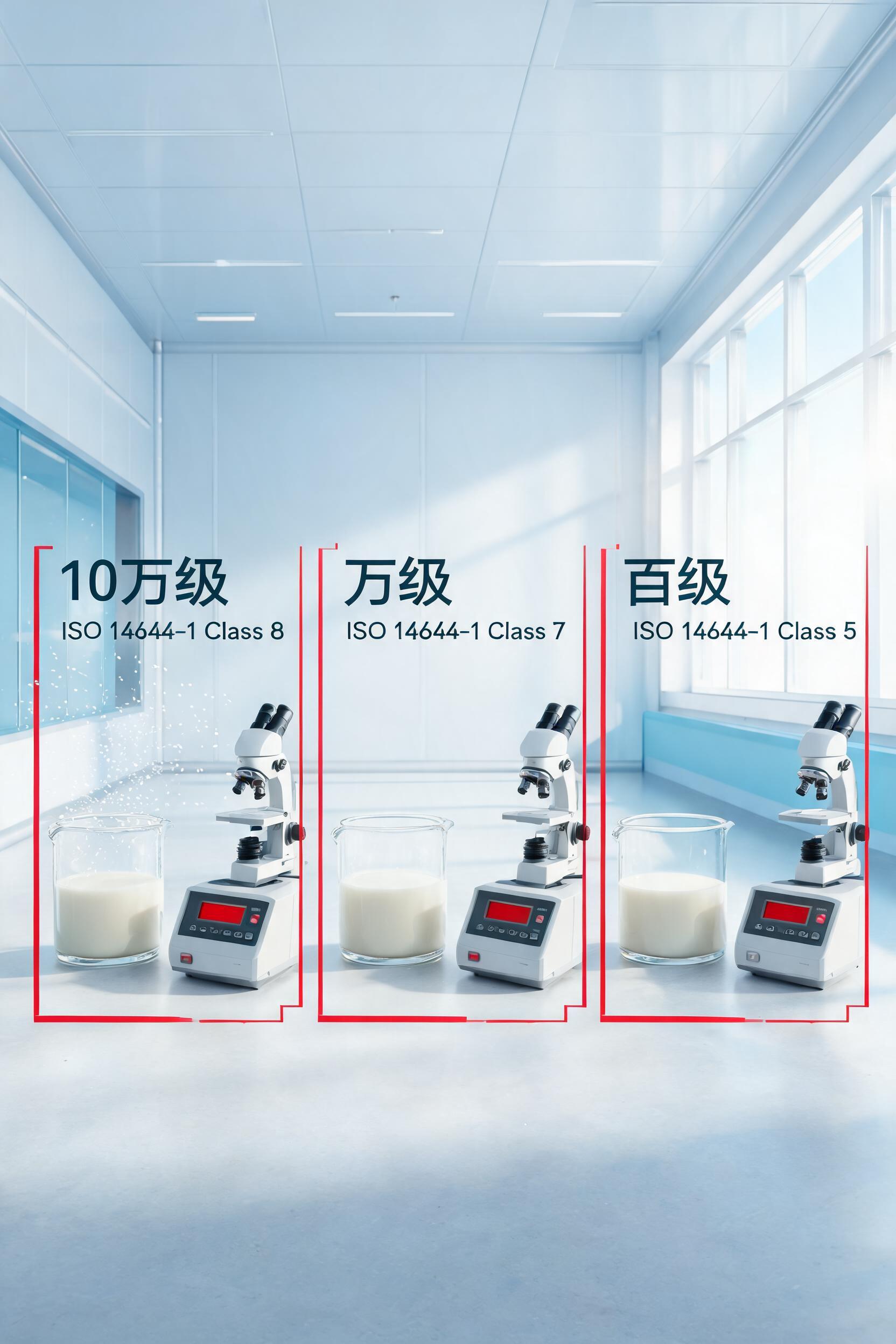
Liquid silicone rubber (LSR) production has high requirements for production environment cleanliness, and cleanrooms are often divided into class 100, class 10000, class 100000 according to ISO 14644. This article sorts out the core differences between cleanrooms of different grades, helping you understand the differences in environmental requirements for the production of different LSR products.
Liquid Silicone Rubber (LSR) production relies on extreme control of environmental contamination to meet the strict performance requirements of end applications. From medical implant components to consumer electronics seals, even microscopic particulates can cause product failure, compromised biocompatibility, or reduced service life. All contamination control in manufacturing facilities is standardized under ISO 14644-1, the global benchmark for cleanroom classification by particulate concentration. For LSR producers, cleanroom class selection is a critical decision: a class that is too low leads to rejectable products, while an unnecessarily high class increases production costs unnecessarily.
At 橡楚(湖北)橡胶有限公司, we operate multiple cleanrooms of different classifications to match the requirements of our diverse LSR product lines, based at our facility in 湖北省鄂州市鄂城区经济开发区凡口街道内河巷54号. This article breaks down the practical differences between the most common cleanroom classes used in LSR production: Class 100,000, Class 10,000, and Class 100 (aligned with the older FS 209E standard still commonly referenced in the industry) mapped to their ISO 14644 equivalents. We explain how these differences impact LSR product quality, what applications require each class, and how to select the right cleanroom class for your LSR project.
---
To understand the differences between 100-class, 10,000-class, and 100,000-class cleanrooms, we first need to clarify the relationship between the historical standard that created these common names and the modern global ISO 14644-1 standard used today.
The names 百级 (Class 100), 万级 (Class 10,000), and 10万级 (Class 100,000) originate from the 1960s U.S. Federal Standard 209E, which classified cleanrooms based on the maximum allowable number of particles 0.5 micrometers (μm) or larger per cubic foot of air. For example:
While FS 209E was officially withdrawn in 2001, the naming convention remains widely used across the global manufacturing industry, particularly in Asia, so it is still the most common way for buyers to reference cleanroom requirements.
The International Organization for Standardization released ISO 14644-1 in 1999 to create a unified global standard for cleanroom classification. Unlike FS 209E, which measures particulate concentration per cubic foot, ISO 14644-1 uses cubic meters as the unit of measure and classifies cleanrooms by an ISO number that correlates to the log base 10 of the maximum allowable concentration of particles ≥0.1μm per cubic meter.
The table below maps the common historical class names to their official ISO 14644-1 equivalents, with maximum allowable particulate counts for reference:
This alignment confirms that the difference between the three classes is not incremental: each step up in cleanroom class (from 10万级 to 万级 to 百级) reduces the maximum allowable particulate concentration by a factor of 10, requiring exponentially stricter environmental controls.
At 橡楚(湖北)橡胶有限公司, we certify all our cleanrooms annually to meet ISO 14644-1 requirements, and hold ISO 9001 quality management certification to ensure consistent classification maintenance across all production lines.
---
Beyond the difference in maximum particulate counts, 10万级, 万级, and 百级 cleanrooms have fundamental differences in design, filtration systems, and operational protocols that directly impact production cost and output quality.
The core function of a cleanroom is to continuously circulate filtered air to remove particulates generated by production equipment, personnel, and raw materials. The required filtration efficiency and air circulation rate increase dramatically with cleanroom class:
Contamination in cleanrooms does not only come from outside air: up to 70% of particulates in a production cleanroom are generated by personnel and production processes. Operational protocols also become stricter as cleanroom class increases:
At 橡楚(湖北)橡胶有限公司, we maintain separate gowning and entry protocols for each of our cleanroom classes to prevent cross-contamination between production zones, with documented testing logs to verify particulate levels meet classification requirements at all times.
---
The cleanroom class directly impacts the quality, performance, and regulatory compliance of finished LSR products. For LSR, contamination can cause several specific defects that are directly tied to particulate concentration in the production environment.
LSR is a low-viscosity liquid material before curing, so it easily traps microscopic particulates that become permanent inclusions in the finished part. The most common defects caused by insufficient cleanroom class include:
To illustrate how cleanroom class selection impacts suitability for different LSR product categories, we have summarized common use cases and the required cleanroom class below:
At 橡楚(湖北)橡胶有限公司, we match production to the required cleanroom class based on your end application, so you do not pay for higher-class cleanroom production than your product actually requires. For example, our general industrial LSR gaskets are produced in our 10万级 cleanroom to keep costs competitive, while our medical-grade LSR components for external use are produced in our 万级 cleanroom to meet regulatory requirements.
---
There are several widespread misconceptions about cleanroom classification that lead to incorrect purchasing or production decisions for LSR buyers. We clarify the most common ones below.
It is a common belief that producing LSR in a higher-class cleanroom will always result in a better product, but this is not the case. A 百级 cleanroom costs approximately 2-3 times more to operate than a 10万级 cleanroom, due to higher energy consumption for air circulation, more frequent filtration replacement, and stricter labor requirements. This additional cost is passed directly to the buyer, and provides no benefit for products that do not require strict contamination control. For example, a general industrial automotive seal produced in a 百级 cleanroom will have the same mechanical performance as one produced in a 10万级 cleanroom, but will cost 2x as much.
Many buyers assume that once a cleanroom is certified to a certain class, it remains that class indefinitely. In reality, HEPA filter efficiency degrades over time, sealing can fail, and operational protocols can drift. A reputable LSR producer will conduct regular particulate testing to verify that cleanrooms maintain their classification, with documented results available for customer audits. At 橡楚(湖北)橡胶有限公司, we conduct in-house particulate testing weekly for all our cleanrooms, and third-party certification annually to confirm alignment with ISO 14644-1 requirements.
Contamination can enter LSR at multiple stages of production, including material preparation, mold setup, post-curing, and final packaging. A clean production room is not sufficient if material preparation or packaging is done in an uncontrolled environment. All of our cleanroom production lines at 橡楚(湖北)橡胶有限公司 include all production stages from raw material preparation to final packaging within the classified cleanroom, to ensure contamination is controlled through the entire production process.
---
The difference between 10万级, 万级, and 百级 cleanrooms for LSR production boils down to maximum allowable particulate concentration, design and operational cost, and suitability for different end use requirements. Aligned with the ISO 14644-1 standard, 10万级 (ISO 8) is the most cost-effective option for general industrial LSR products, 万级 (ISO 7) meets the requirements for food-contact and most external medical LSR products, and 百级 (ISO 5) provides the strict contamination control required for implantable medical devices and precision electronics components.
At 橡楚(湖北)橡胶有限公司, we maintain 10万级, 万级, and 百级 cleanrooms at our production facility in 湖北省鄂州市鄂城区经济开发区凡口街道内河巷54号, and hold ISO 9001 certification to ensure consistent quality control across all production lines. We work with customers to select the appropriate cleanroom classification for their specific application, balancing product performance requirements with cost efficiency. If you have questions about cleanroom requirements for your LSR project, contact us at 18071171144 or email at churubber@163.com to discuss your project requirements.