
橡楚编辑部 5/25/2026 44 min read
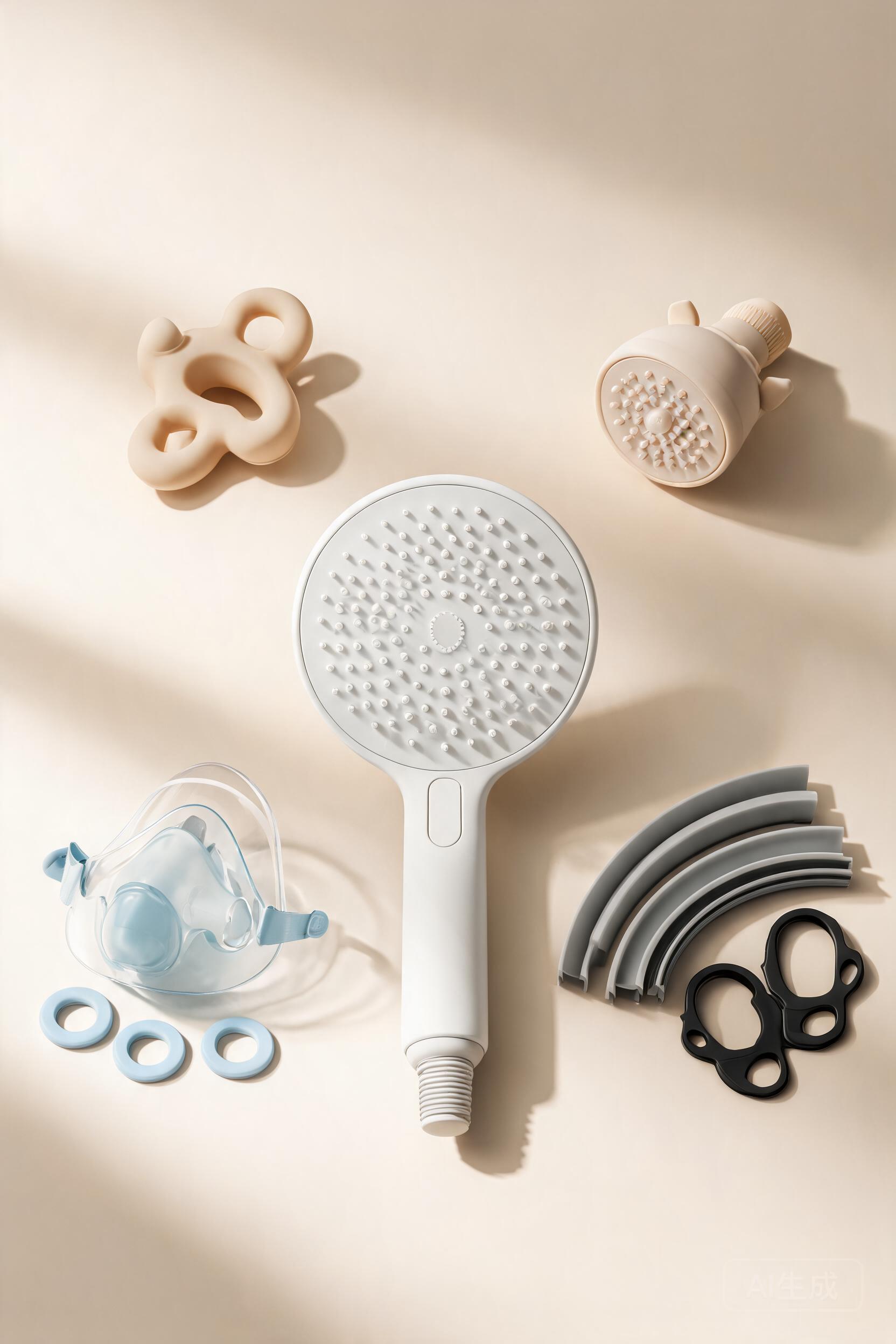
This article sorts out the supply advantages of high-quality liquid silicone shower fitting manufacturers in Central China, explains the performance characteristics and applicable scenarios of LSR overmolded shower accessories, and provides sanitary ware brands with one-stop supply service guidance from selection to batch procurement, helping enterprises reduce procurement costs and stabilize the supply chain.
The global bathroom fixture market is undergoing a rapid shift toward high-performance, durable, and user-centric components, with liquid silicone rubber (LSR) emerging as a material of choice for shower fittings due to its unmatched thermal stability, chemical resistance, and soft-touch ergonomics. As supply chain restructuring accelerates across Asia, Central China has emerged as a strategic manufacturing hub for LSR products, combining lower operational costs, proximity to raw material producers, and access to a skilled technical workforce. For global brands, original equipment manufacturers (OEMs), and procurement teams, partnering with verified Central China LSR suppliers for shower fitting and overmolded (包胶) components delivers tangible advantages: shorter lead times, reduced logistics costs, and access to end-to-end manufacturing capabilities that eliminate the need for multi-vendor coordination. This article explores the technical merits of LSR for shower applications, the unique value proposition of Central China’s LSR manufacturing ecosystem, the one-stop supply model for overmolded shower components, and actionable criteria for supplier qualification.
LSR is a two-part, platinum-catalyzed elastomer that undergoes cross-linking at elevated temperatures, resulting in a material with properties uniquely suited to the harsh, high-moisture environment of residential and commercial shower systems. Unlike conventional materials such as thermoplastic polyurethane (TPU), polyvinyl chloride (PVC), or natural rubber, LSR addresses critical pain points in shower fitting performance, durability, and safety.
LSR’s inherent properties directly resolve common failure points in shower components, as outlined in Table 1, which compares key performance metrics of LSR against competing materials for shower applications.
For shower nozzles, which are exposed to continuous hot water (typically 40–60°C, with peak temperatures reaching 85°C in instantaneous water heater systems), LSR’s thermal stability prevents deformation or hardening that would cause clogging or uneven water spray. Its extremely low water absorption rate eliminates the risk of mold or mildew growth, a common complaint with natural rubber nozzles that develop biofilm buildup over time. Additionally, LSR’s resistance to chlorine and other common water treatment chemicals ensures that components do not discolor, leach harmful substances, or lose elasticity even after years of exposure to municipal water supplies. For ergonomic shower handles and grip components, LSR’s adjustable Shore hardness allows manufacturers to tailor soft-touch properties without compromising structural integrity, reducing user fatigue and improving slip resistance even when wet.
A key technical advantage of LSR for shower fittings is its exceptional overmolding (包胶) adhesion to rigid substrates including polycarbonate (PC), acrylonitrile butadiene styrene (ABS), polypropylene (PP), and brass – materials widely used for shower valve bodies, water distribution manifolds, and handle frames. Unlike thermoplastic elastomers (TPEs), which rely primarily on mechanical interlocking for overmolding bond strength, LSR forms a molecular bond with compatible substrates during the curing process, delivering typical peel strength values of 8–12 N/mm for PC/ABS substrates and 5–7 N/mm for brass surfaces with pre-treated adhesion promoters.
This strong bond eliminates two critical failure points in overmolded shower components: delamination and water intrusion. For shower valve handles with overmolded LSR grips, the molecular bond prevents the soft outer layer from peeling away even after repeated twisting and exposure to hot soapy water, while for integrated shower manifolds with overmolded LSR seal rings, the bond creates a permanent, leak-proof seal that eliminates the need for secondary gaskets. Central China LSR suppliers have optimized overmolding processing parameters – including substrate preheating temperature (100–120°C for PC/ABS), injection pressure (80–120 bar), and curing time (30–60 seconds per 1mm wall thickness) – to achieve consistent bond strength across high-volume production runs, with a defect rate of less than 0.1% for qualified parts.
Central China, encompassing Hubei, Hunan, Henan, and Jiangxi provinces, has rapidly developed into a national LSR manufacturing hub over the past decade, driven by targeted industrial policy, proximity to raw material supply chains, and competitive operational costs. For global procurement teams, sourcing LSR shower fittings from verified Central China suppliers delivers a unique combination of cost efficiency, technical capability, and supply chain resilience that outperforms traditional manufacturing clusters in coastal China or Southeast Asia.
Central China’s strategic location at the intersection of China’s north-south and east-west logistics networks reduces both domestic and international shipping costs for LSR shower components. For domestic Chinese customers, shipping lead times to the Yangtze River Delta and Pearl River Delta manufacturing hubs average 1–2 days, compared to 3–5 days for suppliers based in northeast or southwest China. For international customers, Wuhan Tianhe International Airport and Zhengzhou Xinzheng International Airport offer direct freight routes to 40+ global destinations, with air freight lead times to North America and Europe averaging 3–5 days, and rail freight via the China-Europe Railway Express taking 12–15 days – 30% faster than coastal ports for inland-origin cargo.
Raw material costs are another key advantage: three of China’s top five LSR raw material producers (including Hubei-based Xinghuo Silicone and Hunan-based Chenguang New Materials) are located in Central China, reducing raw material transportation costs by 15–20% compared to coastal suppliers. Operational costs, including factory rent and labor, are 30–40% lower in Central China than in Shanghai, Guangdong, or Jiangsu provinces, allowing suppliers to offer LSR shower components at 10–15% lower average unit costs than coastal counterparts without compromising quality. Table 2 outlines a cost comparison for a standard 16-nozzle LSR shower head component sourced from different regions.
Central China’s leading LSR suppliers have invested heavily in quality control infrastructure to meet international regulatory requirements for bathroom fixture components, eliminating a common pain point of low-cost suppliers: inconsistent quality and non-compliance with global safety standards. All preferred Central China LSR shower fitting manufacturers hold ISO 9001:2015 quality management system certification, and 80% of leading suppliers have obtained ISO 13485 medical-grade quality certification and NSF/ANSI 61 drinking water contact safety certification, ensuring that components meet the strictest safety requirements for residential and commercial plumbing applications.
In-house quality control processes for LSR shower components include:
Central China’s preferred LSR suppliers offer an integrated one-stop supply model that covers the entire product lifecycle from design and prototyping to mass production and post-processing, eliminating the need for customers to coordinate with multiple vendors for tooling, molding, surface treatment, and assembly. This model reduces project lead times by 20–30% compared to fragmented supply chains, while minimizing communication errors and quality inconsistencies across different production stages.
The one-stop supply model for LSR shower fittings encompasses four core service stages, each supported by in-house technical teams:
Central China’s preferred LSR suppliers maintain a comprehensive portfolio of standard off-the-shelf shower components to support fast-turnaround orders, as well as custom manufacturing capabilities for non-standard designs. Standard product lines include:
For custom components, the minimum order quantity starts at 5,000 units for simple parts (e.g., custom-sized gaskets) and 10,000 units for complex overmolded assemblies (e.g., custom shower handles). Suppliers offer flexible order scaling, allowing customers to start with low-volume pilot runs before ramping up to mass production of 100,000+ units per order.
While Central China’s LSR manufacturing ecosystem offers significant advantages, procurement teams must implement structured qualification criteria to identify high-quality, reliable suppliers that align with their product requirements and volume needs. The following criteria are recommended for verifying preferred Central China LSR suppliers:
As the demand for high-performance, durable shower components continues to grow globally, Central China’s LSR manufacturing ecosystem has emerged as a preferred sourcing destination for brands and OEMs seeking a balance of cost efficiency, technical capability, and supply chain reliability. LSR’s unique material properties – including thermal stability, chlorine resistance, and exceptional overmolding adhesion – address longstanding performance pain points of conventional shower fitting materials, delivering 2–3x longer service life and improved user safety. Central China’s preferred LSR suppliers combine geographical cost advantages, standardized quality control, and integrated one-stop supply capabilities to offer end-to-end solutions for both standard and custom LSR shower fittings and overmolded components, reducing project lead times and total procurement costs for customers worldwide. For procurement teams, implementing structured supplier qualification criteria focused on industry experience, in-house capabilities, and regulatory compliance will ensure that partnerships with Central China LSR suppliers deliver long-term value and consistent product quality.