
橡楚编辑部 9/14/2026 49 min read
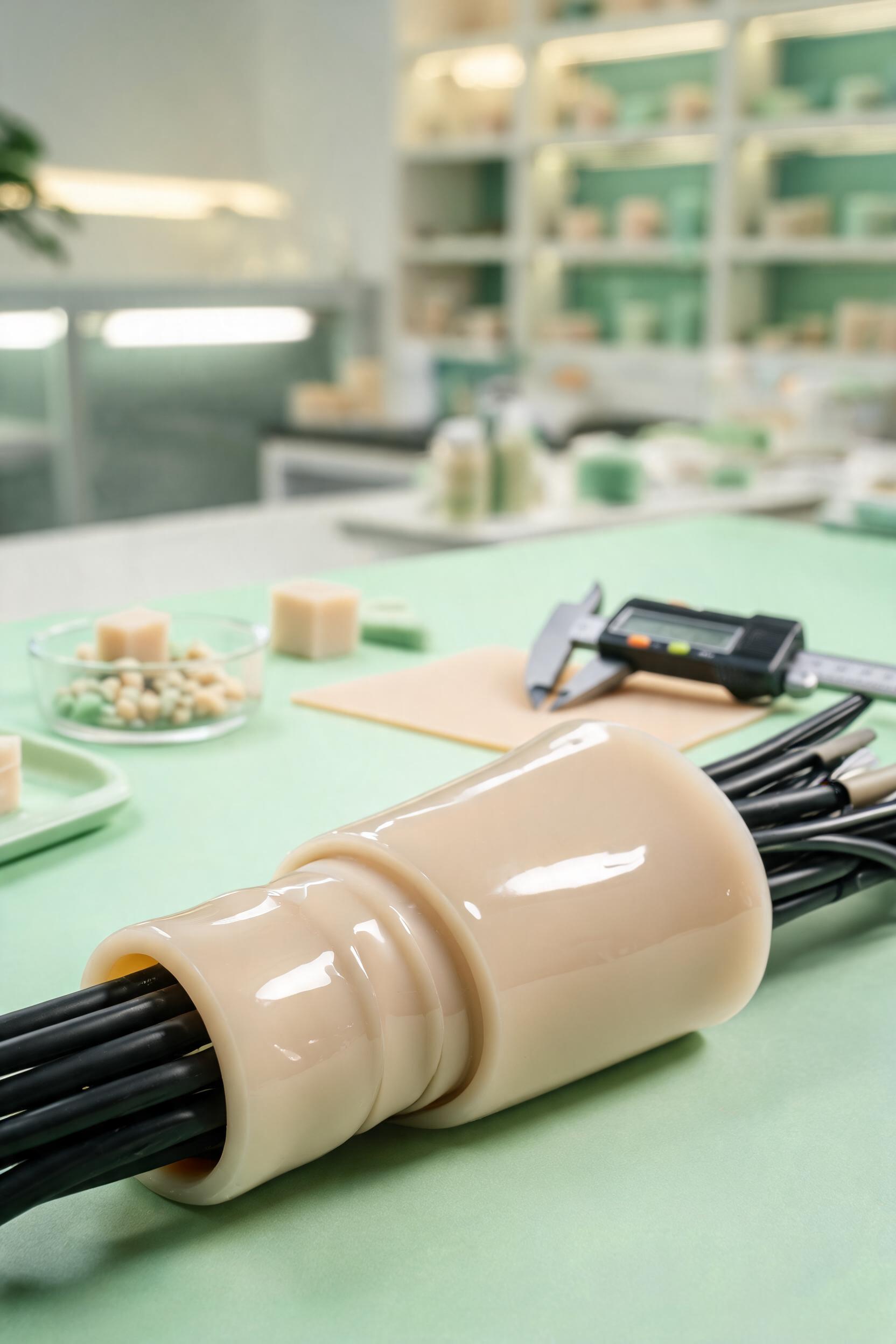
Automotive wiring harness silicone dustproof sheath is a core LSR component that protects vehicle wiring harness systems, effectively blocking dust, moisture, and external impacts to extend the service life of wiring harnesses. This article sorts out the material properties and performance advantages of this type of sheath, provides selection references for different vehicle application scenarios, and shares precautions during installation and use, helping car manufacturers and component suppliers optimize wiring harness protection solutions.
Automotive wiring harnesses serve as the neural network of modern vehicles, transmitting power, control signals, and sensor data across every subsystem from the powertrain to infotainment and advanced driver-assistance systems (ADAS). Exposed harness segments, particularly those routed through engine compartments, chassis underbodies, door panels, and suspension interfaces, face constant exposure to dust, moisture, road debris, temperature extremes, and mechanical vibration. Without robust protective components, these environmental stressors can lead to insulation abrasion, connector corrosion, signal interference, and even catastrophic electrical failure.
The 汽车线束硅胶防尘护套 (automotive wiring harness silicone dustproof sheath) has emerged as the industry-standard solution for protecting high-stakes harness interfaces, outperforming traditional thermoplastic, PVC, and neoprene alternatives in nearly every performance metric relevant to automotive applications. As vehicle electrification accelerates, with EV and hybrid platforms integrating 30% more wiring harness length and 2x more high-voltage connectors than internal combustion engine (ICE) vehicles, the demand for high-performance silicone dustproof sheaths is projected to grow at a 7.2% CAGR through 2030, according to the Global Automotive Components Manufacturers Association. This article analyzes the core performance advantages of silicone dustproof sheaths, breaks down material formulation and structural design considerations for different automotive use cases, and provides a data-driven selection framework to help engineers optimize harness reliability across all vehicle segments.
Silicone elastomers are formed by a backbone of alternating silicon and oxygen atoms, with organic side groups attached to the silicon atoms, giving the material a unique combination of inorganic and organic material properties. For automotive wiring harness protection, this molecular structure translates to four distinct performance advantages that cannot be matched by conventional protective materials.
Unlike thermoplastic materials that soften at high temperatures and become brittle at sub-zero conditions, silicone dustproof sheaths maintain consistent mechanical and sealing performance across an exceptionally wide temperature range, making them suitable for the most demanding automotive environments.
Table 1: Temperature Performance Comparison of Common Harness Sheath Materials
This temperature stability is particularly critical for harnesses routed near engine manifolds, exhaust components, and high-voltage EV traction motor connectors, where ambient temperatures can exceed 180°C during continuous operation. In independent thermal cycling testing per ISO 16750-4, automotive-grade LSR sheaths showed no cracking, shrinkage, or sealing performance degradation after 1,000 cycles of -40°C to 175°C temperature exposure, compared to PVC sheaths that exhibited 35% loss of sealing pressure after 200 cycles and neoprene sheaths that cracked after 600 cycles.
Additionally, silicone sheaths offer inherent resistance to common automotive environmental stressors:
Automotive wiring harnesses are subjected to constant mechanical stress from road vibration, chassis flex, and repeated assembly and disassembly during vehicle manufacturing and servicing. Silicone dustproof sheaths are engineered to withstand these mechanical loads without permanent deformation or failure.
The material’s high elongation at break (typically 300-700% for automotive LSR grades) allows it to stretch over harness connectors and mounting brackets without tearing, even during installation in tight, hard-to-reach vehicle compartments. Its compression set resistance is another key advantage: under ISO 815 testing conditions (22 hours at 150°C, 25% compression), silicone sheaths have a compression set of <10%, meaning they retain 90% of their original elastic force after long-term compressive loading. This ensures consistent sealing pressure at the sheath-connector interface over the 15-year/200,000-mile design life of modern vehicles, whereas PVC and neoprene sheaths typically have compression sets of 40-60% under the same conditions, leading to gradual loss of sealing performance and dust ingress over time.
For vibration damping, silicone has a loss factor of 0.15-0.3 across the 10-2000 Hz frequency range common in automotive operation, meaning it absorbs 15-30% of mechanical vibration energy passing through the harness. Independent testing per ISO 16750-3 (vibration testing for automotive electrical components) found that harnesses protected by silicone sheaths had 75% fewer connector pin fretting failures after 1,000 hours of 10-2000 Hz vibration at 1g acceleration, compared to harnesses with unprotected connectors or rigid plastic sheaths. This vibration damping performance is particularly valuable for ADAS sensor harnesses, where even minor signal interruptions from pin fretting can lead to system malfunctions.
With the rapid growth of electric vehicles, wiring harnesses are now required to safely handle voltages up to 800V and currents up to 500A, making electrical insulation performance a non-negotiable requirement for protective sheaths. Silicone dustproof sheaths offer exceptional dielectric properties that remain stable across temperature, humidity, and frequency ranges, making them ideal for both low-voltage signal harnesses and high-voltage EV powertrain harnesses.
Table 2: Electrical Performance Parameters of Automotive-Grade LSR Sheaths
Notably, these electrical properties remain nearly unchanged across the -40°C to 200°C operating temperature range, unlike PVC which experiences a 50% drop in dielectric strength at 100°C, and nylon which absorbs moisture leading to a 20% drop in volume resistivity at 85% relative humidity. For high-voltage EV harnesses, specially formulated silicone sheaths with tracking resistance ratings of 1A/1000V per IEC 60112 eliminate the risk of electrical arcing between adjacent high-voltage connectors, even when contaminated with dust and moisture.
Silicone sheaths also provide inherent electromagnetic interference (EMI) shielding performance when formulated with conductive fillers such as silver-plated aluminum or carbon nanotubes. Conductive silicone grades offer surface resistivity of 0.01-100 Ω/sq, providing 40-80 dB of EMI attenuation across the 30 MHz to 10 GHz frequency range, eliminating the need for separate metallic shielding layers for CAN bus, Ethernet, and ADAS sensor harnesses that are sensitive to signal interference.
The performance of a 汽车线束硅胶防尘护套 is determined not only by the base silicone material but also by its formulation modifications and structural design, which are tailored to the specific requirements of different vehicle mounting locations.
Automotive silicone dustproof sheaths are manufactured primarily from liquid silicone rubber (LSR), which is formulated with a base polymer, crosslinking agents, catalysts, and functional fillers to meet targeted performance specifications. Three primary formulation categories are used across the automotive industry:
These general-purpose formulations are designed for harnesses routed in passenger compartments, door panels, and non-extreme underhood locations, offering a balanced combination of cost and performance. They typically have a Shore A hardness of 40-60, operating temperature range of -50°C to 180°C, and meet basic IP6K7 ingress protection requirements. Standard LSR sheaths are the most cost-effective choice for low-stress harness applications, with material costs 30-40% lower than high-performance specialized grades.
For harnesses routed near engine components, exhaust systems, and EV battery packs, high-temperature LSR formulations incorporate fumed silica fillers and heat-stabilizing additives to extend continuous operating temperature up to 220°C, with short-term exposure resistance up to 300°C. Flame-retardant grades meet the UL 94 V-0 flammability standard, with oxygen index values >30%, meaning they will not sustain combustion in normal atmospheric conditions, a critical safety requirement for EV high-voltage harnesses. These formulations also include anti-tracking additives to meet IEC 60112 1A/1000V tracking resistance requirements for high-voltage applications.
For vehicles intended for cold-climate markets, low-temperature LSR formulations are modified with phenyl side groups in the silicone polymer backbone, lowering the glass transition temperature to -70°C and eliminating brittleness even in extreme -40°C operating conditions. These grades maintain >200% elongation at break at -40°C, ensuring the sheath does not crack during installation or operation in cold environments. Low-temperature formulations are standard for harnesses routed on chassis underbodies, suspension components, and external sensor interfaces for off-road and commercial vehicles.
The physical structure of the silicone dustproof sheath is optimized for the specific interface it protects, with design features tailored to connector type, mounting environment, and sealing requirements.
Most modern silicone dustproof sheaths incorporate multiple integrated sealing ribs at the harness entry point, connector mating point, and vehicle body mounting point. These ribs are designed to compress 20-30% when installed, creating multiple independent sealing barriers that prevent dust and moisture ingress even if one rib is damaged. For body panel pass-through applications, sheaths include an integrated metal or plastic retaining ring that snaps into pre-cut panel holes, eliminating the need for additional fasteners and reducing installation time by 50% compared to separate seal and retainer designs.
For high-vibration applications such as chassis and suspension harnesses, sheaths may include integrated strain relief features with a corrugated or bellows structure that flexes with harness movement without transferring stress to the connector interface. The bellows design reduces tensile stress on the sheath by 70% during 10mm of harness deflection, preventing tearing or seal separation over millions of vibration cycles.
For complex harness junctions, such as those found in instrument panels and underhood power distribution centers, modular multi-port silicone sheaths are designed to accept 2-20 individual harness connectors in a single sealed assembly. These designs reduce the number of individual sealing components by 80%, lowering assembly complexity and reducing the risk of installation errors. Modular sheaths are typically overmolded directly onto the harness junction block during manufacturing, creating a fully sealed unit that meets IP6K9K ingress protection requirements even under high-pressure washdown.
For serviceable harness interfaces, such as those for aftermarket accessory connections and diagnostic ports, silicone sheaths incorporate a hinged or removable cap that provides sealing when the port is not in use, while allowing quick access without tools. These caps are tethered to the main sheath body to prevent loss during servicing.
Selecting the right silicone dustproof sheath requires a systematic evaluation of application requirements, material performance specifications, and validation criteria to ensure long-term reliability across the vehicle’s design life.
The first step in the selection process is to map the operating conditions of the harness segment to be protected, including:
Once application requirements are defined, verify that the selected sheath material meets all relevant automotive industry standards and performance specifications:
Even the highest-performance silicone sheath will fail if it is not properly matched to the connector and mounting interface. Prior to full production, conduct the following validation tests:
Table 3: Selection Reference for Common Automotive Harness Applications
The 汽车线束硅胶防尘护套 is a critical enabling component for modern vehicle electrical systems, offering unmatched temperature stability, mechanical durability, and electrical insulation performance compared to traditional protective materials. As vehicles become more electrified and connected, with increasingly complex wiring harnesses