
橡楚编辑部 9/15/2026 47 min read
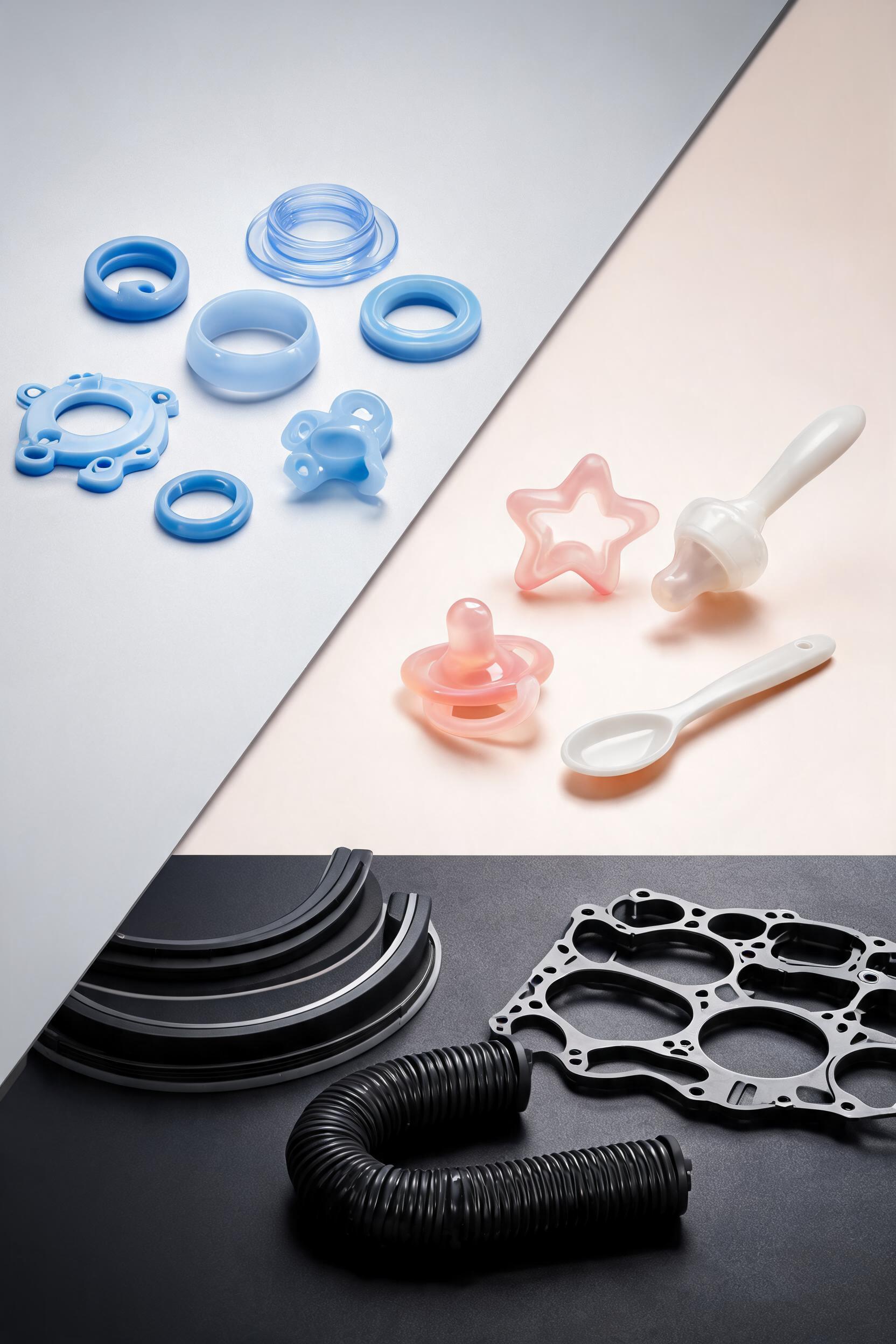
Automotive silicone parts, with excellent properties such as high and low temperature resistance, aging resistance, insulation and sealing, have become indispensable core components in the automotive manufacturing field, widely used in power systems, body sealing, electronic appliances and other modules. This article comprehensively sorts out the core performance advantages and mainstream application scenarios of automotive silicone parts, and explains key points of raw material selection, molding process and quality control in the production process, providing practical reference for upstream and downstream enterprises to optimize selection and improve product reliability.
The global automotive industry’s shift toward electrification, advanced driver-assistance systems (ADAS), and stricter emissions and durability regulations has accelerated demand for high-performance material solutions that outperform traditional rubber, plastic, and metal components. Automotive silicone parts, manufactured from liquid silicone rubber (LSR) and high-consistency silicone rubber (HCR), have emerged as a critical enabler of modern vehicle design, delivering unmatched resistance to extreme temperatures, chemical exposure, and mechanical stress across powertrain, interior, exterior, and ADAS applications. Unlike conventional elastomers such as EPDM or nitrile rubber, silicone maintains consistent material properties across a -60°C to 230°C operating range, with specialized grades capable of withstanding transient temperatures up to 300°C for short durations. This guide explores the core performance advantages of automotive silicone parts, key application use cases, industry-standard quality control frameworks, and emerging trends shaping their adoption in next-generation vehicles.
The widespread integration of silicone components in automotive design is rooted in a unique combination of material properties that address the most pressing durability, safety, and regulatory challenges facing vehicle manufacturers today. These advantages are consistent across both LSR (injected for high-precision, high-volume parts) and HCR (molded for larger, thicker components), with tailored formulations available to meet application-specific requirements.
Automotive components operate in some of the harshest dynamic environments, with under-hood temperatures spiking during combustion or fast EV charging, and exterior parts exposed to sub-zero winter conditions, UV radiation, and road salt. Silicone’s molecular structure, consisting of alternating silicon-oxygen (Si-O) backbone bonds with a bond energy of 452 kJ/mol (far higher than the 358 kJ/mol carbon-carbon (C-C) bonds in organic rubbers), delivers exceptional thermal and chemical stability.
Table 1 compares the performance of silicone against common competing elastomers for automotive use cases:
This performance translates directly to extended component service life: silicone gaskets for EV battery packs, for example, deliver a 15+ year operational lifespan, compared to 5-7 years for EPDM equivalents. Fluorosilicone grades further enhance performance, offering <5% volume swell after 1000 hours of exposure to gasoline, diesel, and transmission fluids, making them ideal for fuel system seals and powertrain gaskets in internal combustion engine (ICE) and hybrid vehicles.
Automotive components must meet strict global safety standards to protect occupants and reduce environmental impact, and silicone outperforms most alternative materials on key compliance metrics. First, silicone is inherently low-odor and low-VOC (volatile organic compound), with food-contact-safe grades available for interior components such as cup holder liners and steering wheel grips that eliminate the "new car smell" associated with off-gassing plastic parts. All automotive-grade silicone formulations meet the EU’s Restriction of Hazardous Substances (RoHS) and Registration, Evaluation, Authorization and Restriction of Chemicals (REACH) regulations, as well as China’s GB/T 39800-2021 standard for automotive interior air quality.
For fire safety, particularly critical for electric vehicle (EV) applications, silicone is self-extinguishing with a Limiting Oxygen Index (LOI) of 26-35%, meaning it will not sustain combustion in normal atmospheric conditions (21% oxygen). Specialized flame-retardant silicone grades meet the UL 94 V-0 flammability standard, as well as the Federal Motor Vehicle Safety Standard (FMVSS) 302 for interior component fire resistance, with peak heat release rates 70% lower than polypropylene during combustion. Unlike many plastic and rubber materials, silicone emits minimal toxic fumes when burned, with no halogenated byproducts, reducing occupant exposure to harmful gases in the event of a vehicle fire.
Silicone’s unique processing properties enable cost-effective manufacturing of complex, high-precision parts that would be unfeasible with traditional elastomers. LSR has a low viscosity before curing, allowing it to fill micro-features as small as 50μm in injection molds with 0.5% dimensional tolerance, making it ideal for high-precision components such as ADAS sensor seals and EV connector gaskets. The material cures rapidly at 120-180°C, enabling cycle times of 30-90 seconds for high-volume production runs, compared to 2-5 minutes for EPDM compression molding.
Silicone also supports advanced overmolding onto a wide range of substrate materials, including aluminum, polycarbonate (PC), acrylonitrile butadiene styrene (ABS), and polyamide (PA), eliminating the need for secondary assembly steps such as adhesive bonding or mechanical fastening. For example, a silicone keypad for an infotainment system can be overmolded directly onto a printed circuit board (PCB) in a single step, reducing assembly costs by 30-40% compared to assembling discrete rubber and plastic components. Post-curing processes further optimize part performance, reducing residual volatile content by up to 90% and improving mechanical strength by 10-15% for high-stress applications.
Automotive silicone parts are deployed across every major vehicle system, with application-specific formulations tailored to meet the unique performance requirements of each use case. The global market for automotive silicone components is projected to reach $7.2 billion by 2028, driven by rapid growth in EV and ADAS adoption, which rely heavily on silicone’s thermal stability and sealing performance.
Powertrain components, whether for ICE, hybrid, or fully electric vehicles, require materials that can withstand extreme temperatures, fluid exposure, and long-term mechanical stress, making silicone the material of choice for a wide range of high-demand applications:
A 2023 study by the U.S. Department of Energy found that using silicone gaskets and TIMs in EV battery packs reduces the risk of thermal runaway propagation by 45% compared to conventional EPDM and ceramic materials, as silicone remains stable at temperatures up to 300°C and acts as a thermal barrier between cells.
Silicone’s combination of safety, durability, and aesthetic versatility has made it a popular choice for interior and exterior components that require long-term performance and occupant comfort:
Many premium automakers now use custom-colored silicone interior components that match vehicle branding, with no color fading after 5000 hours of accelerated UV testing, compared to 1000 hours for painted plastic components.
The proliferation of ADAS features such as adaptive cruise control, lane-keeping assist, and autonomous driving functions has created new demand for components that protect sensitive sensors and electronics from environmental damage while maintaining signal integrity. Silicone is uniquely suited for these applications, as it offers a combination of sealing performance, thermal stability, and radio frequency (RF) transparency that no other elastomer can match:
Automotive engineering firm Bosch estimates that using silicone seals and radomes for ADAS sensors reduces field failure rates by 60% compared to plastic and rubber alternatives, lowering warranty costs for automakers and improving the reliability of safety-critical driving features.
Given the safety-critical nature of many automotive silicone components, manufacturers must adhere to strict quality control frameworks throughout the product lifecycle, from raw material incoming inspection to final part validation. Non-conforming parts can lead to costly warranty claims, vehicle recalls, and even safety hazards, making rigorous testing a non-negotiable requirement for automotive silicone suppliers.
The first step in quality control for automotive silicone parts is validating the raw material and manufacturing process to ensure consistent performance across all production runs:
All tooling for automotive silicone parts must undergo first article inspection (FAI), with 100% of dimensional features measured using coordinate measuring machines (CMM) to confirm compliance with CAD models before production is approved.
During full-scale production, manufacturers implement a combination of automated and manual in-line testing to identify non-conforming parts before they leave the factory:
Many manufacturers also implement statistical process control (SPC) systems that track key process parameters in real time, with automated alerts for any deviations from the approved operating range to prevent defective parts from being produced in the first place.
Before parts are shipped to customers, they undergo final validation testing to ensure they meet all applicable industry and customer-specific performance standards:
For safety-critical components such as ADAS sensor seals and battery gaskets, many automakers require additional field testing in pre-production vehicles for 1-2 years to validate performance in real-world operating conditions before full vehicle launch.
Automotive silicone parts have become an indispensable component of modern vehicle design, delivering a unique combination of thermal stability, safety compliance, design flexibility, and long-term durability that outperforms traditional elastomer and plastic alternatives. As the automotive industry continues to shift toward electrification, autonomous driving, and stricter sustainability regulations, demand for high-performance silicone components will only grow, with specialized grades under development to meet the unique requirements of solid-state batteries, 4D imaging radar, and other next-generation vehicle technologies.
For automakers and suppliers, implementing rigorous quality control frameworks across the entire product lifecycle is critical to unlocking the full potential of silicone components, reducing field failure rates, lowering warranty costs, and ensuring the safety and reliability of vehicles for end users. By selecting IATF 16949-certified silicone suppliers with expertise in automotive application development and testing, manufacturers can streamline product development, improve vehicle performance, and meet the evolving needs of the global automotive market. As material science and manufacturing processes continue to advance, automotive silicone parts will play an increasingly central role in shaping the future of safe, sustainable, and high-performance mobility.